. 2011 May 24;108(21):8749-54.
doi: 10.1073/pnas.1100567108. Epub 2011 May 9.

CD4+ T cells support cytotoxic T lymphocyte priming by controlling lymph node input

Affiliations

CD4+ T cells support cytotoxic T lymphocyte priming by controlling lymph node input

Yosuke Kumamoto et al. Proc Natl Acad Sci U S A. .

Abstract

Rapid induction of CD8(+) cytotoxic T lymphocyte (CTL) responses is critical to combat acute infection with intracellular pathogens. CD4(+) T cells help prime antigen-specific CTLs in secondary lymphoid organs after infection in the periphery. Although the frequency of naïve precursors is very low, the immune system is able to efficiently screen for cognate CTLs through mechanisms that are not well understood. Here we examine the role of CD4(+) T cells in early phases of the immune response. We show that CD4(+) T cells help optimal CTL expansion by facilitating entry of naïve polyclonal CD8(+) T cells into the draining lymph node (dLN) early after infection or immunization. CD4(+) T cells also facilitate input of naïve B cells into reactive LNs. Such "help" involves expansion of the arteriole feeding the dLN and enlargement of the dLN through activation of dendritic cells. In an antigen- and CD40-dependent manner, CD4(+) T cells activate dendritic cells to support naïve lymphocyte recruitment to the dLN. Our results reveal a previously unappreciated mode of CD4(+) T-cell help, whereby they increase the input of naïve lymphocytes to the relevant LN for efficient screening of cognate CD8(+) T cells.


Conflict of interest statement

The authors declare no conflict of interest.

Figures

Fig. 1.
Fig. 1.
CD4+ T cells are required for optimal dLN enlargement and CTL development after vaginal HSV2 infection. WT, MHCIIKO, or CD4KO mice were injected with 1 × 10⁶ naïve gBT-I cells and vaginally infected with 1 × 10⁶ pfu of TKHSV2. Numbers of total cells (A), gBT-I CD8+ T cells (B), and percentages of gBT-I cells (C) in the dLN are shown. Each symbol represents one mouse. Data are pooled from two or more independent experiments. *P < 0.05, **P < 0.01, ***P < 0.001 by one-way ANOVA (naïve, 2 and 4 dpi) and by two-tailed Student's t test (7 dpi).
Fig. 2.
Fig. 2.
Primary CTL responses in ΔCD4T hosts are reduced in magnitude but are phenotypically intact. WT, MHCIIKO, or CD4KO mice were injected with carboxyfluorescein diacetate succinimidyl ester (CFSE)–labeled naïve gBT-I cells and infected as in Fig. 1. (A–C) Expression of CD69 2 d after infection. Numbers of CD69+ gBT-I cells per dLN (A) and percentages of CD69+ cells among total gBT-I cells in the dLN (B) are shown. Data are pooled from three independent experiments. *P < 0.05, **P < 0.01 by one-way ANOVA. In C, CD69 expression on gBT-I cells (thick line), endogenous CD8+ T cells (dashed line), and CD8+ T cells in naïve WT mouse (gray histogram) are shown. (D and E) Intracellular granzyme B expression on 4 and 7 dpi (D) and CFSE dilution on 4 dpi (E) in the donor gBT-I cells in indicated organs. Gray histograms indicate isotype staining (D) or uninfected controls (E).
Fig. 3.
Fig. 3.
DCs induce dLN enlargement in an MHCII- and CD40-dependent manner. (A and B) BMDCs (1 × 10⁶ cells) prepared from indicated mice were injected into WT mice in the footpad. Total LN cellularity in the draining popliteal LNs at day 4 are shown. Data are representative of two or more independent experiments. (C) BMDCs (1 × 10⁶ cells) prepared from indicated mice were labeled with CFSE and injected into the footpad of WT mice. The number of migrated donor BMDCs was calculated from dLNs harvested 2 dpi. **P < 0.01 by one-way ANOVA.
Fig. 4.
Fig. 4.
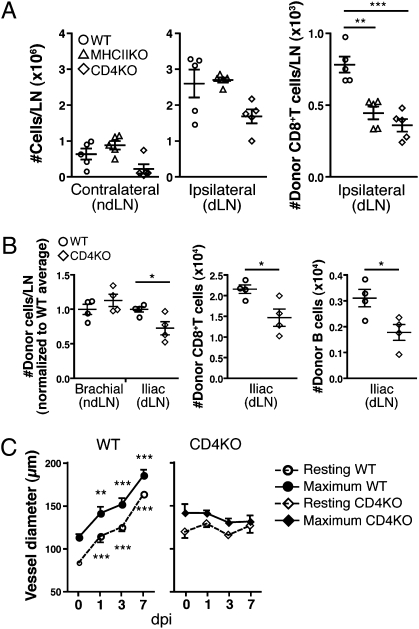
CD4+ T cells increase inflammation-induced naïve CD8+ T-cell influx in the dLN through vascular remodeling. (A) Naïve polyclonal CD8+ T cells (1.5 × 10⁶ cells per recipient) were retro-orbitally transferred into WT, MCHIIKO, or CD4KO mice that had been infected for 12 h with 1 × 10⁶ pfu TKHSV2 in the footpad. Numbers of total cells (Left and Center) and donor CD8+ T cells (Right) in the contralateral [nondraining LN (ndLN)] or ipsilateral (dLN) popliteal LN 12 h after the transfer of CD8+ T cells are shown. Data are representative of two independent experiments. **P < 0.01, ***P < 0.001 by one-way ANOVA. (B) Naïve splenocytes and LN cells were isolated from CD45.1+ congenic WT mice, and 5 × 10⁷ cells were retro-orbitally transferred into WT or CD4KO mice that had been infected for 43 h with 1 × 10⁶ pfu TKHSV2 in the vagina. At 2 h after the donor cell transfer, the draining iliac LNs and nondraining brachial LNs were removed, and the donor cells were counted. Relative cellularity normalized to WT average (Left) or absolute cell numbers in the iliac LNs (Center and Right) are shown. Similar results were observed in an experiment conducted at 24 h postinfection. *P < 0.05 by two-tailed t test. (C) Internal vessel diameter of the arteriole feeding the inguinal LN after vaginal infection with TKHSV2 in WT or CD4-deficient mice. Bars indicate mean ± SD. **P < 0.01, ***P < 0.001 compared with 0 dpi by two-tailed t test (n = 4–11 mice per group).

Comment in

References

    1. Arens R, Schoenberger SP. Plasticity in programming of effector and memory CD8 T-cell formation. Immunol Rev. 2010;235:190–205. - PMC - PubMed
    1. Williams MA, Bevan MJ. Effector and memory CTL differentiation. Annu Rev Immunol. 2007;25:171–192. - PubMed
    1. Castellino F, Germain RN. Cooperation between CD4+ and CD8+ T cells: When, where, and how. Annu Rev Immunol. 2006;24:519–540. - PubMed
    1. Behrens G, et al. Helper T cells, dendritic cells and CTL immunity. Immunol Cell Biol. 2004;82:84–90. - PubMed
    1. Smith CM, et al. Cognate CD4(+) T cell licensing of dendritic cells in CD8(+) T cell immunity. Nat Immunol. 2004;5:1143–1148. - PubMed

Publication types

LinkOut - more resources