Long-term outcomes following positive fecal occult blood test results in older adults: benefits and burdens
- PMID: 21555655
- PMCID: PMC3291514
- DOI: 10.1001/archinternmed.2011.206
Long-term outcomes following positive fecal occult blood test results in older adults: benefits and burdens
Abstract
Background: In the United States, older adults have low rates of follow-up colonoscopy after a positive fecal occult blood test (FOBT) result. The long-term outcomes of these real world practices and their associated benefits and burdens are unknown.
Methods: Longitudinal cohort study of 212 patients 70 years or older with a positive FOBT result at 4 Veteran Affairs (VA) facilities in 2001 and followed up through 2008. We determined the frequency of downstream outcomes during the 7 years of follow-up, including procedures, colonoscopic findings, outcomes of treatment, complications, and mortality based on chart review and national VA and Medicare data. Net burden or benefit from screening and follow-up was determined according to each patient's life expectancy. Life expectancy was classified into 3 categories: best (age, 70-79 years and Charlson-Deyo comorbidity index [CCI], 0), average, and worst (age, 70-84 years and CCI, ≥4 or age, ≥85 years and CCI, ≥1).
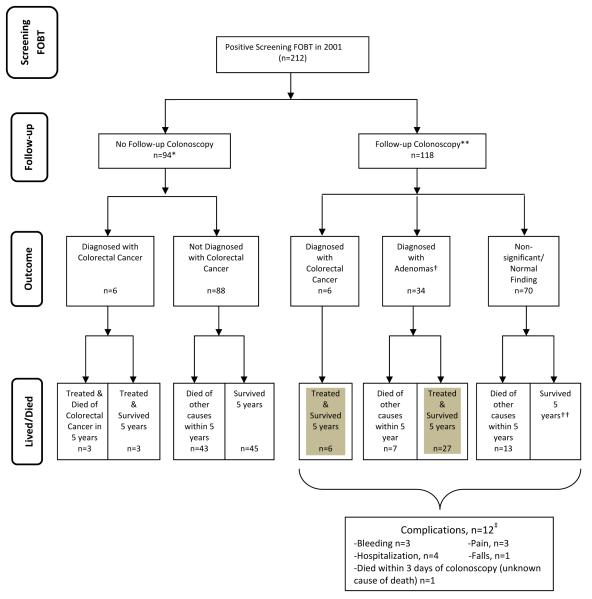
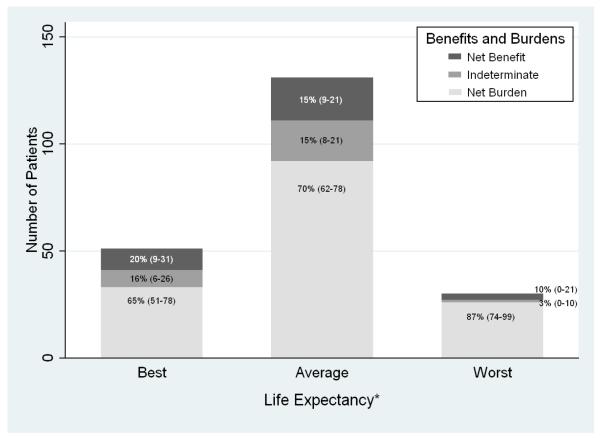
Results: Fifty-six percent of patients received follow-up colonoscopy (118 of 212), which found 34 significant adenomas and 6 cancers. Ten percent experienced complications from colonoscopy or cancer treatment (12 of 118). Forty-six percent of those without follow-up colonoscopy died of other causes within 5 years of FOBT (43 of 94), while 3 died of colorectal cancer within 5 years. Eighty-seven percent of patients with worst life expectancy experienced a net burden from screening (26 of 30) as did 70% with average life expectancy (92 of 131) and 65% with best life expectancy (35 of 51) (P = .048 for trend).
Conclusions: Over a 7-year period, older adults with best life expectancy were less likely to experience a net burden from current screening and follow-up practices than are those with worst life expectancy. The net burden could be decreased by better targeting FOBT screening and follow-up to healthy older adults.
Figures
Comment in
-
Colorectal cancer screening protocols and procedures: comment on "Overuse of screening colonoscopy in the Medicare population" and "Long-term outcomes following positive fecal occult blood test results in older adults".Arch Intern Med. 2011 Aug 8;171(15):1351. doi: 10.1001/archinternmed.2011.198. Epub 2011 May 9. Arch Intern Med. 2011. PMID: 21555652 No abstract available.
-
Screening for colorectal cancer in the elderly population: how much is enough?Arch Intern Med. 2011 Aug 8;171(15):1332-4. doi: 10.1001/archinternmed.2011.364. Arch Intern Med. 2011. PMID: 21824947 No abstract available.
References
-
- Levin B, Hess K, Johnson C. Screening for colorectal cancer. A comparison of 3 fecal occult blood tests. Arch Intern Med. 1997 May 12;157(9):970–976. - PubMed
-
- Lurie JD, Welch HG. Diagnostic testing following fecal occult blood screening in the elderly. J Natl Cancer Inst. 1999 Oct 6;91(19):1641–1646. - PubMed
Publication types
MeSH terms
Grants and funding
LinkOut - more resources
Full Text Sources
Medical