. 2011 Jun;121(6):2457-61.
doi: 10.1172/JCI46405. Epub 2011 May 9.

Mitochondrial dysfunction in patients with primary congenital insulin resistance

Affiliations

Mitochondrial dysfunction in patients with primary congenital insulin resistance

Alison Sleigh et al. J Clin Invest. 2011 Jun.

Abstract

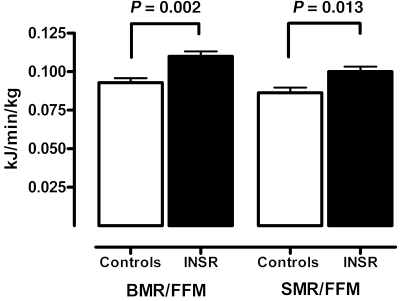
Mitochondrial dysfunction is associated with insulin resistance and type 2 diabetes. It has thus been suggested that primary and/or genetic abnormalities in mitochondrial function may lead to accumulation of toxic lipid species in muscle and elsewhere, impairing insulin action on glucose metabolism. Alternatively, however, defects in insulin signaling may be primary events that result in mitochondrial dysfunction, or there may be a bidirectional relationship between these phenomena. To investigate this, we examined mitochondrial function in patients with genetic defects in insulin receptor (INSR) signaling. We found that phosphocreatine recovery after exercise, a measure of skeletal muscle mitochondrial function in vivo, was significantly slowed in patients with INSR mutations compared with that in healthy age-, fitness-, and BMI-matched controls. These findings suggest that defective insulin signaling may promote mitochondrial dysfunction. Furthermore, consistent with previous studies of mouse models of mitochondrial dysfunction, basal and sleeping metabolic rates were both significantly increased in genetically insulin-resistant patients, perhaps because mitochondrial dysfunction necessitates increased nutrient oxidation in order to maintain cellular energy levels.


Figures
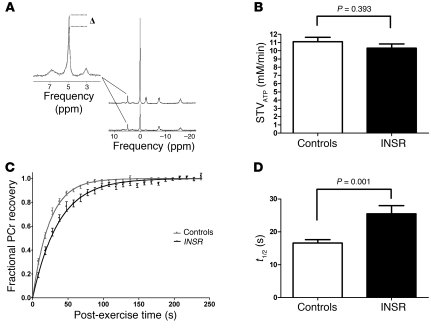
Figure 1
Figure 1. 31P MRS measurements of mitochondrial function.
(A) Representative ST spectra, with saturation of the γ-ATP resonance (right, bottom) and corresponding control spectrum (right, top). The 2 spectra are superimposed (left) to show the difference (Δ) in the Pi resonance. (B) ST VATP in both the controls (white bars; n = 12) and in patients with INSR mutations (black bars; n = 5). (C) Mean fractional PCr recovery curves for controls (gray squares; n = 12) and for patients with INSR mutations (black circles; n = 7). Five spectra were averaged to give a time resolution of 10 seconds for clarity in this figure. The monoexponential fit of the mean recovery rate constant is shown for controls (gray line) and INSR patients (black line). (D) Half time for PCr recovery (t1/2) as measured from the recovery rate after exercise for both controls (white bars; n = 12) and for patients with INSR mutations (black bars; n = 7). In BD, data are mean ± SEM.
Figure 2
Figure 2. Energy expenditure in patients with loss-of-function INSR mutations.
BMR and SMR in healthy controls (white bars; n = 11) and in patients with INSR mutations (black bars; n = 7). Results are expressed per kilogram of fat-free mass (FFM). Data are mean ± SEM.

References

    1. Savage DB, Petersen KF, Shulman GI. Disordered lipid metabolism and the pathogenesis of insulin resistance. Physiol Rev. 2007;87(2):507–520. doi: 10.1152/physrev.00024.2006. - DOI - PMC - PubMed
    1. Patti ME, Corvera S. The role of mitochondria in the pathogenesis of type 2 diabetes. Endocr Rev. 2010;31(3):364–395. doi: 10.1210/er.2009-0027. - DOI - PMC - PubMed
    1. Kelley DE, He J, Menshikova EV, Ritov VB. Dysfunction of mitochondria in human skeletal muscle in type 2 diabetes. Diabetes. 2002;51(10):2944–2950. doi: 10.2337/diabetes.51.10.2944. - DOI - PubMed
    1. Morino K, et al. Reduced mitochondrial density and increased IRS-1 serine phosphorylation in muscle of insulin-resistant offspring of type 2 diabetic parents. J Clin Invest. 2005;115(12):3587–3593. doi: 10.1172/JCI25151. - DOI - PMC - PubMed
    1. Ritov VB, et al. Deficiency of electron transport chain in human skeletal muscle mitochondria in type 2 diabetes mellitus and obesity. Am J Physiol Endocrinol Metab. 2010;298(1):E49–E58. doi: 10.1152/ajpendo.00317.2009. - DOI - PMC - PubMed

Publication types

MeSH terms