Clinical Trial
. 2011 Jun;121(6):1252-60.
doi: 10.1002/lary.21780. Epub 2011 May 6.

Prospective multi-arm evaluation of surgical treatments for vocal fold scar and pathologic sulcus vocalis

Affiliations
Clinical Trial

Prospective multi-arm evaluation of surgical treatments for vocal fold scar and pathologic sulcus vocalis

Nathan V Welham et al. Laryngoscope. 2011 Jun.

Abstract

Objectives/hypothesis: The purpose of this study was to compare the clinical effectiveness of type I thyroplasty, injection laryngoplasty, and graft implantation for the treatment of vocal fold scar and pathologic sulcus vocalis.

Study design: Prospective, multi-arm, quasi-experimental research design.

Methods: Twenty-eight patients with newly diagnosed vocal fold scar and/or pathologic sulcus vocalis were assigned to one of three treatment modalities: type I thyroplasty (n = 9), injection laryngoplasty (n = 9), and graft implantation (n = 10). Psychosocial, auditory-perceptual, acoustic, aerodynamic, and videostroboscopic data were collected pretreatment and at 1, 6, 12, and 18 months posttreatment.

Results: Type I thyroplasty and graft implantation both resulted in reduced voice handicap with no concomitant improvement in auditory-perceptual, acoustic, aerodynamic, or vocal fold physiologic performance. Injection laryngoplasty resulted in no improvement on any vocal function index. Patients who underwent graft implantation exhibited the slowest improvement trajectory across the 18-month follow-up period.

Conclusions: A persistent challenge in this area is that no single treatment modality is successful for the majority of patients, and there is no evidence-based decision algorithm for matching a given treatment to a given patient. Progress therefore requires the identification and categorization of predictive clinical features that can drive evidence-based treatment assignment.


Conflict of interest statement

The authors hold no financial or other conflicts of interest.

Figures
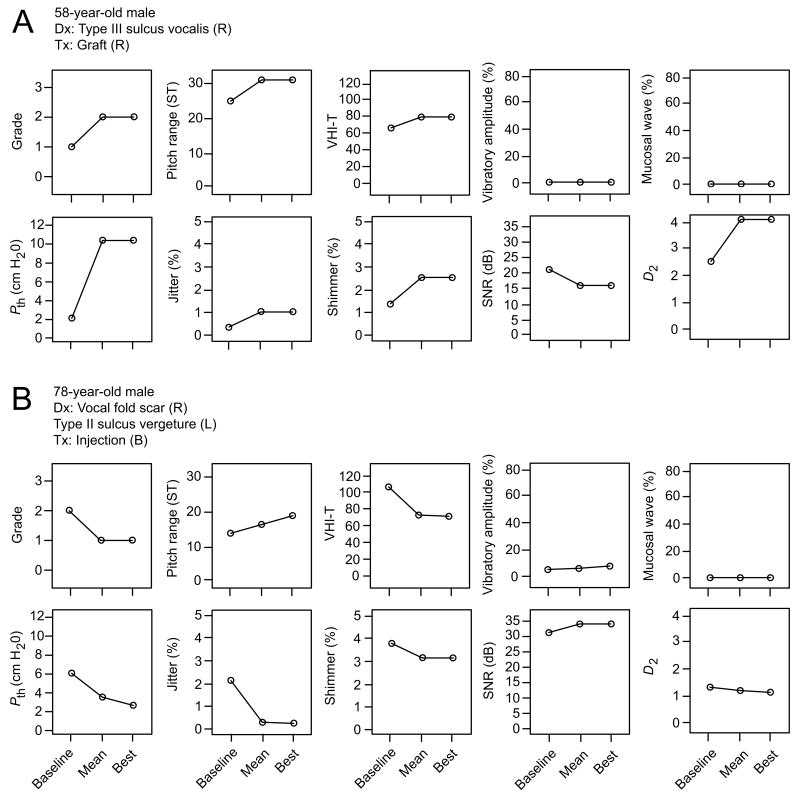
Figure 1
Figure 1
Representative clinical cases illustrating negative and positive outcomes following treatment for vocal fold scarring and pathologic sulcus vocalis. Panel A contains vocal function data collected from a 58-year-old male patient with right-sided Type III sulcus vocalis treated with an acellular dermal matrix graft. This patient demonstrated improved pitch range and no change/deterioration on all other indices. Videostroboscopic closure pattern was spindle-shaped on both pre-treatment and all post-treatment examinations. Panel B contains vocal function data collected from a 78-year-old male patient with right-sided vocal fold scar and left-sided Type II sulcus vergeture treated with bilateral calcium hydroxyapatite injections. This patient demonstrated improvement on all indices except mucosal wave excursion. Videostroboscopic closure pattern was spindle-shaped on both pre-treatment and all post-treatment examinations. Vocal function data are graphed as pre-treatment baseline value, mean post-treatment value across an 18 month period, and best post-treatment value at any time point within this 18 month period. B, bilateral; D2, correlation dimension; Dx, diagnosis; L, left; Pth, phonation threshold pressure; R, right; SNR, signal-to-noise ratio; ST, semitone; Tx, treatment; VHI-T, voice handicap index total score.
Figure 2
Figure 2
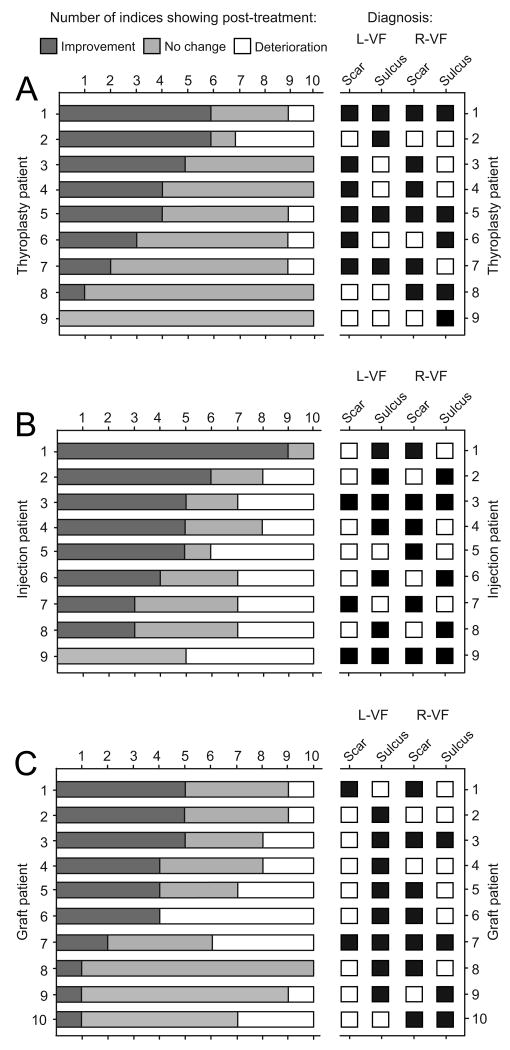
Distribution of the number of vocal function indices showing mean post-treatment improvement, no change or deterioration following type I thyroplasty (A; n = 9), injection laryngoplasty (B; n = 9) and graft implantation (C; n = 10) treatments for vocal fold scarring and pathologic sulcus vocalis. Data are presented by individual patient on the left; key diagnostic information for each patient is presented on the right. Mean post-treatment change reflects an 18 month follow-up period. L-VF, left vocal fold; R-VF, right vocal fold.
Figure 3
Figure 3
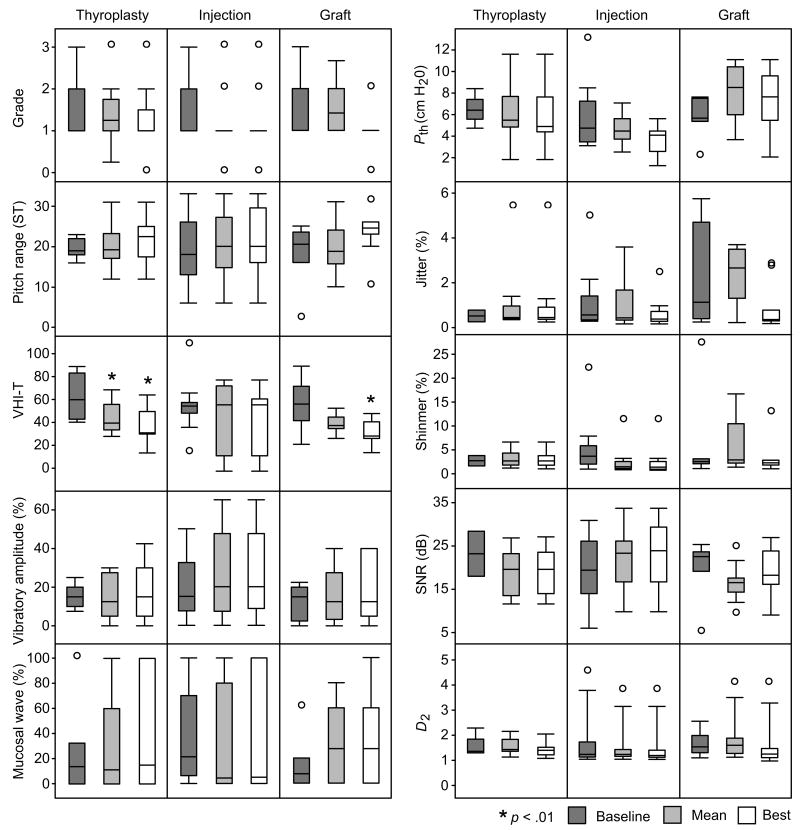
Group analysis of outcomes following type I thyroplasty (n = 9), injection laryngoplasty (n = 9) and graft implantation (n = 10) treatments for vocal fold scarring and pathologic sulcus vocalis. Vocal function data are graphed as pre-treatment baseline value, mean post-treatment value across an 18 month period, and best post-treatment value at any time point within this 18 month period. D2, correlation dimension; Pth, phonation threshold pressure; SNR, signal-to-noise ratio; ST, semitone; VHI-T, voice handicap index total score.
Figure 4
Figure 4
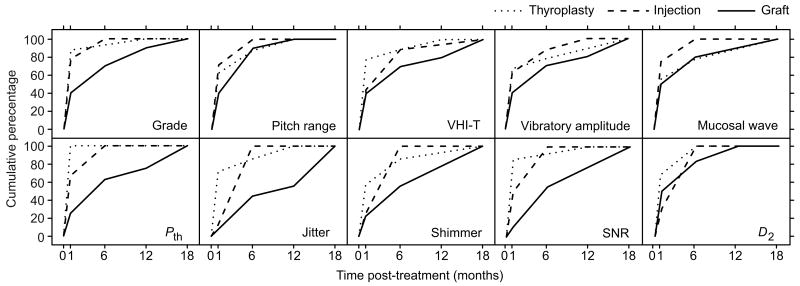
Duration to best post-treatment value following type I thyroplasty (n = 9), injection laryngoplasty (n = 9) and graft implantation (n = 10) treatments for vocal fold scarring and pathologic sulcus vocalis. Best post-treatment value reflects an 18 month follow-up period. Data are presented as cumulative percentage of total patient number within each treatment group. D2, correlation dimension; Pth, phonation threshold pressure; SNR, signal-to-noise ratio; VHI-T, voice handicap index total score.

References

    1. Hirano S, Minamiguchi S, Yamashita M, Ohno T, Kanemaru S, Kitamura M. Histologic characterization of human scarred vocal folds. J Voice. 2009;23:399–407. - PubMed
    1. Thibeault SL, Gray SD, Bless DM, Chan RW, Ford CN. Histologic and rheologic characterization of vocal fold scarring. J Voice. 2002;16:96–104. - PubMed
    1. Rousseau B, Hirano S, Scheidt TD, et al. Characterization of vocal fold scarring in a canine model. Laryngoscope. 2003;113:620–627. - PubMed
    1. Welham NV, Montequin DW, Tateya I, Tateya T, Choi SH, Bless DM. A rat excised larynx model of vocal fold scar. J Speech Lang Hear Res. 2009;52:1008–1020. - PMC - PubMed
    1. Hirano M, Yoshida T, Tanaka S, Hibi S. Sulcus vocalis: functional aspects. Ann Otol Rhinol Laryngol. 1990;99:679–683. - PubMed

Substances