


Obesity and risk of vascular disease: importance of endothelium-dependent vasoconstriction
- PMID: 21557734
- PMCID: PMC3315033
- DOI: 10.1111/j.1476-5381.2011.01472.x
Obesity and risk of vascular disease: importance of endothelium-dependent vasoconstriction
Abstract
Obesity has become a serious global health issue affecting both adults and children. Recent devolopments in world demographics and declining health status of the world's population indicate that the prevalence of obesity will continue to increase in the next decades. As a disease, obesity has deleterious effects on metabolic homeostasis, and affects numerous organ systems including heart, kidney and the vascular system. Thus, obesity is now regarded as an independent risk factor for atherosclerosis-related diseases such as coronary artery disease, myocardial infarction and stroke. In the arterial system, endothelial cells are both the source and target of factors contributing to atherosclerosis. Endothelial vasoactive factors regulate vascular homeostasis under physiological conditions and maintain basal vascular tone. Obesity results in an imbalance between endothelium-derived vasoactive factors favouring vasoconstriction, cell growth and inflammatory activation. Abnormal regulation of these factors due to endothelial cell dysfunction is both a consequence and a cause of vascular disease processes. Finally, because of the similarities of the vascular pathomechanisms activated, obesity can be considered to cause accelerated, 'premature' vascular aging. Here, we will review some of the pathomechanisms involved in obesity-related activation of endothelium-dependent vasoconstriction, the clinical relevance of obesity-associated vascular risk, and therapeutic interventions using 'endothelial therapy' aiming at maintaining or restoring vascular endothelial health.
Linked articles: This article is part of a themed section on Fat and Vascular Responsiveness. To view the other articles in this section visit http://dx.doi.org/10.1111/bph.2012.165.issue-3.
© 2011 The Authors. British Journal of Pharmacology © 2011 The British Pharmacological Society.
Figures
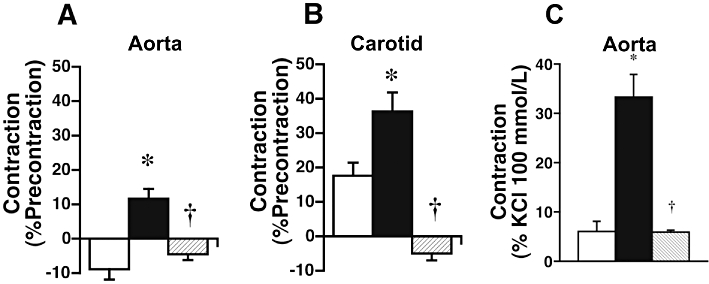
 ) or endothelin ETA-receptor antagonist-treated (
 ) C57 mice on endothelium-dependent contractions to acetylcholine (30 µmol·L−1) in NO-depleted vascular rings of aorta (A) and carotid artery (B). Contractions to angiotensin II in the aorta are depicted on the right (C). Depletion of endothelium-derived NO was achieved by acute treatment with L-NAME (300 µmol·L−1), a non-selective inhibitor of NO synthases. In NO-depleted arteries of control animals on chow diet (□), EDCF were only present in the carotid artery. In mice with diet-induced obesity (
 ), the residual relaxation to acetylcholine is converted into a contraction in the aorta, and the magnitude of EDCF-mediated contractions was doubled in the carotid artery. Chronic treatment with the orally active endothelin ETA receptor antagonist darusentan (LU135252) (
 ) – without affecting body weight – not only completely prevented enhanced EDCF-mediated contractions, but also caused acetylcholine to elicit a small relaxation instead (B). Similarly, in NO-depleted aortic rings, contractions to angiotensin II (0.1 µmol·L−1) were markedly enhanced by obesity (
 ), an effect again completely abrogated after chronic endothelin receptor antagonist treatment which had no effect on obesity (
 ). *P < 0.05 versus control; †P < 0.05 versus obesity. Panels A and B: This research was originally published in Clinical Science. Traupe et al., 2002a. © Portland Press Limited. Panel C is from Barton et al., 2000b, and reproduced with permission of the American Heart Association and the publisher.
References
-
- Abate NI, Mansour YH, Tuncel M, Arbique D, Chavoshan B, Kizilbash A, et al. Overweight and sympathetic overactivity in black Americans. Hypertension. 2001;38:379–383. - PubMed
-
- Abello N, Kerstjens HA, Postma DS, Bischoff R. Protein tyrosine nitration: selectivity, physicochemical and biological consequences, denitration, and proteomics methods for the identification of tyrosine-nitrated proteins. J Proteome Res. 2009;8:3222–3238. - PubMed
-
- Achike FI, To NH, Wang H, Kwan CY. Obesity, metabolic syndrome, adipocytes and vascular function: a holistic viewpoint. Clin Exp Pharmacol Physiol. 2011;38:1–10. - PubMed
-
- Ahlborg G, Shemyakin A, Bohm F, Gonon A, Pernow J. Dual endothelin receptor blockade acutely improves insulin sensitivity in obese patients with insulin resistance and coronary artery disease. Diabetes Care. 2007;30:591–596. - PubMed
Publication types
MeSH terms
LinkOut - more resources
Full Text Sources
Other Literature Sources
Medical
Research Materials
