


USA300 methicillin-resistant Staphylococcus aureus bacteremia and the risk of severe sepsis: is USA300 methicillin-resistant Staphylococcus aureus associated with more severe infections?
- PMID: 21558047
- PMCID: PMC3118841
- DOI: 10.1016/j.diagmicrobio.2011.03.010
USA300 methicillin-resistant Staphylococcus aureus bacteremia and the risk of severe sepsis: is USA300 methicillin-resistant Staphylococcus aureus associated with more severe infections?
Abstract
USA300 methicillin-resistant Staphylococcus aureus (MRSA) is increasing as a cause of severe community-associated bacteremic infections. We assessed severe sepsis in response to infection in patients with USA300 MRSA compared to non-USA300 MRSA bacteremia. A cohort study was conducted from 1997 to 2008 comparing sepsis in response to infection in 271 patients with MRSA bacteremia from 4 VA hospitals. Sixty-seven (25%) patients with MRSA bacteremia were USA300 MRSA; 204 (75%) were non-USA300 MRSA. The proportion of MRSA bacteremia caused by USA300 MRSA increased over time (χ² P < 0.0001). Adjusting for age and nosocomial infection, patients with USA300 MRSA bacteremia were more likely to have severe sepsis or septic shock in response to infection than patients with non-USA300 MRSA bacteremia (adjusted relative risk = 1.82; 95% confidence interval, 1.16-2.87; P = 0.01). This suggests that patients with USA300 MRSA are more likely to develop severe sepsis in response to their infection, which could be due to host or bacterial differences.
Copyright © 2011 Elsevier Inc. All rights reserved.
Conflict of interest statement
No conflicts of interest exist for any of the authors.
Figures
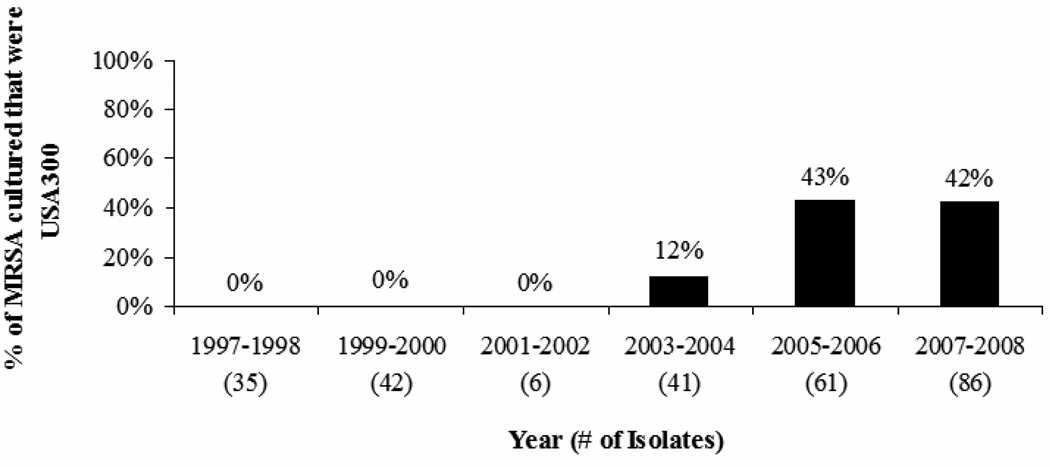
References
-
- Community-associated methicillin-resistant Staphylococcus aureus infections in Pacific Islanders--Hawaii, 2001–2003. MMWR Morb Mortal Wkly Rep. 2004;53:767–770. - PubMed
-
- Bone RC, Sibbald WJ, Sprung CL. The ACCP-SCCM consensus conference on sepsis and organ failure. Chest. 1992;101:1481–1483. - PubMed
-
- Charlson ME, Pompei P, Ales KL, MacKenzie CR. A new method of classifying prognostic comorbidity in longitudinal studies: development and validation. J Chronic Dis. 1987;40:373–383. - PubMed
-
- Cosgrove SE. The relationship between antimicrobial resistance and patient outcomes: mortality, length of hospital stay, and health care costs. Clin Infect Dis. 2006;42 Suppl 2:S82–S89. - PubMed
-
- Cosgrove SE, Sakoulas G, Perencevich EN, Schwaber MJ, Karchmer AW, Carmeli Y. Comparison of mortality associated with methicillin-resistant and methicillin-susceptible Staphylococcus aureus bacteremia: a meta-analysis. Clin Infect Dis. 2003;36:53–59. - PubMed
Publication types
MeSH terms
Grants and funding
LinkOut - more resources
Full Text Sources
Other Literature Sources
Medical
