Review
. 2011 Jul;68(14):2399-408.
doi: 10.1007/s00018-011-0702-x. Epub 2011 May 11.

Functions of skin-resident γδ T cells

Affiliations
Review

Functions of skin-resident γδ T cells

Amanda S Macleod et al. Cell Mol Life Sci. 2011 Jul.

Abstract

The murine epidermis contains resident T cells that express a canonical γδ TCR and arise from fetal thymic precursors. These cells are termed dendritic epidermal T cells (DETC) and use a TCR that is restricted to the skin in adult animals. DETC produce low levels of cytokines and growth factors that contribute to epidermal homeostasis. Upon activation, DETC can secrete large amounts of inflammatory molecules which participate in the communication between DETC, neighboring keratinocytes and langerhans cells. Chemokines produced by DETC may recruit inflammatory cells to the epidermis. In addition, cell-cell mediated immune responses also appear important for epidermal-T cell communication. Information is provided which supports a crucial role for DETC in inflammation, wound healing, and tumor surveillance.


Figures
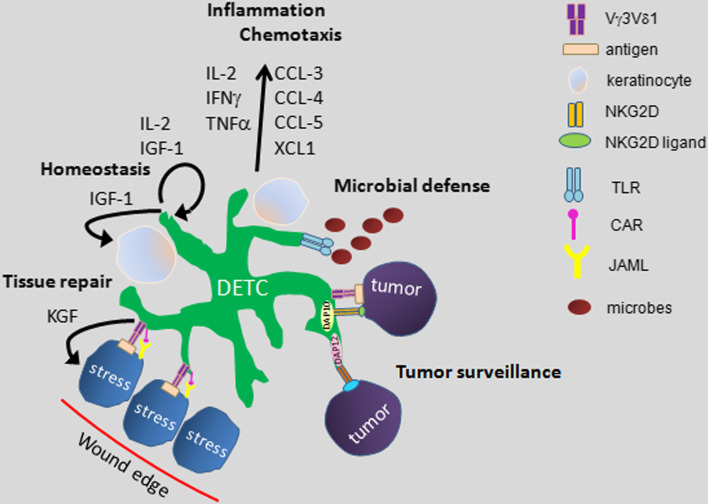
Fig. 1
Fig. 1
Model of functions of skin-resident γδ T Cells. Dendritic epidermal T cells (DETC) are a resident population of Vγ3 Vδ1+ T cells in murine epidermis. Here, they provide a first line of defense against infection, malignancy and injury. DETC contribute to epidermal homeostasis by constitutive production of growth factors and cytokines which promote survival of keratinocytes. Upon infection or other stress to the epidermis, DETC produce a variety of chemokines and cytokines which delicately regulate the cutaneous inflammatory response. When keratinocytes become damaged following injury, this leads to upregulation of an unknown antigen which is subsequently recognized by DETC through the TCR. Additional costimulatory signals are provided to DETC by junctional adhesion molecule-like protein (JAML) recognition of increased Coxsackie and Adenovirus receptor (CAR) expression on wounded keratinocytes. Once activated, DETC locally secrete factors such as keratinocyte growth factors which aid the wound healing response as well as release inflammatory and chemotactic factors to help recruit cells into the site of damage. DETC are also involved in tumor surveillance of cutaneous tumors such as squamous cell carcinoma through TCR and/or NKG2D signals. NKG2D ligands become upregulated on keratinocytes and recognition by DETC leads to anti-tumor effects. The DETC are thus able to provide a multi-pronged defense against disturbance of epidermal homeostasis

References

    1. Asarnow DM, Goodman T, LeFrancois L, Allison JP. Distinct antigen receptor repertoires of two classes of murine epithelium-associated T cells. Nature. 1989;341:60–62. doi: 10.1038/341060a0. - DOI - PubMed
    1. Havran WL, Grell S, Duwe G, Kimura J, Wilson A, Kruisbeek AM, O’Brien RL, Born W, Tigelaar RE, Allison JP. Limited diversity of T-cell receptor γ-chain expression of murine Thy-1+ dendritic epidermal cells revealed by Vγ3-specific monoclonal antibody. Proc Natl Acad Sci USA. 1989;86:4185–4189. doi: 10.1073/pnas.86.11.4185. - DOI - PMC - PubMed
    1. Asarnow DM, Kuziel WA, Bonyhadi M, Tigelaar RE, Tucker PW, Allison JP. Limited diversity of γδ antigen receptor genes of Thy-1+ dendritic epidermal cells. Cell. 1988;55:837–847. doi: 10.1016/0092-8674(88)90139-0. - DOI - PubMed
    1. Havran WL, Allison JP. Developmentally ordered appearance of thymocytes expressing different T-cell antigen receptors. Nature. 1988;335:443–445. doi: 10.1038/335443a0. - DOI - PubMed
    1. Itohara S, Farr AG, Lafaille JJ, Bonneville M, Takagaki Y, Haas W, Tonegawa S. Homing of a γδ thymocyte subset with homogeneous T-cell receptors to mucosal epithelia. Nature. 1990;343:754–757. doi: 10.1038/343754a0. - DOI - PubMed

Publication types

MeSH terms

Substances

LinkOut - more resources
