


The evolutionary history of division of labour
- PMID: 21561969
- PMCID: PMC3223655
- DOI: 10.1098/rspb.2011.0766
The evolutionary history of division of labour
Abstract
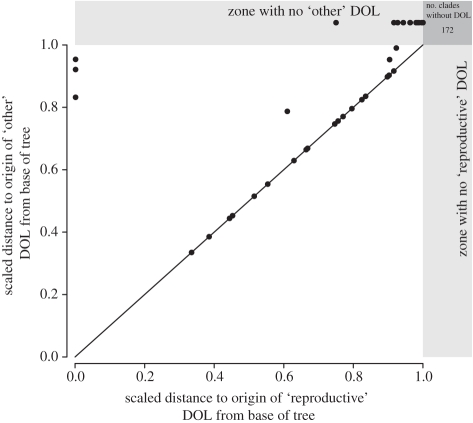
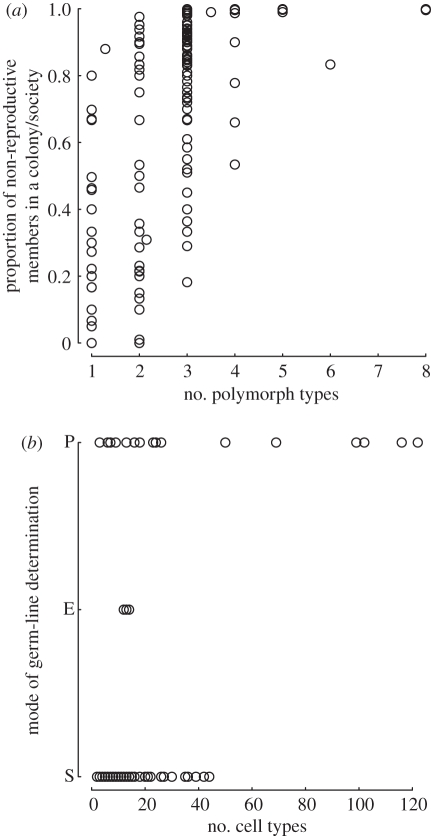
Functional specialization, or division of labour (DOL), of parts within organisms and colonies is common in most multi-cellular, colonial and social organisms, but it is far from ubiquitous. Several mechanisms have been proposed to explain the evolutionary origins of DOL; the basic feature common to all of them is that functional differences can arise easily. These mechanisms cannot explain the many groups of colonial and social animals that exhibit no DOL despite up to 500 million years of evolution. Here, I propose a new hypothesis, based on a multi-level selection theory, which predicts that a reproductive DOL is required to evolve prior to subsequent functional specialization. I test this hypothesis using a dataset consisting of the type of DOL for living and extinct colonial and social animals. The frequency distribution of DOL and the sequence of its acquisition confirm that reproductive specialization evolves prior to functional specialization. A corollary of this hypothesis is observed in colonial, social and also within multi-cellular organisms; those species without a reproductive DOL have a smaller range of internal variation, in terms of the number of polymorphs or cell types, than species with a reproductive DOL.
Figures

References
-
- Beklemeshev W. N. 1969. Principles of comparative anatomy of invertebrates. Chicago, IL: University of Chicago Press
-
- Costa J. T. 2006. The other insect societies. Cambridge, MA: Belknap Press of Harvard University Press
-
- Harvell C. D. 1994. The evolution of polymorphism in colonial invertebrates and social insects. Q. Rev. Biol. 69, 155–185 10.1086/418538 (doi:10.1086/418538) - DOI
-
- Wilson E. O. 1975. Sociobiology: the new synthesis. Cambridge, MA: Belknap Press of Harvard University Press
-
- Huxley J. 1912. The individual in the animal kingdom. New York, NY: Cambridge University Press
Publication types
MeSH terms
LinkOut - more resources
Full Text Sources
