


Does maternal weight gain in pregnancy have long-term effects on offspring adiposity? A sibling study in a prospective cohort of 146,894 men from 136,050 families
- PMID: 21562086
- PMCID: PMC3127508
- DOI: 10.3945/ajcn.110.009324
Does maternal weight gain in pregnancy have long-term effects on offspring adiposity? A sibling study in a prospective cohort of 146,894 men from 136,050 families
Abstract
Background: A small number of relatively small studies have found greater gestational weight gain to be associated with greater offspring body mass index (BMI; in kg/m(2)), but whether this association is caused by intrauterine mechanisms or by shared genetic and environmental risk factors for adiposity is unclear.
Objective: The objective was to examine the association of greater maternal weight gain (MWG; postnatal weight minus weight at the first antenatal clinic assessment) with greater offspring BMI and to explore whether any observed association is explained by intrauterine mechanisms.
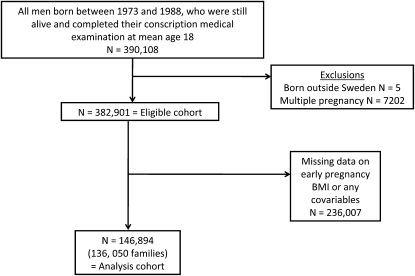
Design: This was a prospective cohort study that used record linkage data (n = 146,894 individuals from 136,050 families). To compare the within-sibling and between-nonsibling associations, we used fixed- and between-cluster linear regression models.
Results: Associations of MWG with later offspring BMI differed by the mother's early-pregnancy overweight or obesity status (P for interaction <0.0001). MWG was positively associated with BMI at a mean age of 18 y in the offspring of normal-weight women but only between unrelated men (0.07; 95% CI: 0.06, 0.07) per 1-kg greater MWG; no within-sibling association (0.00; 95% CI: -0.02, 0.02) per 1-kg greater MWG was found. In contrast, in overweight and obese women we found a within-sibling association (0.06; 95% CI: 0.01, 0.12) and an association between unrelated men (0.02; 95% CI: 0.01, 0.03) per 1-kg greater MWG.
Conclusion: In normal-weight mothers, most of the association between MWG and later offspring BMI is explained by shared familial (genetic and early environmental) characteristics, whereas evidence indicates a contribution of intrauterine mechanisms in overweight and obese women.
Figures
References
-
- Viswanthan M, Siega-Riz AM, Moos M-K, et al. Outcomes of maternal weight gain. Rockville, MD: Agency for Healthcare Research and Quality, 2008. (Evidence Report/Technology Assessment no. 168. AHRQ Publication no. 08-E009.)
-
- Rasmussen KM, Yaktine AL. Weight gain during pregnancy: reexamining the guidelines. Committee to reexamine IOM pregnancy weight guidelines. Washington, DC: US Institute of Medicine and National Research Council, 2009 - PubMed
-
- Halfon N, Lu MC. Gestational weight gain and birthweight. Lancet 2010;376:937–8 - PubMed
Publication types
MeSH terms
Grants and funding
LinkOut - more resources
Full Text Sources
