


Single nucleotide polymorphisms at the ADIPOQ gene locus interact with age and dietary intake of fat to determine serum adiponectin in subjects at risk of the metabolic syndrome
- PMID: 21562092
- PMCID: PMC3592482
- DOI: 10.3945/ajcn.111.014209
Single nucleotide polymorphisms at the ADIPOQ gene locus interact with age and dietary intake of fat to determine serum adiponectin in subjects at risk of the metabolic syndrome
Abstract
Background: Adiponectin gene expression is modulated by peroxisome proliferator-activated receptor γ, which is a transcription factor activated by unsaturated fatty acids.
Objective: We investigated the effect of the interaction between variants at the ADIPOQ gene locus, age, sex, body mass index (BMI), ethnicity, and the replacement of dietary saturated fatty acids (SFAs) with monounsaturated fatty acids (MUFAs) or carbohydrates on serum adiponectin concentrations.
Design: The RISCK (Reading, Imperial, Surrey, Cambridge, and Kings) study is a parallel-design, randomized controlled trial. Serum adiponectin concentrations were measured after a 4-wk high-SFA (HS) diet and a 24-wk intervention with reference (HS), high-MUFA (HM), and low-fat (LF) diets. Single nucleotide polymorphisms at the ADIPOQ locus -11391 G/A (rs17300539), -10066 G/A (rs182052), -7734 A/C (rs16861209), and +276 G/T (rs1501299) were genotyped in 448 participants.
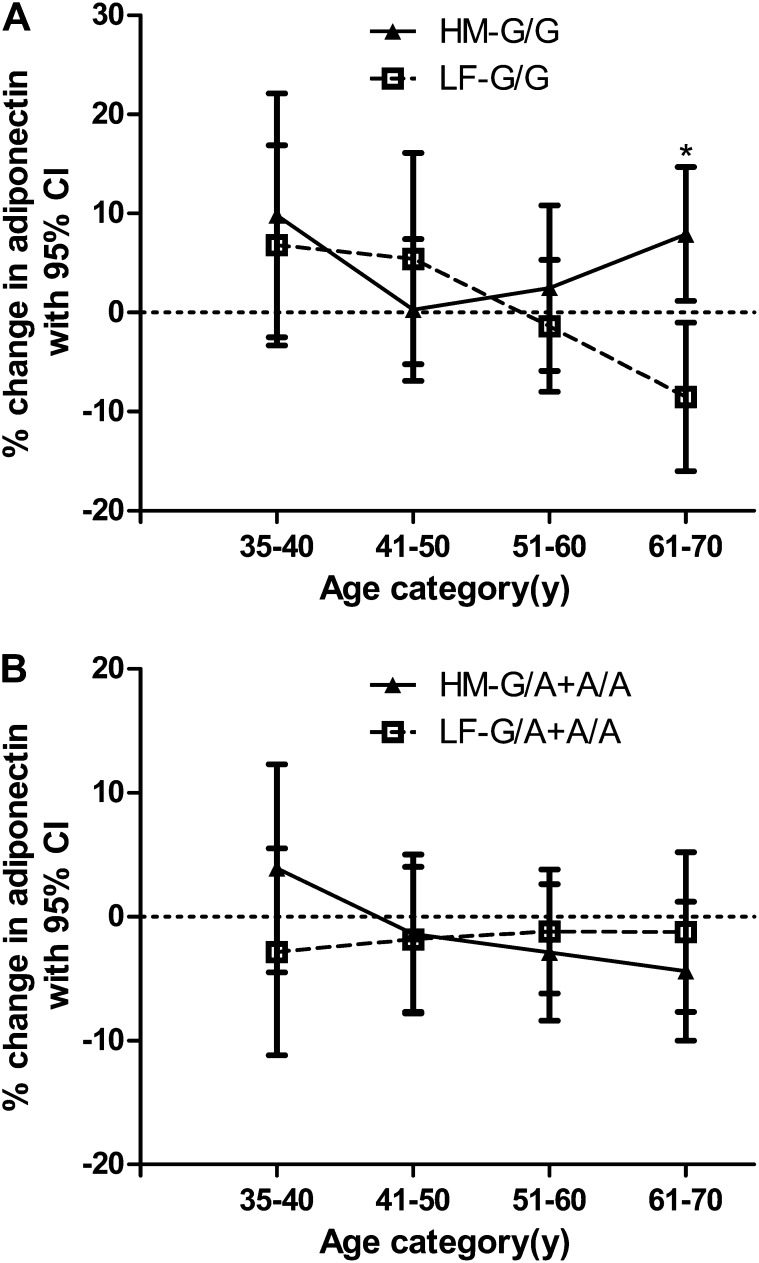
Results: In white Europeans, +276 T was associated with higher serum adiponectin concentrations (n = 340; P = 0.006) and -10066 A was associated with lower serum adiponectin concentrations (n = 360; P = 0.03), after adjustment for age, BMI, and sex. After the HM diet, -10066 G/G subjects showed a 3.8% increase (95% CI: -0.1%, 7.7%) and G/A+A/A subjects a 2.6% decrease (95% CI: -5.6%, 0.4%) in serum adiponectin (P = 0.006 for difference after adjustment for the change in BMI, age, and sex). In -10066 G/G homozygotes, serum adiponectin increased with age after the HM diet and decreased after the LF diet.
Conclusion: In white -10066 G/G homozygotes, an HM diet may help to increase adiponectin concentrations with advancing age. This trial was registered at clinicaltrials.gov as ISRCTN29111298.
Figures
References
-
- Moller DE, Kaufman KD. Metabolic syndrome: a clinical and molecular perspective. Annu Rev Med 2005;56:45–62 - PubMed
-
- Corella D, Ordovas JM. Single nucleotide polymorphisms that influence lipid metabolism: Interaction with dietary factors. Annu Rev Nutr 2005;25:341–90 - PubMed
-
- Yamauchi T, Kamon J, Minokoshi Y, et al. Adiponectin stimulates glucose utilization and fatty-acid oxidation by activating AMP-activated protein kinase. Nat Med 2002;8:1288–95 - PubMed
-
- Yamauchi T, Kamon J, Waki H, et al. The fat-derived hormone adiponectin reverses insulin resistance associated with both lipoatrophy and obesity. Nat Med 2001;7:941–6 - PubMed
Publication types
MeSH terms
Substances
Associated data
Grants and funding
LinkOut - more resources
Full Text Sources
Medical
Miscellaneous
