


Blockade of 5-HT2 receptor selectively prevents MDMA-induced verbal memory impairment
- PMID: 21562484
- PMCID: PMC3154112
- DOI: 10.1038/npp.2011.80
Blockade of 5-HT2 receptor selectively prevents MDMA-induced verbal memory impairment
Abstract
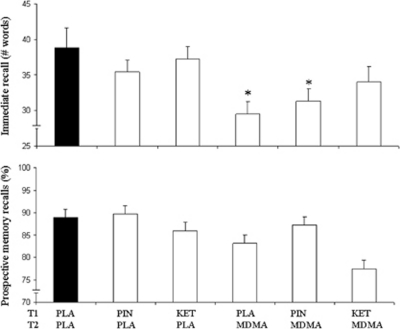
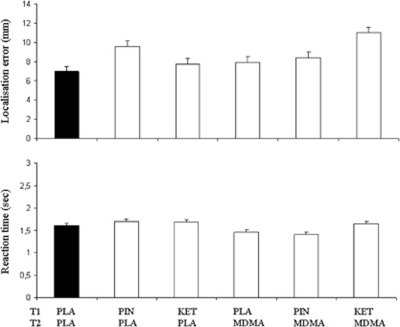
3,4-Methylenedioxymethamphetamine (MDMA) or 'ecstasy' has been associated with memory deficits during abstinence and intoxication. The human neuropharmacology of MDMA-induced memory impairment is unknown. This study investigated the role of 5-HT(2A) and 5-HT(1A) receptors in MDMA-induced memory impairment. Ketanserin is a 5-HT(2A) receptor blocker and pindolol a 5-HT(1A) receptor blocker. It was hypothesized that pretreatment with ketanserin and pindolol would protect against MDMA-induced memory impairment. Subjects (N=17) participated in a double-blind, placebo-controlled, within-subject design involving six experimental conditions consisting of pretreatment (T1) and treatment (T2). T1 preceded T2 by 30 min. T1-T2 combinations were: placebo-placebo, pindolol 20 mg-placebo, ketanserin 50 mg-placebo, placebo-MDMA 75 mg, pindolol 20 mg-MDMA 75 mg, and ketanserin 50 mg-MDMA 75 mg. Memory function was assessed at Tmax of MDMA by means of a word-learning task (WLT), a spatial memory task and a prospective memory task. MDMA significantly impaired performance in all memory tasks. Pretreatment with a 5-HT(2A) receptor blocker selectively interacted with subsequent MDMA treatment and prevented MDMA-induced impairment in the WLT, but not in the spatial and prospective memory task. Pretreatment with a 5-HT(1A) blocker did not affect MDMA-induced memory impairment in any of the tasks. Together, the results demonstrate that MDMA-induced impairment of verbal memory as measured in the WLT is mediated by 5-HT(2A) receptor stimulation.
Figures
References
-
- Borg J. Molecular imaging of the 5-HT1A receptor in relation to human cognition. Behav Brain Res. 2008;195:103–111. - PubMed
-
- Borg J, Andree B, Lundberg J, Halldin C, Farde L. Search for correlations between serotonin 5-HT1A receptor expression and cognitive functions--a strategy in translational psychopharmacology. Psychopharmacology (Berl) 2006;185:389–394. - PubMed
-
- Brogden RN, Sorkin EM. Ketanserin. A review of its pharmacodynamic and pharmacokinetic properties, and therapeutic potential in hypertension and peripheral vascular disease. Drugs. 1990;40:903–949. - PubMed
-
- Cole JC, Sumnall H. The pre-clinical behavioural pharmacology of 3,4-methylenedioxymethamphetamine (MDMA) Neurosci Biobehav Rev. 2003;27:199–217. - PubMed
-
- Deelman BG, Liebrand WB, Koning-Haanstra M, van den Burg W. Measurements of aphasic disorders. A brief description of the SAN-battery. Gerontologie. 1980;11:17–21. - PubMed
Publication types
MeSH terms
Substances
LinkOut - more resources
Full Text Sources
Medical
