. 2011 Dec;5(12):1844-56.
doi: 10.1038/ismej.2011.59. Epub 2011 May 12.

Identification of a novel acetate-utilizing bacterium belonging to Synergistes group 4 in anaerobic digester sludge

Affiliations

Identification of a novel acetate-utilizing bacterium belonging to Synergistes group 4 in anaerobic digester sludge

Tsukasa Ito et al. ISME J. 2011 Dec.

Abstract

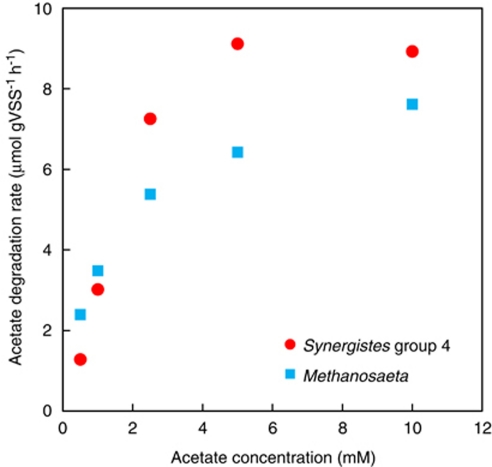
Major acetate-utilizing bacterial and archaeal populations in methanogenic anaerobic digester sludge were identified and quantified by radioisotope- and stable-isotope-based functional analyses, microautoradiography-fluorescence in situ hybridization (MAR-FISH) and stable-isotope probing of 16S rRNA (RNA-SIP) that can directly link 16S rRNA phylogeny with in situ metabolic function. First, MAR-FISH with (14)C-acetate indicated the significant utilization of acetate by only two major groups, unidentified bacterial cells and Methanosaeta-like filamentous archaeal cells, in the digester sludge. To identify the acetate-utilizing unidentified bacteria, RNA-SIP was conducted with (13)C(6)-glucose and (13)C(3)-propionate as sole carbon source, which were followed by phylogenetic analysis of 16S rRNA. We found that bacteria belonging to Synergistes group 4 were commonly detected in both 16S rRNA clone libraries derived from the sludge incubated with (13)C-glucose and (13)C-propionate. To confirm that this bacterial group can utilize acetate, specific FISH probe targeting for Synergistes group 4 was newly designed and applied to the sludge incubated with (14)C-acetate for MAR-FISH. The MAR-FISH result showed that bacteria belonging to Synergistes group 4 significantly took up acetate and their active population size was comparable to that of Methanosaeta in this sludge. In addition, as bacteria belonging to Synergistes group 4 had high K(m) for acetate and maximum utilization rate, they are more competitive for acetate over Methanosaeta at high acetate concentrations (2.5-10 mM). To our knowledge, it is the first time to report the acetate-utilizing activity of uncultured bacteria belonging to Synergistes group 4 and its competitive significance to acetoclastic methanogen, Methanosaeta.


Figures
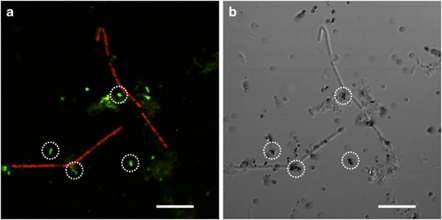
Figure 1
Figure 1
MAR-FISH image of acetate-utilizing bacterial and archaeal cells in the anaerobic digester sludge. (a) FISH image and (b) MAR image. In situ hybridization was performed with fluorescein isothiocyanate (FITC)-labeled EUB338-mixed probe and tetramethylrhodamine 5-isothiocyanate (TRITC)-labeled ARC915 probe. After incubating with 2.5 m glucose for 1 h, 740 kBq [2-14C]acetate was injected into the sample (the radiolabeled acetate concentration was 18% of total acetate concentration), and the samples were incubated for 2 h. Dotted circles indicate MAR-positive bacterial cells. Filamentous archaeal cells are also MAR-positive. Bar represents 10 μm.
Figure 2
Figure 2
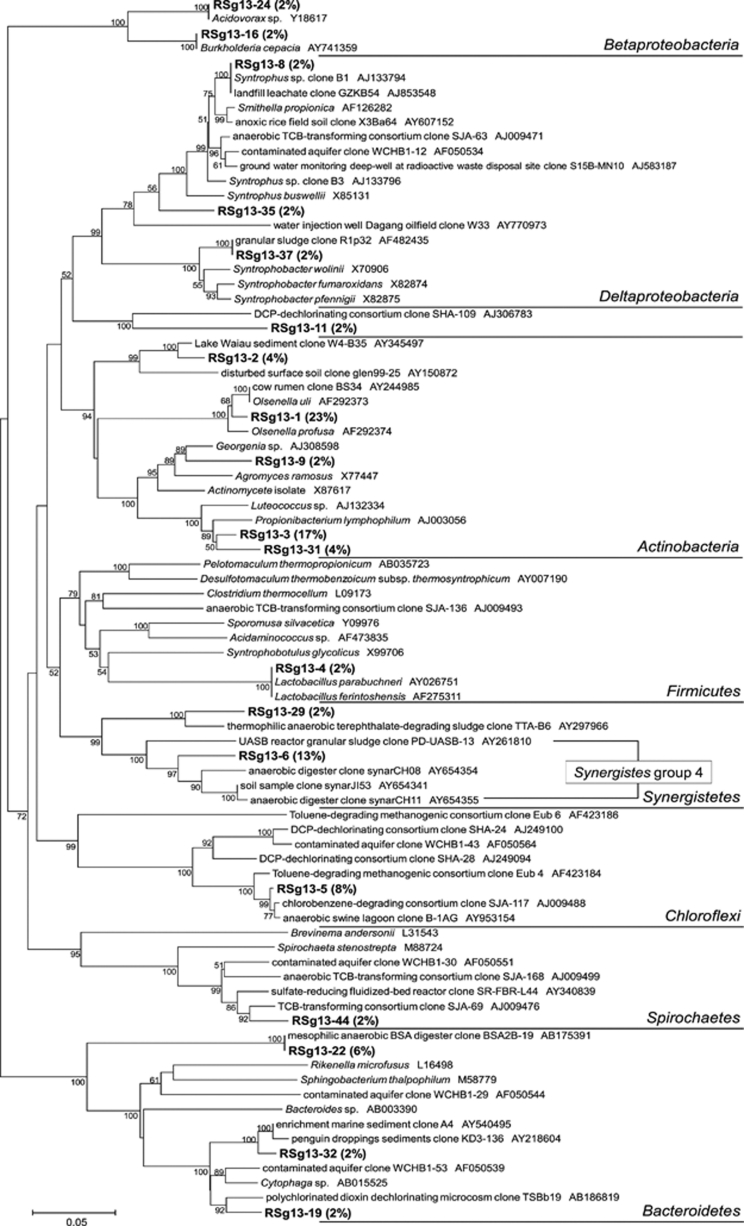
A phylogenetic tree showing the affiliation of 16S rRNA clones retrieved from ‘heavy' fraction of the RNA, which was extracted from the anaerobic digester sludge incubated with 2.5 m [13C6]glucose for 48 h (batch incubation). The numbers near branching points indicates bootstrap values. The scale bar represents 5% sequence divergence.
Figure 3
Figure 3
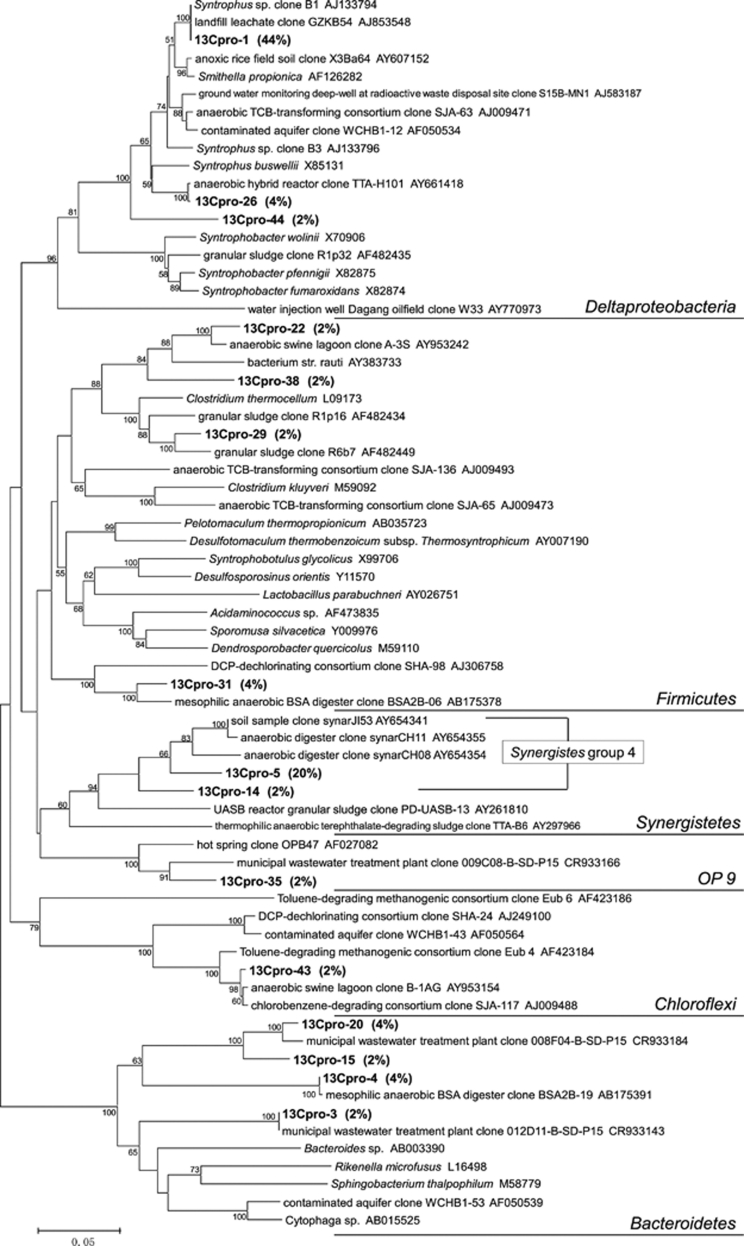
A phylogenetic tree showing the affiliation of 16S rRNA clones retrieved from ‘heavy' fraction of the RNA, which was extracted from the anaerobic digester sludge incubated at 0.5 m [13C3]propionate for 58 h (continuous-flow incubation). The numbers near branching points indicates bootstrap values. The scale bar represents 5% sequence divergence.
Figure 4
Figure 4
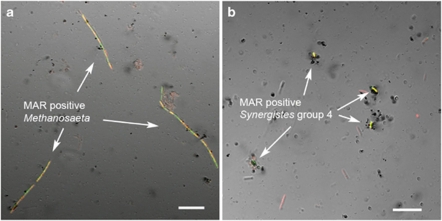
MAR-FISH images of acetate-utilizing archaeal and bacterial cells present in the anaerobic digester sludge incubated for 5 h at 0.5 m acetate containing 19% [2-14C]acetate. In these images, MAR-positive cells are identified with genus-specific probes, which are yellowish owing to the cross-hybridization with domain probes. (a) FITC-labeled MX825 probe-stained filamentous MAR-positive cells. The sample was simultaneously hybridized with TRITC-labeled ARC915 probe. (b) FITC-labeled Syner195 probe-stained MAR-positive cells. The sample was simultaneously hybridized with TRITC-labeled EUB338-mixed probe. Bars represent 10 μm.
Figure 5
Figure 5
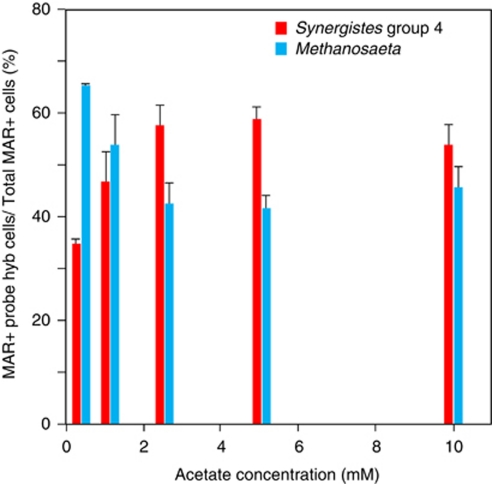
Relative abundance of [14C]acetate-utilizing Methanosaeta and Synergistes group 4 populations at 0.5 m, 1.0 m, 2.5 m, 5 m and 10 m acetate determined by MAR-FISH using probes of MSX825 and Syner195, respectively. The samples were incubated for 5 h at each acetate concentration containing 19% [2-14C]acetate. The genus-specific probes were always combined with domain-specific probes, and the sample was counter-stained with 4′, 6-diamidino-2-phenylindole (DAPI). Error bars represent the standard errors of duplicated measurements.
Figure 6
Figure 6
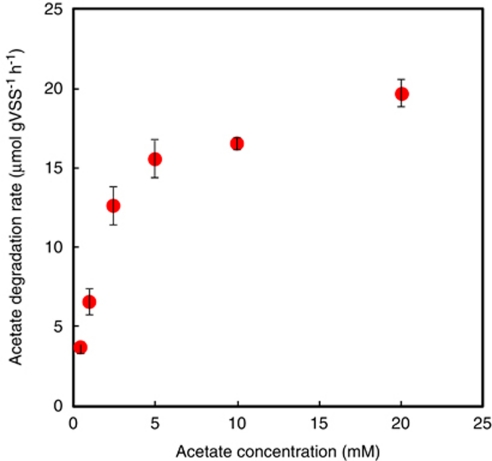
Acetate degradation rates of the anaerobic digester sludge incubated at 0.5 m, 1.0 m, 2.5 m, 5 m, 10 m and 20 m acetate containing 185 kBq [2-14C]acetate for 10 h, which was determined by liquid scintillation counting. Error bars represent the standard errors of duplicated measurements.
Figure 7
Figure 7
Acetate degradation rates of Methanosaeta and Synergistes group 4 in the anaerobic digester sludge at 0.5 m, 1.0 m, 2.5 m, 5 m and 10 m acetate concentrations. The rates were calculated from the values of Figures 5 and 6.

References

    1. Altschul SF, Madden TL, Schaffer AA, Zhang J, Zhang Z, Miller W, et al. Gapped BLAST and PSI-BLAST: a new generation of protein database search programs. Nucleic Acids Res. 1997;25:3389–3402. - PMC - PubMed
    1. Amann RI, Binder BJ, Olson RJ, Chisholm SW, Devereux R, Stahl DA. Combination of 16S rRNA-targeted oligonucleotide probes with flow cytometry for analyzing mixed microbial populations. Appl Environ Microbiol. 1990;56:1919–1925. - PMC - PubMed
    1. Andreasen K, Nielsen PH. Application of microautoradiography to the study of substrate uptake by filamentous microorganisms in activated sludge. Appl Environ Microbiol. 1997;63:3662–3668. - PMC - PubMed
    1. Ariesyady HD, Ito T, Okabe S. Functional bacterial and archaeal community structures of major trophic groups in a full-scale anaerobic sludge digester. Water Res. 2007a;41:1554–1568. - PubMed
    1. Ariesyady HD, Ito T, Yoshiguchi K, Okabe S. Phylogenetic and functional diversity of propionate-oxidizing bacteria in an anaerobic digester sludge. Appl Microbiol Biotechnol. 2007b;75:673–683. - PubMed

Publication types