. 2010;82(8):1585-1597.
doi: 10.1351/PAC-CON-09-09-37.

Trinuclear Metal Clusters in Catalysis by Terpenoid Synthases

Affiliations

Trinuclear Metal Clusters in Catalysis by Terpenoid Synthases

Julie A Aaron et al. Pure Appl Chem. 2010.

Abstract

Terpenoid synthases are ubiquitous enzymes that catalyze the formation of structurally and stereochemically diverse isoprenoid natural products. Many isoprenoid coupling enzymes and terpenoid cyclases from bacteria, fungi, protists, plants, and animals share the class I terpenoid synthase fold. Despite generally low amino acid sequence identity among these examples, class I terpenoid synthases contain conserved metal binding motifs that coordinate to a trinuclear metal cluster. This cluster not only serves to bind and orient the flexible isoprenoid substrate in the precatalytic Michaelis complex, but it also triggers the departure of the diphosphate leaving group to generate a carbocation that initiates catalysis. Additional conserved hydrogen bond donors assist the metal cluster in this function. Crystal structure analysis reveals that the constellation of three metal ions required for terpenoid synthase catalysis is generally identical among all class I terpenoid synthases of known structure.


Figures
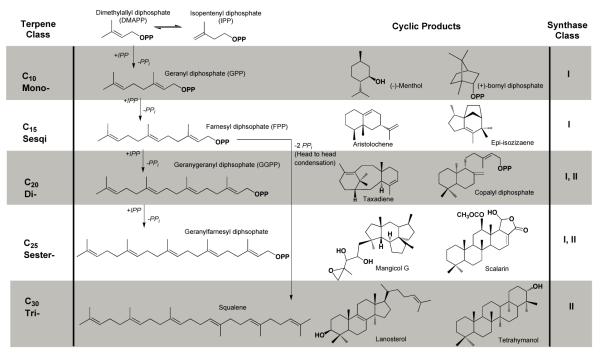
Fig. 1
Fig. 1
General scheme of terpenoid nomenclature and biosynthesis (OPP = diphosphate, PPi = inorganic diphosphate).
Fig. 2
Fig. 2
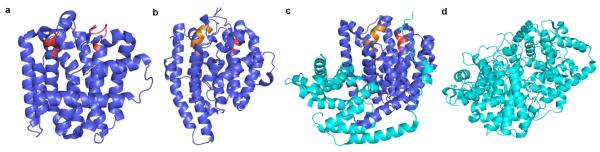
Structural similarities among various terpenoid synthases define the core class I terpenoid cyclase fold (blue). Conserved metal binding motifs are the aspartate-rich motifs (red) and “NSE/DTE” motifs (orange) highlighted in (a) E. coli FPP synthase (PDB code 1RQI), (b) epi-isozizaene synthase (PDB code T.B.A.), and (c) (+)-bornyl diphosphate synthase (PDB code 1N22), which contains an additional N-terminal domain (cyan). This α-helical domain is topologically similar to the α-barrel fold of the class II terpenoid cyclases, which occurs in a double domain architecture in the triterpene cyclase (d) oxidosqualene cyclase (PDB code 1W6K).
Fig. 3
Fig. 3
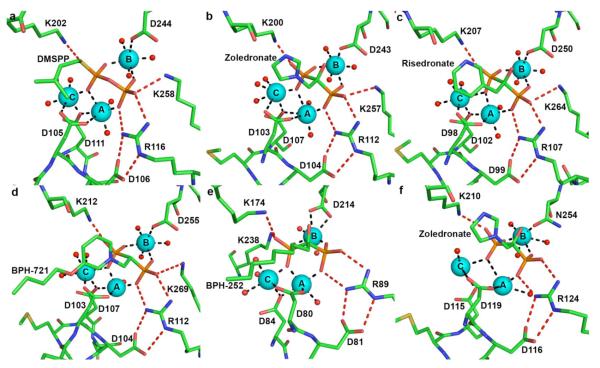
Conservation of Mg2+3-PPi and -diphosphate binding motifs among isoprenoid coupling enzymes. Metal coordination (black) and hydrogen bond (red) interactions with phosphate(s) are indicated. (a) E. coli FPP synthase-Mg2+3-DMSPP-IPP complex (PDB code 2EGW); (b) human FPP synthase-Mg2+3-zoledronate complex (PDB 2F8Z); (c) T. cruzi FPP synthase-Mg2+3-risedronate complex (PDB code 1YHL); (d) T. brucei FPP synthase-Mg2+3-BPH-721 complex (PDB code 3DYH); (e) S. cerevisae GGPP synthase-Mg2+2-BPH-252 complex (PDB code 2Z4X); (f) C. parvum nonspecific prenyl synthase-Mg2+3-zoledronate complex (PDB code 2Q58).
Fig. 4
Fig. 4
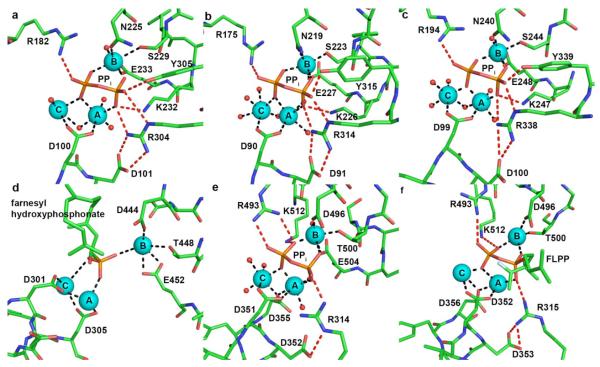
Conservation of Mg2+3-PPi and -diphosphate binding motifs among terpenoid cyclases. Metal coordination (black) and hydrogen bond (red) interactions with phosphate(s) are indicated. (a) F. sporotrichioides trichodiene synthase-Mg2+3-PPi complex (PDB code 1JFG); (b) A. terreus aristolochene synthase-Mg2+3-PPi complex (PDB 2OA6); (c) S. coelicolor epi-isozizaene synthase-Mg2+3-PPi complex (PDB code 3KB9); (d) N. tabacum 5-epi-aristolochene synthase-Mg2+3-farnesyl hydroxyphosphonate complex (PDB code 5EAT; note that many of the metal-phosphate interactions indicated are too long to be considered inner-sphere metal coordination interactions); (e) S. officinalis (+)-bornyl diphosphate synthase-Mg2+3-PPi complex (PDB code 1N22; metal ions are labeled according to the convention first established for trichodiene synthase); (f) M. spicata limonene synthase-Mn2+3-FLPP complex (PDB code 2ONG; conserved hydrogen bonding is indicated between D353 and R315 despite poor geometry).
Fig. 5
Fig. 5
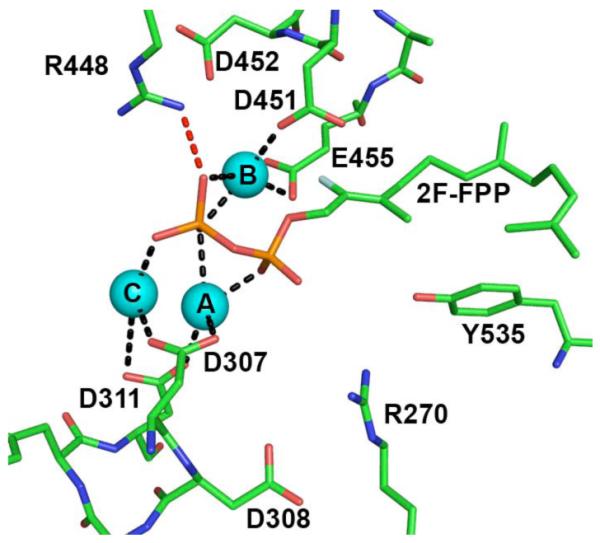
The diphosphate binding site of (+)-δ-cadinene synthase from G. arboreum (PDB code 3G4F) with a putative Mg2+3 cluster and 2F-FPP bound. Metal ions are labeled according to convention established for trichodiene synthase. Some metal-phosphate interactions are too long to be considered inner-sphere coordination interactions, which could be a consequence of the nonproductive binding mode observed for 2F-FPP.
Fig. 6
Fig. 6
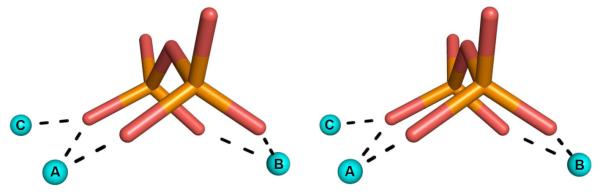
Stereoview of the Mg2+3-PPi cluster from epi-isozizaene synthase [43]. Dashed lines (black) represent metal-coordination interactions. The PPi anion forms 6-membered ring chelates with Mg2+A and Mg2+B, both of which adopt distorted sofa conformations.

References

    1. Christianson DW. Science. 2007;316:60–61. - PubMed
    1. Aharoni A, Jongsma MA, Bouwmeester HJ. Trends Plant Sci. 2005;10:594–602. - PubMed
    1. Pichersky E, Noel JP, Dudareva N. Science. 2006;311:808–811. - PMC - PubMed
    1. Rondeau J-M, Bitsch F, Bourgier E, Geiser M, Hemmig R, Kroemer M, Lehmann S, Ramage P, Rieffel S, Strauss A, Green JR, Jahnke W. ChemMedChem. 2006;1:267–273. - PubMed
    1. Agrawal AG, Somani RR. Mini Rev. Med. Chem. 2009;9:638–652. - PubMed

LinkOut - more resources