Randomized Controlled Trial
. 2011 Aug;54(8):2103-12.
doi: 10.1007/s00125-011-2174-9. Epub 2011 May 12.

Low-dose glucocorticoid treatment affects multiple aspects of intermediary metabolism in healthy humans: a randomised controlled trial

Affiliations
Randomized Controlled Trial

Low-dose glucocorticoid treatment affects multiple aspects of intermediary metabolism in healthy humans: a randomised controlled trial

D H van Raalte et al. Diabetologia. 2011 Aug.

Abstract

Aim/hypothesis: To assess whether low-dose glucocorticoid treatment induces adverse metabolic effects, as is evident for high glucocorticoid doses.

Methods: In a randomised placebo-controlled double-blind (participants and the investigators who performed the studies and assessed the outcomes were blinded) dose-response intervention study, 32 healthy men (age 22 ± 3 years; BMI 22.4 ± 1.7 kg/m(2)) were allocated to prednisolone 7.5 mg once daily (n = 12), prednisolone 30 mg once daily (n = 12), or placebo (n = 8) for 2 weeks using block randomisation. Main outcome measures were glucose, lipid and protein metabolism, measured by stable isotopes, before and at 2 weeks of treatment, in the fasted state and during a two-step hyperinsulinaemic clamp conducted in the Clinical Research Unit of the Academic Medical Centre, Amsterdam, the Netherlands

Results: Prednisolone, compared with placebo, dose dependently and significantly increased fasting plasma glucose levels, whereas only prednisolone 30 mg increased fasting insulin levels (29 ± 15 pmol/l). Prednisolone 7.5 mg and prednisolone 30 mg decreased the ability of insulin to suppress endogenous glucose production (by 17 ± 6% and 46 ± 7%, respectively, vs placebo). Peripheral glucose uptake was not reduced by prednisolone 7.5 mg, but was decreased by prednisolone 30 mg by 34 ± 6% (p < 0.0001). Compared with placebo, prednisolone treatment tended to decrease lipolysis in the fasted state (p = 0.062), but both prednisolone 7.5 mg and prednisolone 30 mg decreased insulin-mediated suppression of lipolysis by 11 ± 5% and 34 ± 6%, respectively. Finally, prednisolone treatment increased whole-body proteolysis during hyperinsulinaemia, which tended to be driven by prednisolone 30 mg (5 ± 2%; p = 0.06). No side effects were reported by the study participants. All participants completed the study and were analysed.

Conclusions/interpretation: Not only at high doses but also at low doses, glucocorticoid therapy impaired intermediary metabolism by interfering with the metabolic actions of insulin on liver and adipose tissue. These data indicate that even low-dose glucocorticoids may impair glucose tolerance when administered chronically.

Trial registration: ISRCTN83991850.


Figures

Fig. 1
Fig. 1
The effects of prednisolone treatment on glucose metabolism. a Prednisolone treatment increased basal EGP. This was driven by prednisolone 30 mg once daily. b EGP during insulin infusion was dose dependently increased by prednisolone treatment. c The rate of glucose disappearance was decreased by prednisolone 30 mg, but not by prednisolone 7.5 mg once daily. Data represent means ± SEM. Black bars, before treatment; white bars, day 14 of treatment. Between-group changes from baseline were tested by Kruskal–Wallis (indicated by top line). Post hoc tests were done by Mann–Whitney U with Bonferroni correction for multiple testing (indicated by line with brackets). **p < 0.01; ***p < 0.001. PLB, placebo
Fig. 2
Fig. 2
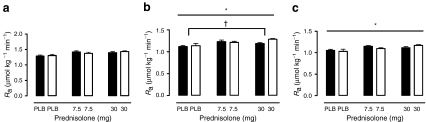
The effects of prednisolone treatment on glycerol appearance (R a). a Prednisolone treatment tended to decrease basal lipolysis, which seemed caused by the prednisolone 30 mg once daily dose. b During insulin infusion targeted at 200 pmol/l, prednisolone treatment dose dependently increased glycerol turnover. This reached significance for prednisolone 30 mg, but remained a trend for prednisolone 7.5 mg once daily. c At higher insulin (600 pmol/l) during step 2 of the clamp, a similar pattern was observed, with a dose-dependent increase of whole-body lipolysis with prednisolone treatment. Data represent means ± SEM. Black bars, before treatment; white bars, day 14 of treatment. Between-group changes from baseline were tested by Kruskal–Wallis (indicated by top line). Post hoc tests were done by Mann–Whitney U with Bonferroni correction for multiple testing (indicated by line with brackets). *p < 0.05; **p < 0.01; p = 0.062; p = 0.09. PLB, placebo
Fig. 3
Fig. 3
The effect of prednisolone treatment on valine appearance (R a). a Valine turnover in the basal state was not affected by prednisolone treatment. b Overall, valine turnover was increased during step 1 of the hyperinsulinaemic–euglycaemic clamp by prednisolone treatment. This seemed driven by prednisolone 30 mg in post hoc analysis, but failed to reach statistical significance. c A similar pattern was observed during step 2 of the clamp, where overall prednisolone treatment increased valine turnover; however, in post hoc testing, no significance was reached for either dose compared with placebo. Data represent means ± SEM. Black bars, before treatment; white bars, day 14 of treatment. Between-group changes from baseline were tested by Kruskal–Wallis (indicated by top line). Post hoc tests were done by Mann–Whitney U with Bonferroni correction for multiple testing (indicated by line with brackets). *p < 0.05; p = 0.06. PLB, placebo

References

    1. Bijlsma JW, van der Goes MC, Hoes JN, Jacobs JW, Buttgereit F, Kirwan J. Low-dose glucocorticoid therapy in rheumatoid arthritis: an obligatory therapy. Ann NY Acad Sci. 2010;1193:123–126. doi: 10.1111/j.1749-6632.2009.05342.x. - DOI - PubMed
    1. Hernandez-Rodriguez J, Cid MC, Lopez-Soto A, Espigol-Frigole G, Bosch X. Treatment of polymyalgia rheumatica: a systematic review. Arch Intern Med. 2009;169:1839–1850. doi: 10.1001/archinternmed.2009.352. - DOI - PubMed
    1. Salvarani C, Cantini F, Hunder GG. Polymyalgia rheumatica and giant-cell arteritis. Lancet. 2008;372:234–245. doi: 10.1016/S0140-6736(08)61077-6. - DOI - PubMed
    1. Parker BJ, Bruce IN. High dose methylprednisolone therapy for the treatment of severe systemic lupus erythematosus. Lupus. 2007;16:387–393. doi: 10.1177/0961203307079502. - DOI - PubMed
    1. Lichtenstein GR, Abreu MT, Cohen R, Tremaine W. American Gastroenterological Association Institute medical position statement on corticosteroids, immunomodulators, and infliximab in inflammatory bowel disease. Gastroenterology. 2006;130:935–939. doi: 10.1053/j.gastro.2006.01.047. - DOI - PubMed

Publication types

Associated data