


Resource partitioning to male and female flowers of Spinacia oleracea L. in relation to whole-plant monocarpic senescence
- PMID: 21565983
- PMCID: PMC3153683
- DOI: 10.1093/jxb/err148
Resource partitioning to male and female flowers of Spinacia oleracea L. in relation to whole-plant monocarpic senescence
Abstract
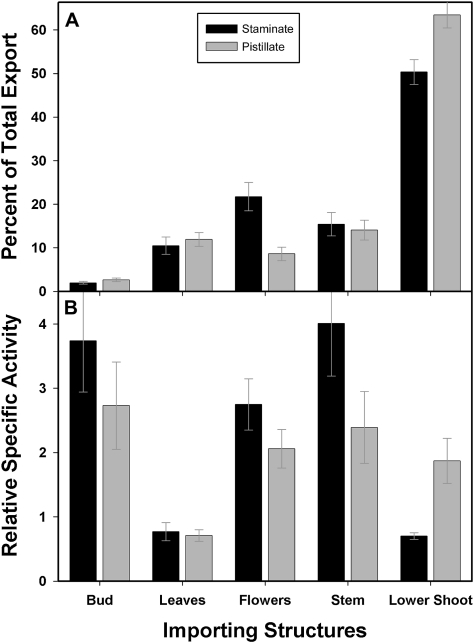
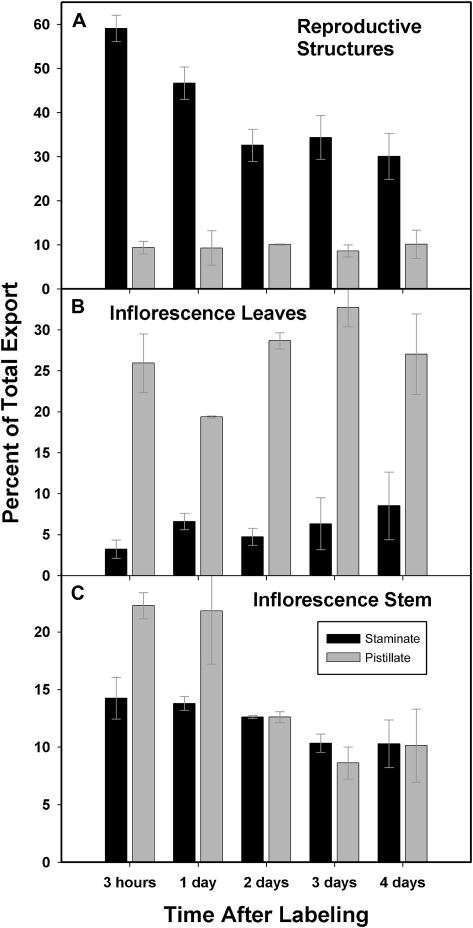
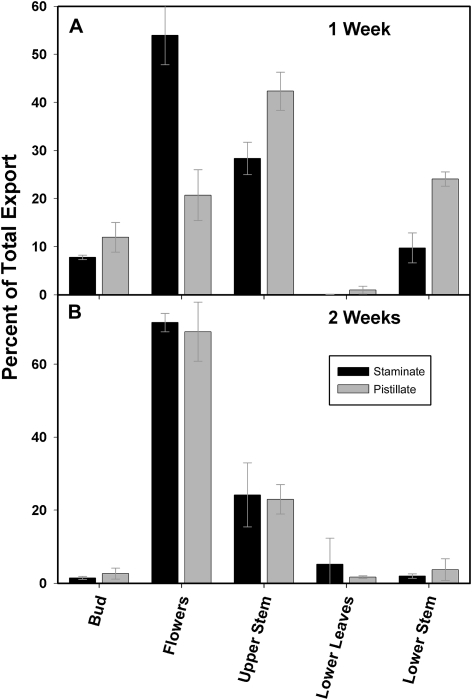
Male plants of spinach (Spinacea oleracea L.) senesce following flowering. It has been suggested that nutrient drain by male flowers is insufficient to trigger senescence. The partitioning of radiolabelled photosynthate between vegetative and reproductive tissue was compared in male (staminate) versus female (pistillate) plants. After the start of flowering staminate plants senesce 3 weeks earlier than pistillate plants. Soon after the start of flowering, staminate plants allocated several times as much photosynthate to flowering structures as did pistillate plants. The buds of staminate flowers with developing pollen had the greatest draw of photosynthate. When the staminate plants begin to show senescence 68% of fixed C was allocated to the staminate reproductive structures. In the pistillate plants, export to the developing fruits and young flowers remained near 10% until mid-reproductive development, when it increased to 40%, declining to 27% as the plants started to senesce. These differences were also present on a sink-mass corrected basis. Flowers on staminate spinach plants develop faster than pistillate flowers and have a greater draw of photosynthate than do pistillate flowers and fruits, although for a shorter period. Pistillate plants also produce more leaf area within the inflorescence to sustain the developing fruits. The (14)C in the staminate flowers declined due to respiration, especially during pollen maturation; no such loss occurred in pistillate reproductive structures. The partitioning to the reproductive structures correlates with the greater production of floral versus vegetative tissue in staminate plants and their more rapid senescence. As at senescence the leaves still had adequate carbohydrate, the resources are clearly phloem-transported compounds other than carbohydrates. The extent of the resource redistribution to reproductive structures and away from the development of new vegetative sinks, starting very early in the reproductive phase, is sufficient to account for the triggering of senescence in the rest of the plant.
Figures







References
-
- Borras L, Maddonni GA, Otegui ME. Leaf senescence in maize hybrids: plant population, row spacing and kernel set effects. Field Crops Research. 2003;82:13–26.
-
- Borrell A, Hammer G, Van Oosterom E. Stay-green: a consequence of the balance between supply and demand for nitrogen during grain filling? Annals of Applied Biology. 2001;138:91–95.
-
- Cairns AJ. Colorimetric microtiter plate assay of glucose and fructose by enzyme-linked formazan production applicability to the measurement of fructosyltransferase activity in higher plants. Analytical Biochemistry. 1987;167:270–278. - PubMed
-
- Crafts-Brandner SJ, Egli DB. Modification of seed growth in soybean by physical restraint effect on leaf senescence. Journal of Experimental Botany. 1987;38:2043–2049.
Publication types
MeSH terms
LinkOut - more resources
Full Text Sources
Research Materials
