. 2011 Jul;111(1):185-91.
doi: 10.1152/japplphysiol.00126.2011. Epub 2011 May 12.

Decreased specific force and power production of muscle fibers from myostatin-deficient mice are associated with a suppression of protein degradation

Affiliations

Decreased specific force and power production of muscle fibers from myostatin-deficient mice are associated with a suppression of protein degradation

Christopher L Mendias et al. J Appl Physiol (1985). 2011 Jul.

Erratum in

  • J Appl Physiol. 2011 Dec;111(6):1889

Abstract

Myostatin (MSTN) is a member of the transforming growth factor-β superfamily of cytokines and is a negative regulator of skeletal muscle mass. Compared with MSTN(+/+) mice, the extensor digitorum longus muscles of MSTN(-/-) mice exhibit hypertrophy, hyperplasia, and greater maximum isometric force production (F(o)), but decreased specific maximum isometric force (sF(o); F(o) normalized by muscle cross-sectional area). The reason for the reduction in sF(o) was not known. Studies in myotubes indicate that inhibiting myostatin may increase muscle mass by decreasing the expression of the E3 ubiquitin ligase atrogin-1, which could impact the force-generating capacity and size of muscle fibers. To gain a greater understanding of the influence of myostatin on muscle contractility, we determined the impact of myostatin deficiency on the contractility of permeabilized muscle fibers and on the levels of atrogin-1 and ubiquitinated myosin heavy chain in whole muscle. We hypothesized that single fibers from MSTN(-/-) mice have a greater F(o), but no difference in sF(o), and a decrease in atrogin-1 and ubiquitin-tagged myosin heavy chain levels. The results indicated that fibers from MSTN(-/-) mice have a greater cross-sectional area, but do not have a greater F(o) and have a sF(o) that is significantly lower than fibers from MSTN(+/+) mice. The extensor digitorum longus muscles from MSTN(-/-) mice also have reduced levels of atrogin-1 and ubiquitinated myosin heavy chain. These findings suggest that myostatin inhibition in otherwise healthy muscle increases the size of muscle fibers and decreases atrogin-1 levels, but does not increase the force production of individual muscle fibers.


Figures
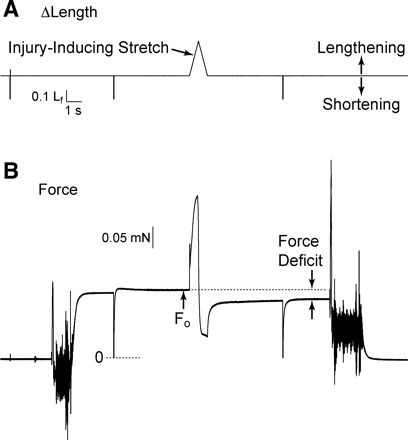
Fig. 1.
Fig. 1.
Determination of fiber susceptibility to injury caused by a lengthening contraction. A: fiber length (Lf) perturbations applied through control of servomotor position. B: force responses corresponding to the length perturbations. A lengthening movement of 30% of Lf was applied at a constant velocity of 0.5 Lf × s−1. Following the lengthening contraction, the fiber was immediately returned to original length at the same velocity. The large, rapid shortening movements evident in the records were sufficient in size to slacken the fiber and serve to indicate the zero force level in the force record. Fibers were allowed to remain slack for 30 ms before being rapidly returned to original length. Note the sustained reduction in force following stretch of the fully activated fiber. Δ, Change; Fo, maximum isometric force.
Fig. 2.
Fig. 2.
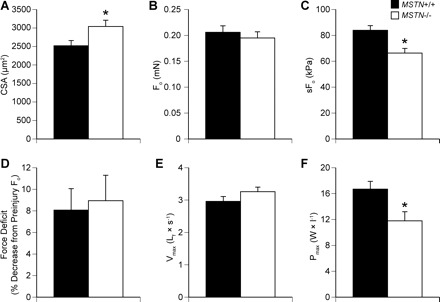
Contractile and morphological properties of permeabilized extensor digitorum longus (EDL) muscle fibers from myostatin MSTN+/+ and MSTN−/− mice. A: cross-sectional area (CSA) (MSTN+/+ N = 37; MSTN−/− N = 36). B: Fo (MSTN+/+ N = 37; MSTN−/− N = 36). C: specific Fo (sFo) (MSTN+/+ N = 37; MSTN−/− N = 36). D: decrease in Fo production following a 30% lengthening contraction (MSTN+/+ N = 10; MSTN−/− N = 10). E: maximum shortening velocity (Vmax) (MSTN+/+ N = 11; MSTN−/− N = 11). F: maximum power production (Pmax) (MSTN+/+ N = 11; MSTN−/− N = 11). Values are means ± SE. *Significantly different from MSTN+/+ (P < 0.05).
Fig. 3.
Fig. 3.
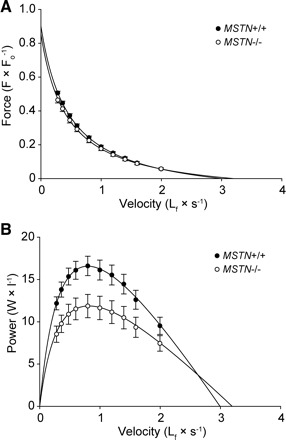
Force-velocity (A) and power-velocity (B) curves for EDL muscle fibers from MSTN+/+ and MSTN−/− mice. Note that the force-velocity relationship of fibers from MSTN−/− mice is not different from that of fibers from MSTN+/+ mice when the force axis is normalized by Fo, suggesting that cross-bridge kinetics are unchanged in the MSTN−/− phenotype. Power (the product of force and velocity), normalized by fiber volume and plotted as a function of shortening velocity, reveals that a reduction in normalized power is another consequence of reduced sFo in the MSTN−/− fibers. Each point represents mean ± SE; N = 11 fibers for each genotype.
Fig. 4.
Fig. 4.
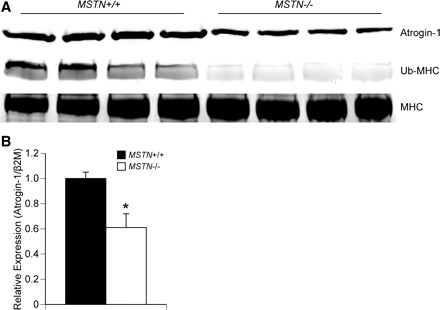
A: immunoblot showing that, compared with MSTN+/+ mice, EDL muscles from MSTN−/− mice have a decrease in atrogin-1 and ubiquitinated myosin heavy chain (Ub-MHC). Total myosin heavy chain (MHC) is shown as a loading control. N = 4 mice from each genotype. B: gene expression data showing that, compared with MSTN+/+ mice, EDL muscles from MSTN−/− mice have a decrease in atrogin-1 expression. N = 4 mice from each genotype. Values are means ± SE. *Significantly different from MSTN+/+ (P < 0.05).

References

    1. Allen DL, Unterman TG. Regulation of myostatin expression and myoblast differentiation by FoxO and SMAD transcription factors. Am J Physiol Cell Physiol 292: C188–C199, 2007 - PubMed
    1. Amthor H, Macharia R, Navarrete R, Schuelke M, Brown SC, Otto A, Voit T, Muntoni F, Vrbóva G, Partridge T, Zammit P, Bunger L, Patel K. Lack of myostatin results in excessive muscle growth but impaired force generation. Proc Natl Acad Sci USA 104: 1835–1840, 2007 - PMC - PubMed
    1. Bodine SC, Latres E, Baumhueter S, Lai VK, Nunez L, Clarke BA, Poueymirou WT, Panaro FJ, Na E, Dharmarajan K, Pan ZQ, Valenzuela DM, DeChiara TM, Stitt TN, Yancopoulos GD, Glass DJ. Identification of ubiquitin ligases required for skeletal muscle atrophy. Science 294: 1704–1708, 2001 - PubMed
    1. Bogdanovich S, Perkins KJ, Krag TOB, Whittemore LA, Khurana TS. Myostatin propeptide-mediated amelioration of dystrophic pathophysiology. FASEB J 19: 543–549, 2005 - PubMed
    1. Brenner B. Technique for stabilizing the striation pattern in maximally calcium-activated skinned rabbit psoas fibers. Biophys J 41: 99–102, 1983 - PMC - PubMed

Publication types

LinkOut - more resources