


Infantile cortical hyperostosis and COL1A1 mutation in four generations
- PMID: 21567126
- PMCID: PMC3197908
- DOI: 10.1007/s00431-011-1463-0
Infantile cortical hyperostosis and COL1A1 mutation in four generations
Abstract
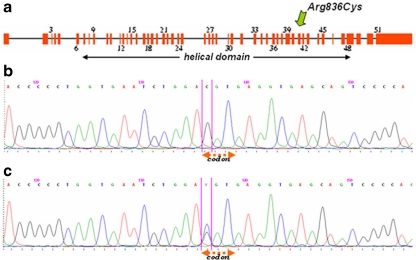
Infantile cortical hyperostosis (ICH, OMIM 114000) is a rare familial disorder which affects infants. It spontaneously heals in the first years of life. The disease is characterized by regressive subperiosteal hyperosteogenesis mainly affecting long bones, mandible, clavicles, and ribs which are remarkably swollen and deformed on X-rays. But it is also important to take into consideration the autosomal dominant pattern of inheritance to detect it. In 2005 Gensure et al. detected 3040C → T mutation in COL1A1 gene in three unrelated ICH families. Four generations of patients belonging to the same family were examined in our study. Molecular testing has now disclosed a pathogenic mutation in nine of them. The patients spontaneously recovered. Although our paper shows a distinct correlation between R836C mutation and ICH, there is a certain interindividual and intra-familial variability.
Figures


References
-
- Bernstein RM, Zaleske DJ. Familial aspects of Caffey's disease. Am J Orthop. 1995;24:777–781. - PubMed
-
- Blank E. Recurrent Caffey's cortical hyperostosis and persistent deformity. Pediatrics. 1975;55:856–860. - PubMed
-
- Boer G, Battistella P. Il fattore genetico nell'iperostosi corticale infantile (sindrome di de Toni-Caffey-Silvermann) Minerva Pediatr. 1966;18:1291–1299. - PubMed
Publication types
MeSH terms
Substances
Supplementary concepts
LinkOut - more resources
Full Text Sources
Medical
Miscellaneous
