


Identification and functional characterization of T cells reactive to citrullinated vimentin in HLA-DRB1*0401-positive humanized mice and rheumatoid arthritis patients
- PMID: 21567378
- PMCID: PMC3174345
- DOI: 10.1002/art.30445
Identification and functional characterization of T cells reactive to citrullinated vimentin in HLA-DRB1*0401-positive humanized mice and rheumatoid arthritis patients
Abstract
Objective: Antibodies toward the citrullinated form of the synovial antigen vimentin are specific for rheumatoid arthritis (RA) and are associated with HLA-DRB1*0401. This suggests that T cells specific for peptides derived from citrullinated vimentin presented in the context of HLA-DRB1*0401 may contribute to the etiopathogenesis of RA. The aim of this study was to identify immunodominant epitopes from citrullinated vimentin presented by HLA-DRB1*0401 and to characterize the resulting T cell responses.
Methods: We first predicted an HLA-binding T cell epitope from citrullinated vimentin based on the binding motif of HLA-DRB1*0401 and then confirmed its affinity. A class II major histocompatibility complex (MHC) tetramer loaded with the citrullinated form of vimentin aa 59-78 (cit-vimentin aa 59-78) was constructed and used to screen for specific T cells in HLA-DRB1*0401-transgenic mice, patients with RA, and healthy control subjects. Additionally, the cytokine output following cit-vimentin aa 59-78 challenge was analyzed in patients and healthy control subjects by multicolor flow cytometry and Luminex-based analysis.
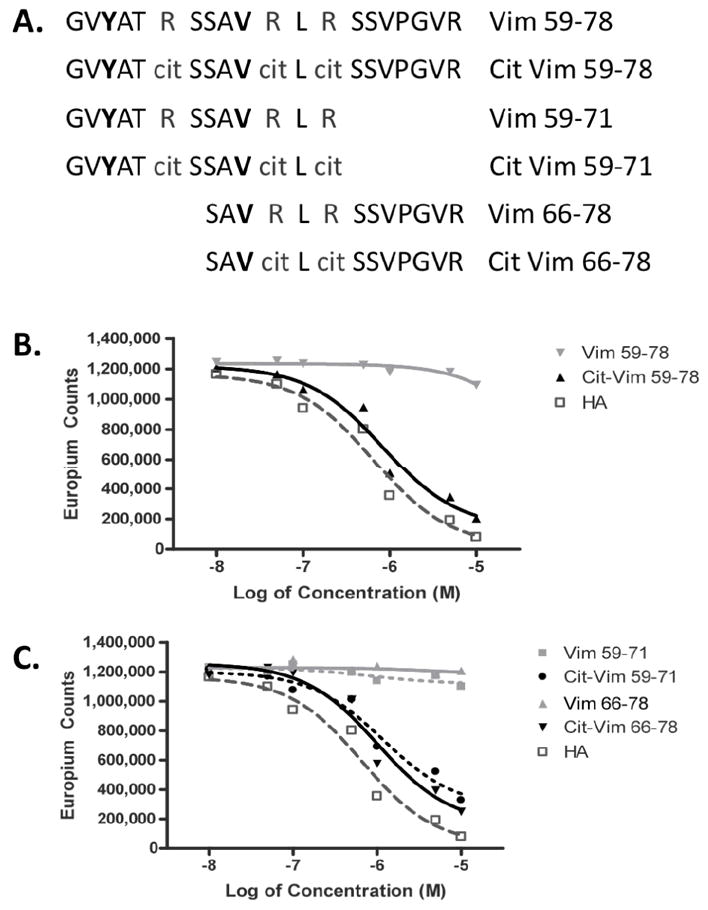
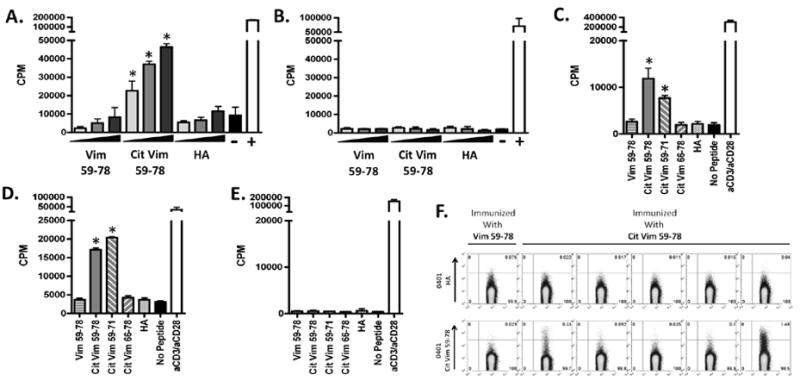
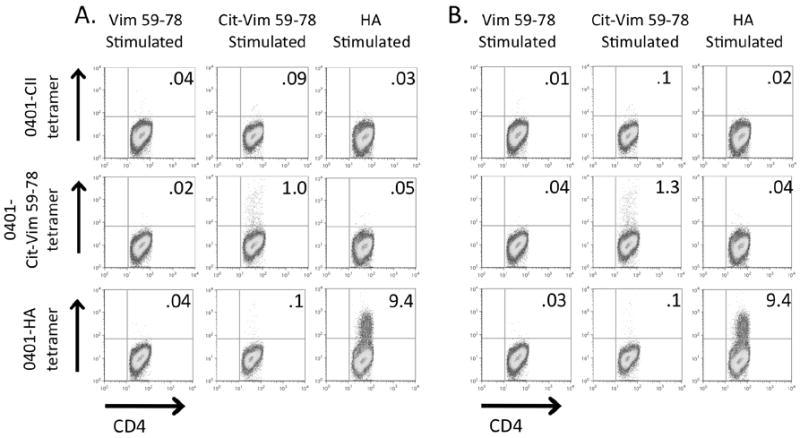
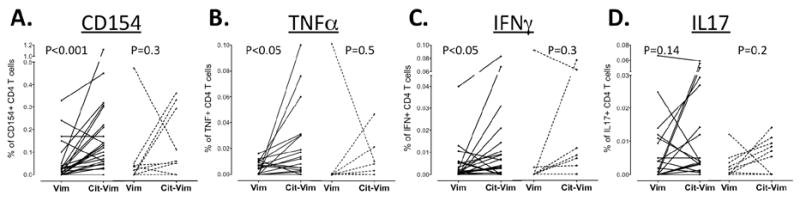
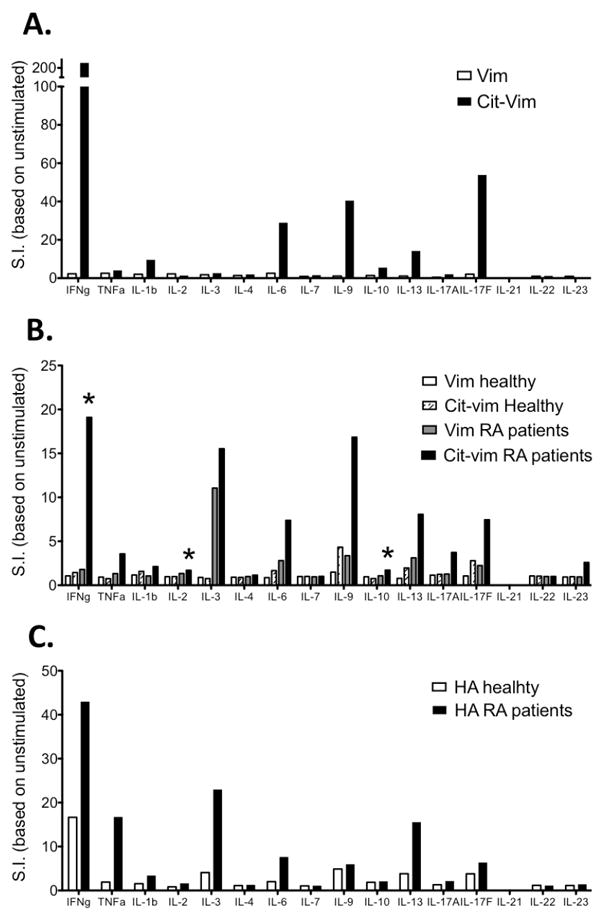
Results: The citrullinated form of vimentin aa 59-78 bound to HLA-DRB1*0401, but the native form could not. Subsequently, cit-vimentin aa 59-78-specific T cells were detected in immunized mice and in the periphery of both HLA-DR*0401-positive healthy control subjects and HLA-DR*0401-positive patients with RA, using class II MHC tetramers, CD154 up-regulation, and intracellular cytokine measurements. As demonstrated in cell culture supernatants, the production of cytokines (predominantly interferon-γ) in response to cit-vimentin aa 59-78 was significantly higher in patients compared with controls.
Conclusion: Here, we describe a posttranslational modification of an RA candidate autoantigen toward which HLA-DRB1*0401-restricted T cells can be detected in both patients with RA and healthy controls but for which a proinflammatory response is observed uniquely in patients with RA.
Copyright © 2011 by the American College of Rheumatology.
Conflict of interest statement
Figures
Comment in
-
On the trail of arthritogenic T cells.Arthritis Rheum. 2011 Oct;63(10):2851-3. doi: 10.1002/art.30440. Arthritis Rheum. 2011. PMID: 21567373 No abstract available.
References
-
- Holmdahl R, Klareskog L, Rubin K, Larsson E, Wigzell H. T lymphocytes in collagen II-induced arthritis in mice. Characterization of arthritogenic collagen II-specific T-cell lines and clones. Scand J Immunol. 1985;22(3):295–306. - PubMed
-
- Stanescu R, Lider O, van Eden W, Holoshitz J, Cohen IR. Histopathology of arthritis induced in rats by active immunization to mycobacterial antigens or by systemic transfer of T lymphocyte lines. A light and electron microscopic study of the articular surface using cationized ferritin. Arthritis Rheum. 1987;30(7):779–92. - PubMed
-
- Mahdi H, Fisher BA, Kallberg H, Plant D, Malmstrom V, Ronnelid J, et al. Specific interaction between genotype, smoking and autoimmunity to citrullinated alpha-enolase in the etiology of rheumatoid arthritis. Nat Genet. 2009;41(12):1319–24. - PubMed
-
- Klareskog L, Ronnelid J, Lundberg K, Padyukov L, Alfredsson L. Immunity to citrullinated proteins in rheumatoid arthritis. Annu Rev Immunol. 2008;26:651–75. - PubMed
-
- Gregersen PK, Silver J, Winchester RJ. The shared epitope hypothesis. An approach to understanding the molecular genetics of susceptibility to rheumatoid arthritis. Arthritis Rheum. 1987;30(11):1205–13. - PubMed
Publication types
MeSH terms
Substances
Grants and funding
LinkOut - more resources
Full Text Sources
Other Literature Sources
Medical
Molecular Biology Databases
Research Materials
