


Role of spared pathways in locomotor recovery after body-weight-supported treadmill training in contused rats
- PMID: 21568686
- PMCID: PMC3235344
- DOI: 10.1089/neu.2010.1660
Role of spared pathways in locomotor recovery after body-weight-supported treadmill training in contused rats
Abstract
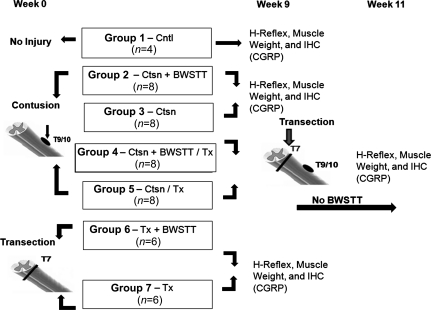
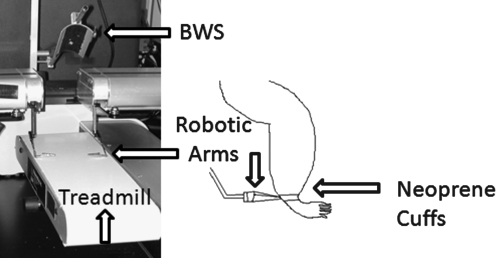
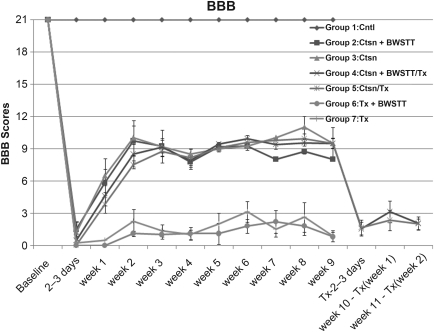
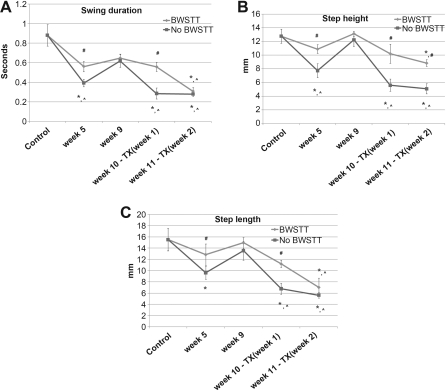
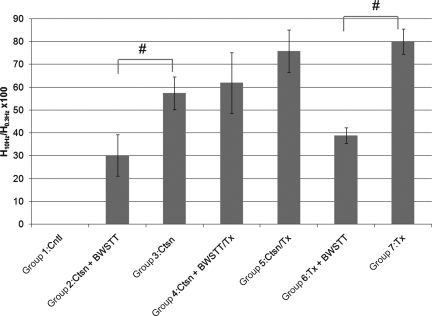
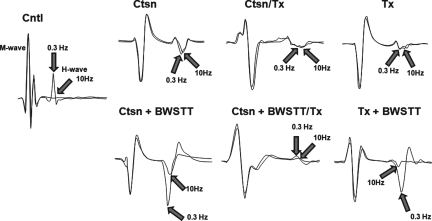
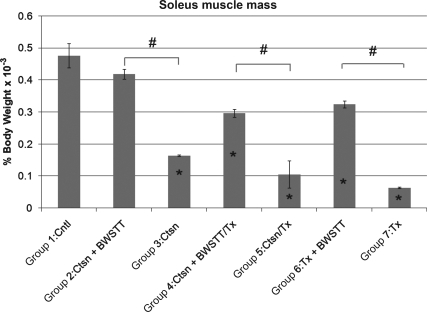
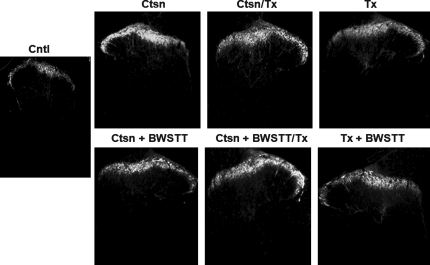
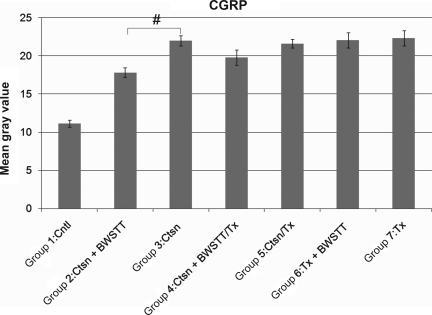
Body-weight-supported treadmill training (BWSTT)-related locomotor recovery has been shown in spinalized animals. Only a few animal studies have demonstrated locomotor recovery after BWSTT in an incomplete spinal cord injury (SCI) model, such as contusion injury. The contribution of spared descending pathways after BWSTT to behavioral recovery is unclear. Our goal was to evaluate locomotor recovery in contused rats after BWSTT, and to study the role of spared pathways in spinal plasticity after BWSTT. Forty-eight rats received a contusion, a transection, or a contusion followed at 9 weeks by a second transection injury. Half of the animals in the three injury groups were given BWSTT for up to 8 weeks. Kinematics and the Basso-Beattie-Bresnahan (BBB) test assessed behavioral improvements. Changes in Hoffmann-reflex (H-reflex) rate depression property, soleus muscle mass, and sprouting of primary afferent fibers were also evaluated. BWSTT-contused animals showed accelerated locomotor recovery, improved H-reflex properties, reduced muscle atrophy, and decreased sprouting of small caliber afferent fibers. BBB scores were not improved by BWSTT. Untrained contused rats that received a transection exhibited a decrease in kinematic parameters immediately after the transection; in contrast, trained contused rats did not show an immediate decrease in kinematic parameters after transection. This suggests that BWSTT with spared descending pathways leads to neuroplasticity at the lumbar spinal level that is capable of maintaining locomotor activity. Discontinuing training after the transection in the trained contused rats abolished the improved kinematics within 2 weeks and led to a reversal of the improved H-reflex response, increased muscle atrophy, and an increase in primary afferent fiber sprouting. Thus continued training may be required for maintenance of the recovery. Transected animals had no effect of BWSTT, indicating that in the absence of spared pathways this training paradigm did not improve function.
Figures
References
-
- Barbeau H. Rossignol S. Recovery of locomotion after chronic spinalization in the adult cat. Brain Res. 1987;412:84–95. - PubMed
-
- Barbeau H. Visintin M. Optimal outcomes obtained with body-weight support combined with treadmill training in stroke subjects. Arch. Phys. Med. Rehabil. 2003;84:1458–1465. - PubMed
-
- Basso D.M. Beattie M.S. Bresnahan J.C. A sensitive and reliable locomotor rating scale for open field testing in rats. J. Neurotrauma. 1995;12:1–21. - PubMed
-
- Beaumont E. Houlé J.D. Peterson C.A. Gardiner P.F. Passive exercise and fetal spinal cord transplant both help to restore motoneuronal properties after spinal cord transection in rats. Muscle Nerve. 2004;29:234–242. - PubMed
Publication types
MeSH terms
Grants and funding
LinkOut - more resources
Full Text Sources
Medical
