. 2011 May 10:11:79.
doi: 10.1186/1471-2229-11-79.

In Medicago truncatula, water deficit modulates the transcript accumulation of components of small RNA pathways

Affiliations

In Medicago truncatula, water deficit modulates the transcript accumulation of components of small RNA pathways

Cláudio Capitão et al. BMC Plant Biol. .

Abstract

Background: Small RNAs (sRNAs) are 20-24 nucleotide (nt) RNAs and are involved in plant development and response to abiotic stresses. Plants have several sRNA pathways implicated in the transcriptional and post-transcriptional silencing of gene expression. Two key enzyme families common to all pathways are the Dicer-like (DCL) proteins involved in sRNAs maturation and the Argonautes (AGOs) involved in the targeting and functional action of sRNAs. Post-transcriptional silencing mediated by AGOs may occur by cleavage or translational repression of target mRNA's, while transcriptional silencing may be controlled by DNA methylation and chromatin remodeling. Thus far, these gene families have not been characterized in legumes, nor has their involvement in adaptation to water deficit been studied.

Results: A bioinformatic search in Medicago truncatula genome databases, using Arabidopsis thaliana AGO and DCL cDNA and protein sequences, identified three sequences encoding for putative Dicer-like genes and twelve sequences encoding for putative Argonaute genes. Under water deficit conditions and mainly in roots, MtDCL1 and MtAGO1, two enzymes probably involved in the processing and activation of microRNAs (miRNAs), increased their transcript levels. mir162 which target DCL1 mRNA and mir168 which target AGO1 mRNA reduced their expression in the roots of plants subjected to water deficit. Three putative genes, MtDCL3, MtAGO4b and MtAGO4c probably involved in DNA methylation mechanisms, increased their mRNA levels. However, the mRNA levels of MtAGO6 reduced, which probably encodes a protein with functions similar to MtAGO4. MtAGO7 mRNA levels increased and possibly encodes a protein involved in the production of trans-acting small interfering RNAs. The transcript abundance of MtAGO12a, MtAGO12b and MtAGO12c reduced under water deprivation. Plants recovered from water deprivation reacquire the mRNA levels of the controls.

Conclusions: Our work demonstrates that in M. truncatula the transcript accumulation of the components of small RNA pathways is being modulated under water deficit. This shows that the transcriptional and post-transcriptional control of gene expression mediated by sRNAs is probably involved in plant adaptation to abiotic environmental changes. In the future this will allow the manipulation of these pathways providing a more efficient response of legumes towards water shortage.


Figures

Figure 1
Figure 1
Phylogenetic relations and characteristics of Medicago truncatula AGOs. (A) Evolutionary relationship of M. truncatula and A. thaliana (At) AGOs. The complete protein sequences were aligned using the T-Coffee software [46-48] and a Neighbour joining tree was constructed using the MEGA4.0 software [49]. (B) Characterization of the MtAGO proteins domains. The protein domains were obtained using the Conserved Domains Database (CDD) database of NCBI. The Argonaute protein domains DUF1785 (purple), PAZ (dark-blue), MID (orange) and PIWI (black) are shown. (C) The catalytic center of MtAGOs was obtained from the alignment of the PIWI domains, corresponding to the positions of the aspartate, aspartate and histidine (DDH) motif and the Argonaute 1 histidine at position 800 (H800). D, aspartate, H, histidine, S, serine, A, alanine, P, proline, R, arginine. Figure B to scale.
Figure 2
Figure 2
DCLs and AGOs Loci in M. truncatula chromosomes (MtChr). The AGO1 locus is not annotated in the M. truncatula genome because is not totally sequenced.
Figure 3
Figure 3
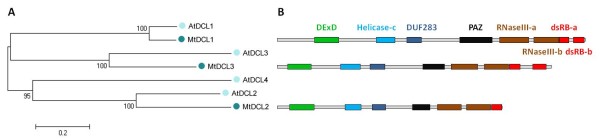
Phylogenetic relations and characteristics of Medicago truncatula DCLs. (A) Evolutionary relationship of M. truncatula and A. thaliana (At) DCLs. The complete protein sequences were aligned using the T-Coffee software [46-48] and a Neighbour joining tree was constructed using the MEGA4.0 software [49]. (B) Characterization of MtDCL proteins domains. The protein domains were obtained using the Conserved Domains Database (CDD) database of NCBI. The Dicer-like protein domains DExD (green), Helicase-c in (blue), DUF283 (dark-blue), PAZ (black), RNAase III (brown), dsRB (red) are shown. Figure B to scale.
Figure 4
Figure 4
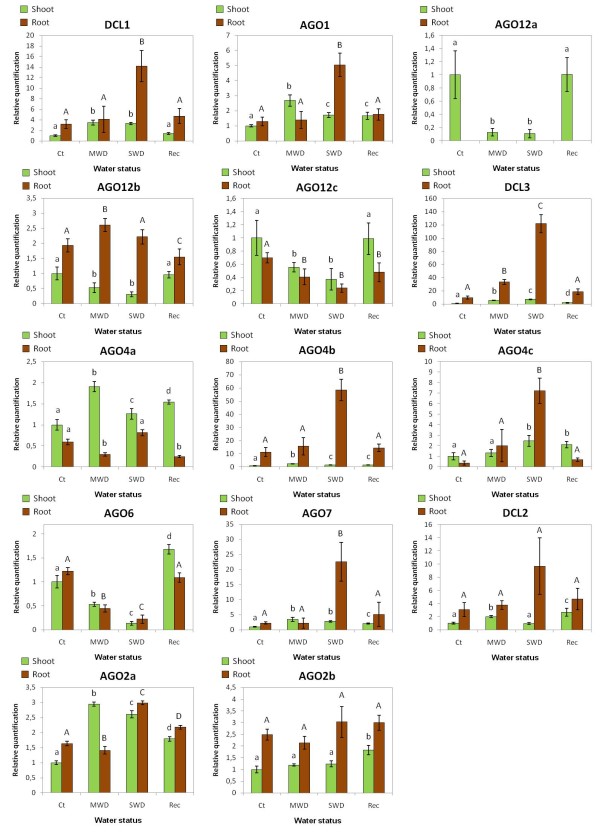
Relative accumulation of Dicer-like and Argonautes mRNAs in M. truncatula in different water status. The shoots (green) and roots (brown) of M. truncatula were the organs analyzed in the different water treatment conditions imposed. Values are the mean of two technical replicates of three independent cDNAs for each treatment and bars represent standard errors. The relative mRNA accumulation was calculated using L2 as the reference gene and normalized against the shoot control treatment. The AGO1 and DCL1 primer pair was designed to give one amplicon with the cleavage site of their corresponding miRNA, miR168 and miR162 respectively. A One Way ANOVA Test of significance was used to compare the four conditions in each organ followed by the Tukey Test (p-value <0.05). Ct, Control; MWD, Moderate Water Deficit; SWD, Severe Water Deficit, Rec, Recovery.
Figure 5
Figure 5
miR162 and miR168 expression in shoots and roots of M. truncatula in different water status. The U6 small nuclear RNA was used as internal loading control. The accumulation of miR162 and miR168 (numbers indicated under each lane) was quantified according to U6 small nuclear RNA loading control and normalized to control conditions. The membrane was first hybridized with miR162 probe and then striped and rehybridized with miR168 probe. (M) miRNA size marker with three bands of 24, 21 and 17 nt (New England Biolabs) is shown in the left.. Ct, Control; MWD, Moderate Water Deficit; SWD, Severe Water Deficit; Rec, Recovery.

References

    1. Finnegan EJ, Matzke MA. The small RNA world. Journal of cell science. 2003;116:4689–4693. doi: 10.1242/jcs.00838. - DOI - PubMed
    1. Szittya G, Moxon S, Santos DM, Jing R, Fevereiro MP, Moulton V, Dalmay T. High-throughput sequencing of Medicago truncatula short RNAs identifies eight new miRNA families. BMC genomics. 2008;9:593. doi: 10.1186/1471-2164-9-593. - DOI - PMC - PubMed
    1. Jagadeeswaran G, Zheng Y, Li YF, Shukla LI, Matts J, Hoyt P, Macmil SL, Wiley GB, Roe BA, Zhang W, Sunkar R. Cloning and characterization of small RNAs from Medicago truncatula reveals four novel legume-specific microRNA families. The New phytologist. 2009;184:85–98. doi: 10.1111/j.1469-8137.2009.02915.x. - DOI - PubMed
    1. Trindade I, Capitão C, Dalmay T, Fevereiro MP, Santos DMD. miR398 and miR408 are up-regulated in response to water deficit in Medicago truncatula. Planta. 2010;231:705–716. doi: 10.1007/s00425-009-1078-0. - DOI - PubMed
    1. Eamens A, Wang MB, Smith NA, Waterhouse PM. RNA silencing in plants: yesterday, today, and tomorrow. Plant physiology. 2008;147:456–468. doi: 10.1104/pp.108.117275. - DOI - PMC - PubMed

Publication types

MeSH terms