


Confounders in the assessment of the renal effects associated with low-level urinary cadmium: an analysis in industrial workers
- PMID: 21569589
- PMCID: PMC3118317
- DOI: 10.1186/1476-069X-10-37
Confounders in the assessment of the renal effects associated with low-level urinary cadmium: an analysis in industrial workers
Abstract
Background: Associations of proteinuria with low-level urinary cadmium (Cd) are currently interpreted as the sign of renal dysfunction induced by Cd. Few studies have considered the possibility that these associations might be non causal and arise from confounding by factors influencing the renal excretion of Cd and proteins.
Methods: We examined 184 healthy male workers (mean age, 39.5 years) from a zinc smelter (n = 132) or a blanket factory (n = 52). We measured the concentrations of Cd in blood (B-Cd) and the urinary excretion of Cd (U-Cd), retinol-binding protein (RBP), protein HC and albumin. Associations between biomarkers of metal exposure and urinary proteins were assessed by simple and multiple regression analyses.
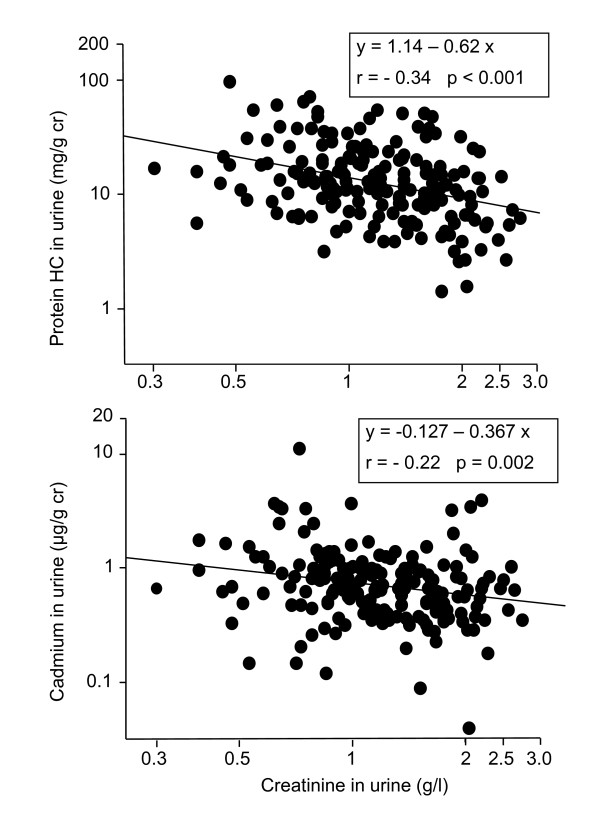
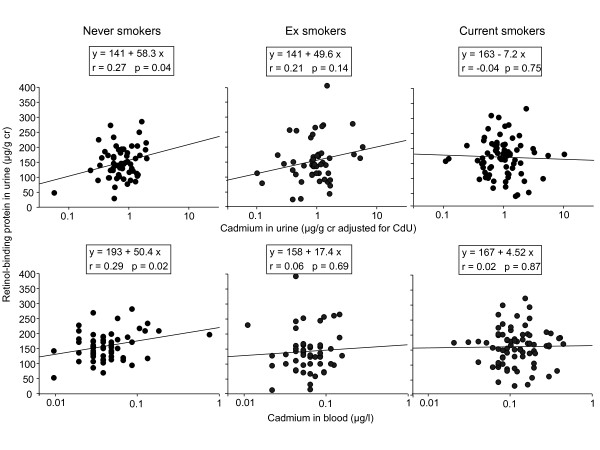
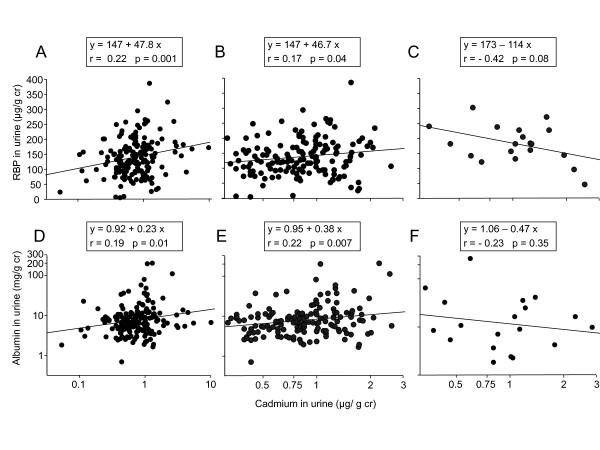
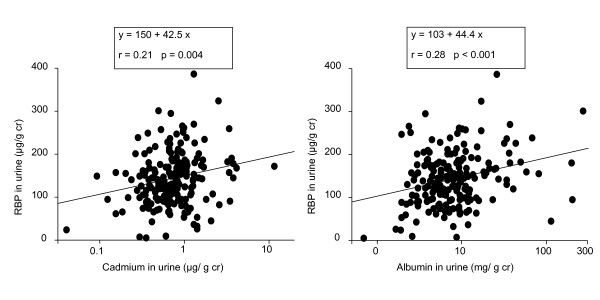
Results: The medians (interquartile range) of B-Cd (μg/l) and U-Cd (μg/g creatinine) were 0.80 (0.45-1.16) and 0.70 (0.40-1.3) in smelter workers and 0.66 (0.47-0.87) and 0.55 (0.40-0.90) in blanket factory workers, respectively. Occupation had no influence on these values, which varied mainly with smoking habits. In univariate analysis, concentrations of RBP and protein HC in urine were significantly correlated with both U-Cd and B-Cd but these associations were substantially weakened by the adjustment for current smoking and the residual influence of diuresis after correction for urinary creatinine. Albumin in urine did not correlate with B-Cd but was consistently associated with U-Cd through a relationship, which was unaffected by smoking or diuresis. Further analyses showed that RBP and albumin in urine mutually distort their associations with U-Cd and that the relationship between RBP and Cd in urine was almost the replicate of that linking RBP to albumin
Conclusions: Associations between proteinuria and low-level urinary Cd should be interpreted with caution as they appear to be largely driven by diuresis, current smoking and probably also the co-excretion of Cd with plasma proteins.
Figures
References
-
- Nordberg G, Nogawa K, Nordberg M, Friberg L. In: Handbook on toxicilogy of metals. Nordberg G, Fowler B, Nordberg M, Friberg, L, editor. Academic Press. New York; 2007. Cadmium; pp. 65–78.
-
- Järup L, Berglund M, Elinder CG, Nordberg G, Vahter M. Health effects of cadmium exposure - a review of the literature and a risk estimate. Scand J Work Environ Health. 1998;24(Suppl 1):1–51. - PubMed
-
- Bernard A. Renal dysfunction induced by cadmium: biomarkers of critical effects. Biometals. 2004;17:519–523. - PubMed
Publication types
MeSH terms
Substances
LinkOut - more resources
Full Text Sources
Medical
