


Maturation of human dendritic cells with Saccharomyces cerevisiae (yeast) reduces the number and function of regulatory T cells and enhances the ratio of antigen-specific effectors to regulatory T cells
- PMID: 21569810
- PMCID: PMC3134265
- DOI: 10.1016/j.vaccine.2011.04.101
Maturation of human dendritic cells with Saccharomyces cerevisiae (yeast) reduces the number and function of regulatory T cells and enhances the ratio of antigen-specific effectors to regulatory T cells
Abstract
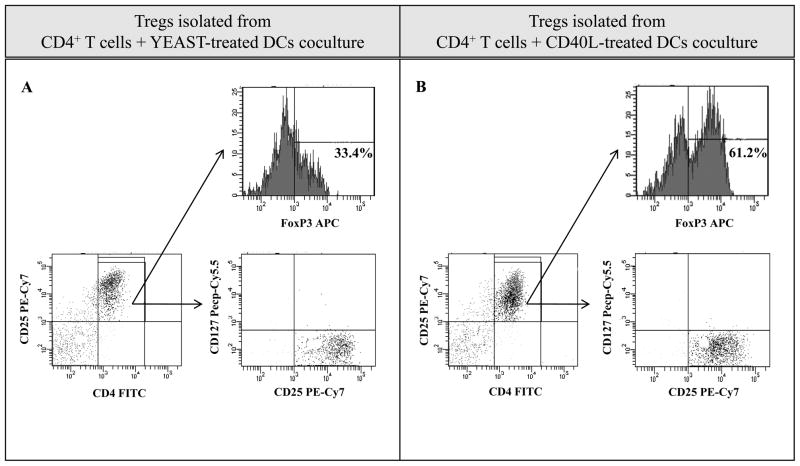
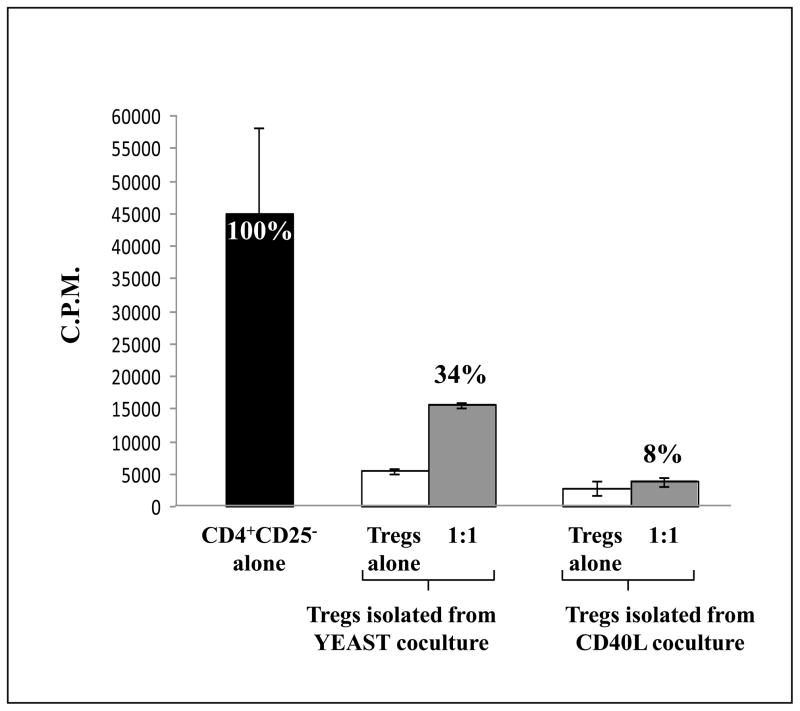
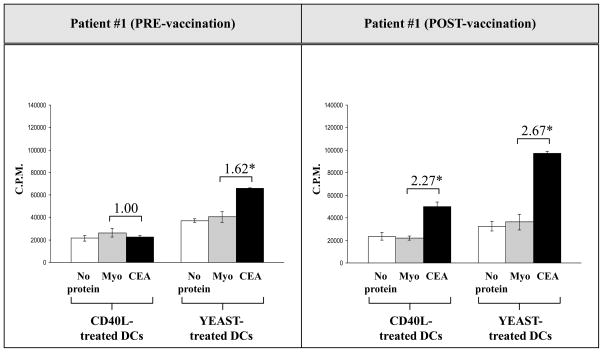
We compared the effects of yeast-treated human dendritic cells (DCs) with CD40L-matured human DCs for the induction of effector cells and the number and functionality of CD4(+)CD25(+)CD127(-)FoxP3(+) regulatory T cells (Tregs). DCs were treated with yeast or CD40L and cocultured with isolated autologous CD4(+) T cells. CD4(+)CD25(+)CD127(-) T cells isolated from the coculture of CD4(+) T cells plus yeast-treated DCs (yeast coculture) had a lower expression of FoxP3 and decreased suppressive function compared to CD4(+)CD25(+)CD127(-) T cells isolated from the coculture of CD4(+) T cells plus CD40L-treated DCs (CD40L coculture). Also, compared to the CD40L coculture, the yeast coculture showed increases in the ratio of CD4(+)CD25(+) activated T cells to Tregs and in the production of Th1-related cytokines (IL-2, TNF-α, IFN-γ) and IL-6. In addition, yeast-treated DCs used as antigen-presenting cells (APCs) incubated with the tumor antigen CEA enhanced the proliferation of CEA-specific CD4(+) T cells compared to the use of CD40L-matured DCs used as APCs. This is the first study to report on the role of yeast-treated/matured human DCs in reducing Treg frequency and functionality and in enhancing effector to Treg ratios. These results provide an additional rationale for the use of yeast as a vector in cancer vaccines.
Published by Elsevier Ltd.
Figures
References
-
- Arthur JF, Butterfield LH, Roth MD, Bui LA, Kiertscher SM, Lau R, et al. A comparison of gene transfer methods in human dendritic cells. Cancer Gene Ther. 1997;4(1):17–25. - PubMed
-
- Bello-Fernandez C, Matyash M, Strobl H, Pickl WF, Majdic O, Lyman SD, et al. Efficient retrovirus-mediated gene transfer of dendritic cells generated from CD34+ cord blood cells under serum-free conditions. Hum Gene Ther. 1997;8(14):1651–8. - PubMed
-
- Neering SJ, Hardy SF, Minamoto D, Spratt SK, Jordan CT. Transduction of primitive human hematopoietic cells with recombinant adenovirus vectors. Blood. 1996;88(4):1147–55. - PubMed
-
- Philip R, Brunette E, Ashton J, Alters S, Gadea J, Sorich M, et al. Transgene expression in dendritic cells to induce antigen-specific cytotoxic T cells in healthy donors. Cancer Gene Ther. 1998;5(4):236–46. - PubMed
-
- Szabolcs P, Gallardo HF, Ciocon DH, Sadelain M, Young JW. Retrovirally transduced human dendritic cells express a normal phenotype and potent T-cell stimulatory capacity. Blood. 1997;90(6):2160–7. - PubMed
Publication types
MeSH terms
Substances
Grants and funding
LinkOut - more resources
Full Text Sources
Other Literature Sources
Research Materials
Miscellaneous
