


Misfolded protein aggregates: mechanisms, structures and potential for disease transmission
- PMID: 21571086
- PMCID: PMC3175247
- DOI: 10.1016/j.semcdb.2011.04.002
Misfolded protein aggregates: mechanisms, structures and potential for disease transmission
Abstract
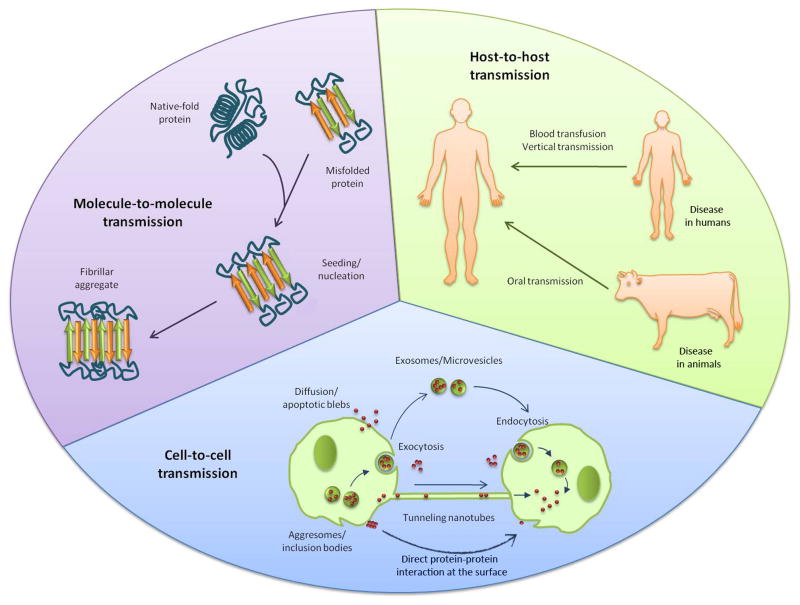
Some of the most prevalent human degenerative diseases appear as a result of the misfolding and aggregation of proteins. Compelling evidence suggest that misfolded protein aggregates play an important role in cell dysfunction and tissue damage, leading to the disease. Prion protein (Prion diseases), amyloid-beta (Alzheimer's disease), alpha-synuclein (Parkinson's disease), Huntingtin (Huntington's disease), serum amyloid A (AA amyloidosis) and islet amyloid polypeptide (type 2 diabetes) are some of the proteins that trigger disease when they get misfolded. The recent understanding of the crucial role of misfolded proteins as well as the structural requirements and mechanism of protein misfolding have raised the possibility that these diseases may be transmissible by self-propagation of the protein misfolding process in a similar way as the infamous prions transmit prion diseases. Future research in this field should aim to clarify this possibility and translate the knowledge of the basic disease mechanisms into development of novel strategies for early diagnosis and efficient treatment.
Copyright © 2011 Elsevier Ltd. All rights reserved.
Figures
References
-
- Soto C. Unfolding the role of Protein Misfolding in Neurodegenerative Diseases. Nature Rev Neurosci. 2003;4:49–60. - PubMed
-
- Soto C, Estrada LD. Protein misfolding and neurodegeneration. Arch Neurol. 2008;65:184–9. - PubMed
-
- Selkoe DJ. Amyloid beta-protein and the genetics of Alzheimer’s disease. J Biol Chem. 1996;271:18295–8. - PubMed
-
- Buxbaum JN, Tagoe CE. The genetics of the amyloidoses. Annu Rev Med. 2000;51:543–69. - PubMed
-
- Hardy J. Genetic dissection of primary neurodegenerative diseases. Biochem Soc Symp. 2001:51–7. - PubMed
Publication types
MeSH terms
Substances
Grants and funding
LinkOut - more resources
Full Text Sources
Other Literature Sources
