


Does the amount of fat mass predict age-related loss of lean mass, muscle strength, and muscle quality in older adults?
- PMID: 21572082
- PMCID: PMC3184893
- DOI: 10.1093/gerona/glr070
Does the amount of fat mass predict age-related loss of lean mass, muscle strength, and muscle quality in older adults?
Abstract
Background: An excessive amount of adipose tissue may contribute to sarcopenia and may be one mechanism underlying accelerated loss of muscle mass and strength with aging. We therefore examined the association of baseline total body fat with changes in leg lean mass, muscle strength, and muscle quality over 7 years of follow-up and whether this link was explained by adipocytokines and insulin resistance.
Methods: Data were from 2,307 men and women, aged 70-79 years, participating in the Health, Aging, and Body Composition study. Total fat mass was acquired from dual energy X-ray absorptiometry. Leg lean mass was assessed by dual energy X-ray absorptiometry in Years 1, 2, 3, 4, 5, 6, and 8. Knee extension strength was measured by isokinetic dynamometer in Years 1, 2, 4, 6, and 8. Muscle quality was calculated as muscle strength divided by leg lean mass.
Results: Every SD greater fat mass was related to 1.3 kg more leg lean mass at baseline in men and 1.5 kg in women (p < .01). Greater fat mass was also associated with a greater decline in leg lean mass in both men and women (0.02 kg/year, p < .01), which was not explained by higher levels of adipocytokines and insulin resistance. Larger fat mass was related to significantly greater muscle strength but significantly lower muscle quality at baseline (p < .01). No significant differences in decline of muscle strength and quality were found.
Conclusions: High fatness was associated with lower muscle quality, and it predicts accelerated loss of lean mass. Prevention of greater fatness in old age may decrease the loss of lean mass and maintain muscle quality and thereby reducing disability and mobility impairments.
Figures
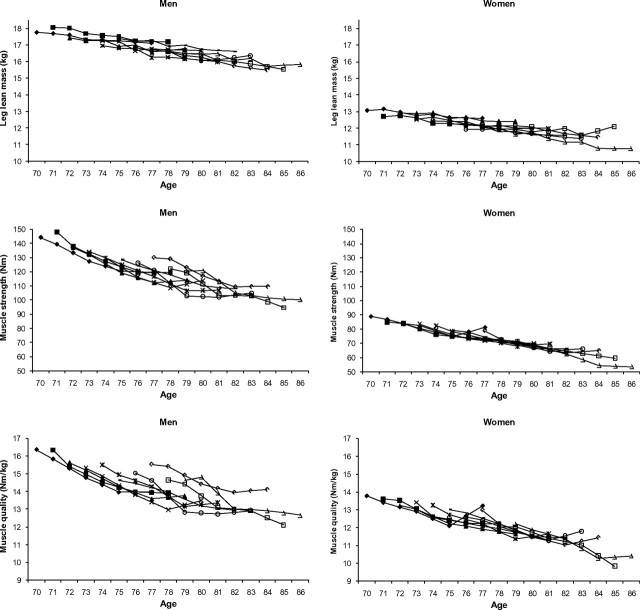
 , birth cohort 70;
  , birth cohort 71;
  , birth cohort 72;
  , birth cohort 73;
  , birth cohort 74;
  , birth cohort 76;
  , birth cohort 77;
  , birth cohort 78;
  , birth cohort 79.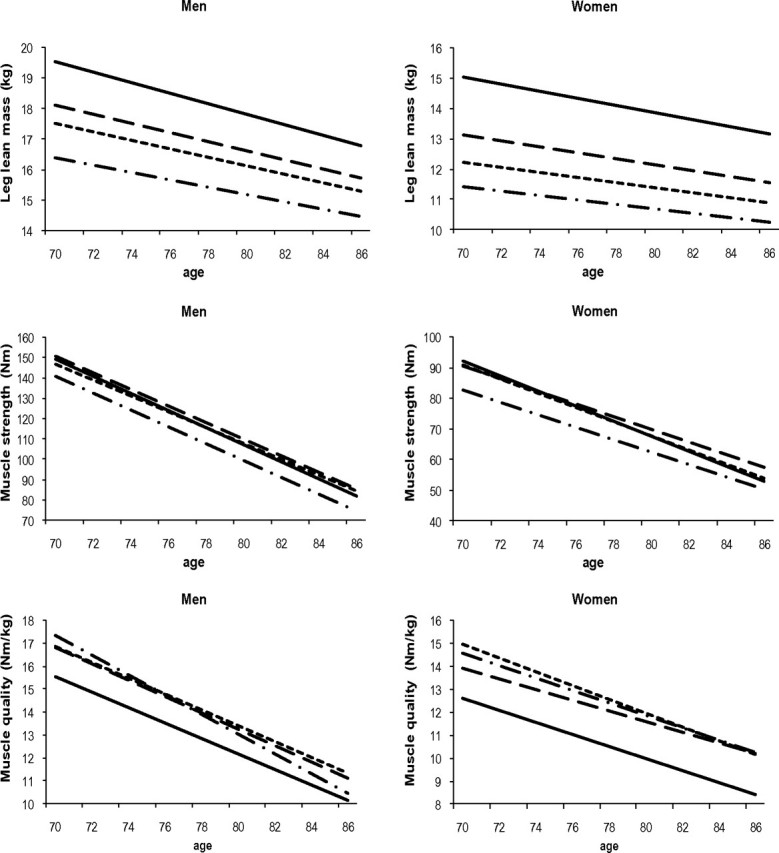
 ; 3=
; 3=  ; 4 = high = solid line.
References
-
- Janssen I, Heymsfield SB, Ross R. Low relative skeletal muscle mass (sarcopenia) in older persons is associated with functional impairment and physical disability. J Am Geriatr Soc. 2002;50:889–896. - PubMed
-
- Visser M, Goodpaster BH, Kritchevsky SB, et al. Muscle mass, muscle strength, and muscle fat infiltration as predictors of incident mobility limitations in well-functioning older persons. J Gerontol A Biol Sci Med Sci. 2005;60:324–333. - PubMed
-
- Goodpaster BH, Park SW, Harris TB, et al. The loss of skeletal muscle strength, mass, and quality in older adults: the health, aging and body composition study. J Gerontol A Biol Sci Med Sci. 2006;61:1059–1064. - PubMed
-
- Hughes VA, Frontera WR, Wood M, et al. Longitudinal muscle strength changes in older adults: influence of muscle mass, physical activity, and health. J Gerontol Biol Sci. 2001;56:B209–B217. - PubMed
-
- Lauretani F, Russo CR, Bandinelli S, et al. Age-associated changes in skeletal muscles and their effect on mobility: an operational diagnosis of sarcopenia. J Appl Physiol. 2003;95:1851–1860. - PubMed
