


Association of recent HIV infection and in-utero HIV-1 transmission
- PMID: 21572305
- PMCID: PMC3263827
- DOI: 10.1097/QAD.0b013e3283489d45
Association of recent HIV infection and in-utero HIV-1 transmission
Abstract
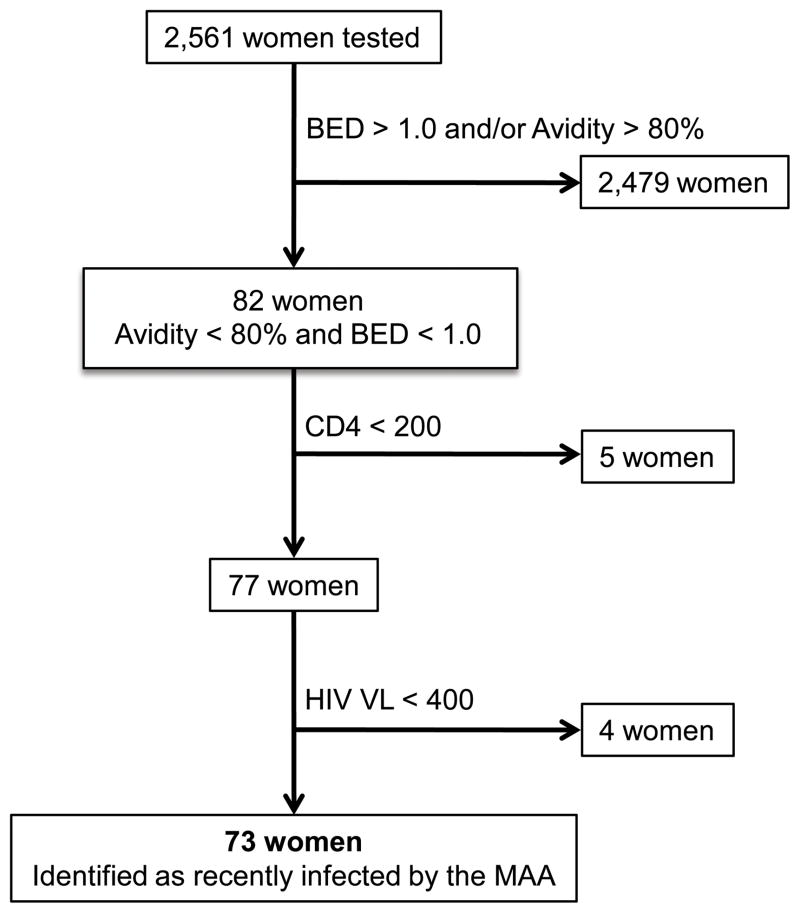
Objective: We previously developed a multiassay algorithm (MAA) to identify recent HIV infection that includes the BED-capture enzyme immunoassay, an avidity assay based on the Genetic Systems HIV-1/HIV-2 + O enzyme immunoassay, CD4 cell count, and HIV viral load. We used this MAA to evaluate the association between recent maternal HIV infection and in-utero transmission of HIV.
Methods: Plasma samples were collected at delivery from 2561 HIV-infected women in the postexposure prophylaxis of infants-Malawi trial. The MAA described above was used to identify women with recent HIV infection. Logistic regression models assessed association between recent HIV infection and in-utero HIV transmission (defined as a positive infant HIV DNA test at birth).
Results: Seventy-three women were identified as recently infected using the MAA. Those women were younger and had lower parity than women who were identified as not recently infected using the MAA (P < 0.0001 for age and parity). The frequency of in-utero HIV transmission was 17.8% among women identified as recently infected, compared with 6.7% among women identified as not recently infected (13/73 vs. 166/2488, P = 0.001). In a multivariate model, three factors were independently associated with in-utero HIV transmission: recent infection [adjusted odds ratio (AOR): 2.49, 95% confidence interval (CI): 1.30-4.78, P = 0.006], log(10) HIV viral load at delivery (AOR: 2.01, 95% CI: 1.60-2.51, P < 0.0001), and younger age (per 10 year increase, AOR: 0.66, 95% CI: 0.43-0.93, P = 0.02).
Conclusion: Results obtained using a MAA suggest that recent maternal HIV acquisition is strongly associated with in-utero HIV transmission, independent of HIV viral load at delivery.
Conflict of interest statement
None of the authors has a commercial or other association that might pose a conflict of interest.
Figures
References
-
- Interagency Task Team on Prevention of HIV Infection in Pregnant Women M, and their Children. [Accessed October 2010];Guidance on global scale-up of the prevention of mother-to-child transmission of HIV. 2007 http://www.who.int/hiv/pub/guidelines/pmtct_scaleup2007/en/index.html.
-
- Dunn DN, ML, Ades AE, Peckham CS. Risk of human immunodeficiency virus type 1 transmission through breastfeeding. Lancet. 1992;340:585–588. - PubMed
-
- Liang K, Gui X, Zhang YZ, Zhuang K, Meyers K, Ho DD. A case series of 104 women infected with HIV-1 via blood transfusion postnatally: high rate of HIV-1 transmission to infants through breast-feeding. J Infect Dis. 2009;200(5):682–6. - PubMed
-
- Lockman S, Creek T. Acute maternal HIV infection during pregnancy and breast-feeding: substantial risk to infants. J Infect Dis. 2009;200(5):667–9. - PubMed
-
- Moodley D, Esterhuizen TM, Pather T, Chetty V, Ngaleka L. High HIV incidence during pregnancy: compelling reason for repeat HIV testing. AIDS. 2009;23(10):1255–9. - PubMed
Publication types
MeSH terms
Substances
Grants and funding
LinkOut - more resources
Full Text Sources
Medical
Research Materials
