. 2011 Jun;13(6):722-7.
doi: 10.1038/ncb2254. Epub 2011 May 15.

The Rho GEFs LARG and GEF-H1 regulate the mechanical response to force on integrins

Affiliations

The Rho GEFs LARG and GEF-H1 regulate the mechanical response to force on integrins

Christophe Guilluy et al. Nat Cell Biol. 2011 Jun.

Abstract

How individual cells respond to mechanical forces is of considerable interest to biologists as force affects many aspects of cell behaviour. The application of force on integrins triggers cytoskeletal rearrangements and growth of the associated adhesion complex, resulting in increased cellular stiffness, also known as reinforcement. Although RhoA has been shown to play a role during reinforcement, the molecular mechanisms that regulate its activity are unknown. By combining biochemical and biophysical approaches, we identified two guanine nucleotide exchange factors (GEFs), LARG and GEF-H1, as key molecules that regulate the cellular adaptation to force. We show that stimulation of integrins with tensional force triggers activation of these two GEFs and their recruitment to adhesion complexes. Surprisingly, activation of LARG and GEF-H1 involves distinct signalling pathways. Our results reveal that LARG is activated by the Src family tyrosine kinase Fyn, whereas GEF-H1 catalytic activity is enhanced by ERK downstream of a signalling cascade that includes FAK and Ras.


Figures
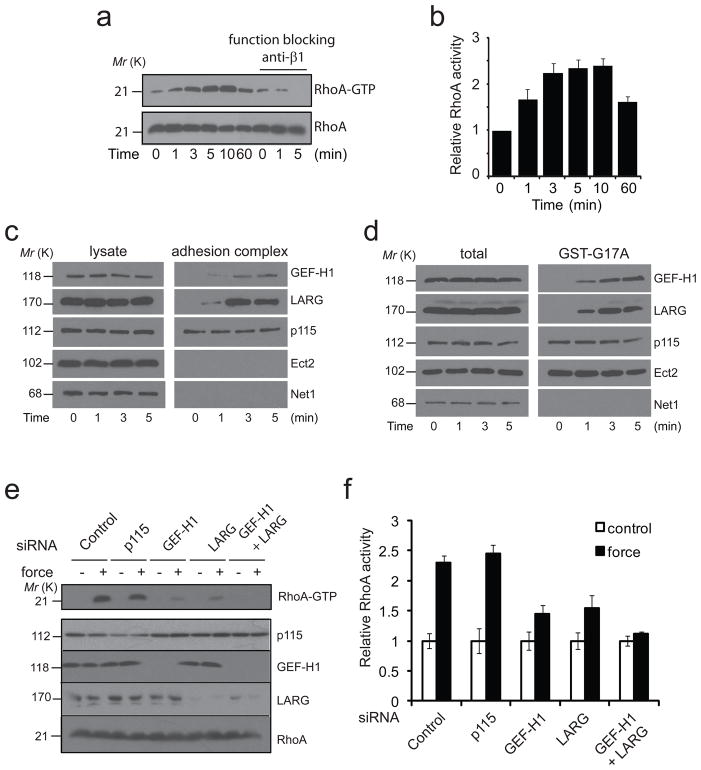
Figure 1
Figure 1. LARG and GEF-H1 activate RhoA in response to force
a, b, REF52 cells were incubated without or with the function blocking anti-β1antibody (P4C10) for 30 min and then with FN-coated magnetic beads. A permanent magnet was used to generate tensional force for different amounts of time. Active RhoA (RhoA-GTP) was isolated with GST-RBD and analyzed by western blot (a). Corresponding densitometric analysis of RhoA-GTP normalized to RhoA levels and expressed as relative to the control in the absence of stimulation by force (error bars represent s.e.m., n=5) (b). c, REF52 cells were incubated 30 min with FN-coated beads and stimulated with tensional force using a permanent magnet for different amounts of time before cell lysis. After magnetic separation of the adhesion complex fraction, the lysate and the adhesion complex fraction were analyzed by western blot. All results are representative of at least three independent experiments. d, REF52 cells were incubated 30 min with FN-coated beads and stimulated with tensional force using a permanent magnet for different amounts of time before cell lysis. Active GEFs were sedimented with GST-RhoA(G17A) and analyzed by western blot. All results are representative of at least three independent experiments. e, f, REF52 cells were transfected 48 h with control siRNA or siRNA targeting p115, GEF-H1, LARG or both GEF-H1 and LARG, and incubated 30 min with FN-coated beads. After stimulation with tensional force for 5 min cells were lysed and active RhoA (RhoA-GTP) was isolated with GST-RBD and analyzed by western blot (e). f, corresponding densitometric analysis. RhoA-GTP is normalized to RhoA levels and expressed relative to the control (error bars represent s.e.m., n=4). Uncropped images of blots are shown in Supplementary Fig. S5.
Figure 2
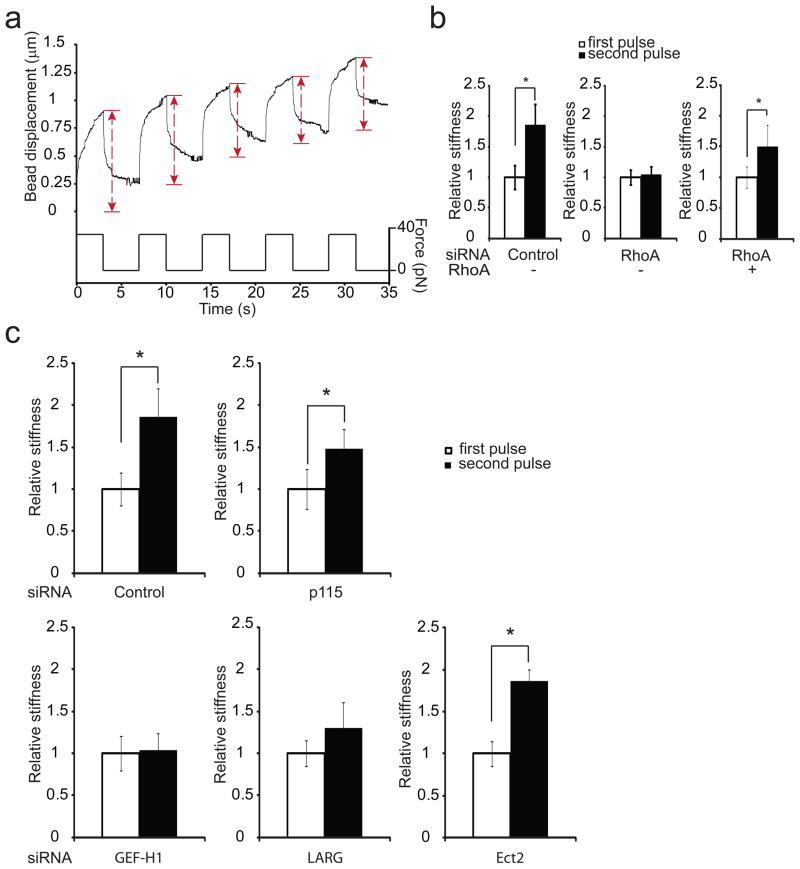
Figure 2. LARG and GEF-H1 mediate cellular stiffening in response to force applied on integrins
a, Typical displacement of a FN-coated bead bound to a REF52 fibroblast during force pulse application. b, change in stiffness during 2 force pulses applied to FN-coated beads bound to REF52 cells transfected 48 h with control siRNA or RhoA siRNA or RhoA siRNA and a siRNA-resistant mutant of RhoA (myc-RhoA) (error bars represent s.e.m., n= 20; * p<0.01). c, Change in stiffness during 2 force pulses applied to FN-coated beads bound to REF52 cells transfected 48 h with control siRNA or siRNA targeting p115, GEF-H1, LARG, Ect2 (error bars represent s.e.m., n=20,* p<0.05).
Figure 3
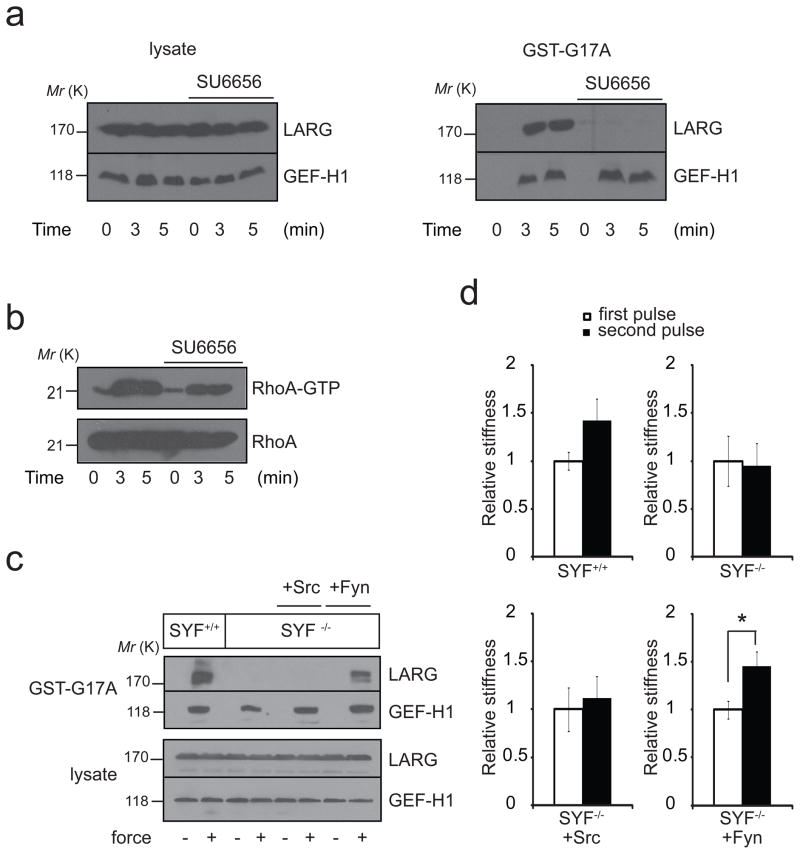
Figure 3. Fyn mediates LARG activation in response to force
a, REF52 cells untreated or treated with SU6656 (2.5 μM for 30 min) were incubated with FN-coated beads and stimulated with tensional forces for different amounts of time. Active LARG and GEF-H1 were sedimented with GST-RhoA(G17A) and analyzed by western blot. b, REF52 cells untreated or treated with SU6656 (2.5 μM for 30 min) were incubated with FN-coated beads. After stimulation with tensional force for different amounts of time, cells were lysed and active RhoA (RhoA-GTP) was isolated with GST-RBD and analyzed by western blot. c, SYF−/− cells and SYF cells re-expressing Src, Yes and Fyn (SYF+/+) or re-expressing Src or Fyn were incubated with FN-coated beads and stimulated with tensional forces for 3 min. Active LARG and GEF-H1 were pulled down with GST-RhoA(G17A) and analyzed by western blot. d, Change in stiffness during 2 force pulses applied to FN-coated beads bound to SYF−/− cells and SYF cells re-expressing Src, Yes and Fyn (SYF+/+) or re-expressing either Src or Fyn (error bars represent s.e.m., *p=0.01; n=20). Uncropped images of blots are shown in Supplementary Fig. S5.
Figure 4
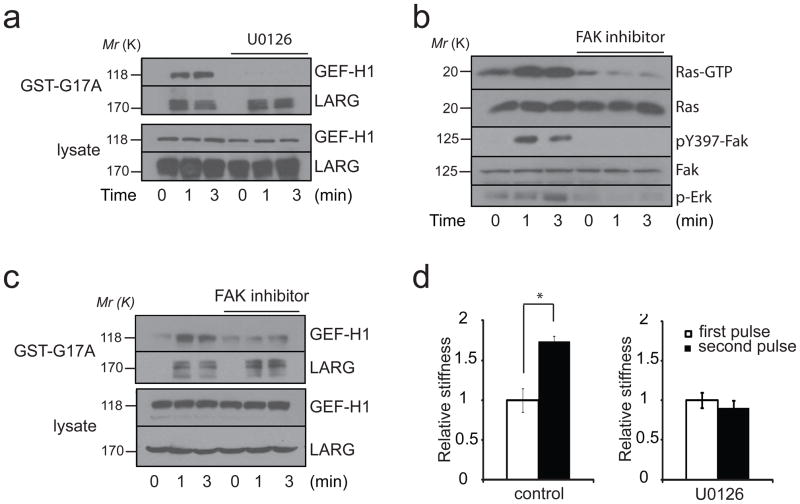
Figure 4. ERK activates GEF-H1 in response to force
a, REF52 cells untreated or treated with U0126 (5 μM for 30 min) were incubated with FN-coated beads and stimulated with tensional forces for different amounts of time. Active LARG and GEF-H1 were sedimented with GST-RhoA(G17A) and analyzed by western blot. b, REF52 cells untreated or treated with the FAK inhibitor 14 (5 μM for 30 min) were incubated with FN-coated beads and stimulated with tensional forces for different amounts of time. Active Ras (Ras-GTP) was sedimented with Raf1-GST. Phosphorylated FAK (Tyr397), phosphorylated ERK (Thr202-Tyr204), total FAK were analyzed by western blot. c, REF52 cells untreated or treated with the FAK inhibitor 14 (5 μM for 30 min) were incubated with FN-coated beads and stimulated with tensional forces for different amounts of time. Active LARG and GEF-H1 were sedimented with GST-RhoA(G17A) and analyzed by western blot. d, change in stiffness during 2 force pulses applied to FN-coated beads bound to REF52 cells treated with or without U0126 (5 μM for 30 min) (error bars represent s.e.m., *p<0.01; n=20). Uncropped images of blots are shown in Supplementary Fig. S5.

References

    1. Hoffman BD, Crocker JC. Cell mechanics: dissecting the physical responses of cells to force. Annu Rev Biomed Eng. 2009;11:259–288. - PubMed
    1. Wang N, Butler JP, Ingber DE. Mechanotransduction across the cell surface and through the cytoskeleton. Science. 1993;260:1124–1127. - PubMed
    1. Matthews BD, Overby DR, Mannix R, Ingber DE. Cellular adaptation to mechanical stress: role of integrins, Rho, cytoskeletal tension and mechanosensitive ion channels. J Cell Sci. 2006;119:508–518. - PubMed
    1. Choquet D, Felsenfeld DP, Sheetz MP. Extracellular matrix rigidity causes strengthening of integrin-cytoskeleton linkages. Cell. 1997;88:39–48. - PubMed
    1. Zhao XH, Laschinger C, Arora P, Szaszi K, Kapus A, McCulloch CA. Force activates smooth muscle alpha-actin promoter activity through the Rho signaling pathway. J Cell Sci. 2007;120:1801–1809. - PubMed

Publication types

MeSH terms