


Autism spectrum disorders and identified toxic land fills: co-occurrence across States
- PMID: 21572830
- PMCID: PMC3091342
- DOI: 10.4137/ehi.s830
Autism spectrum disorders and identified toxic land fills: co-occurrence across States
Abstract
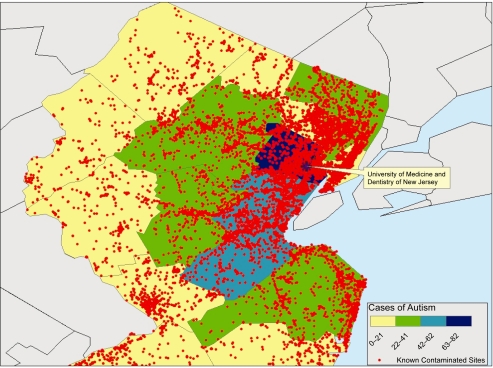
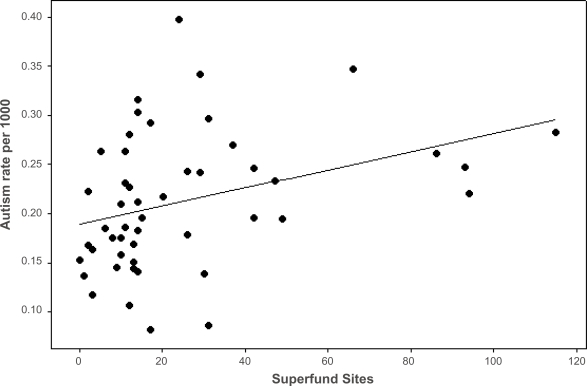
It is believed that gene by environmental interactions contribute to the pathogenesis of autism spectrum disorders (ASD). We hypothesize that ASD are associated with early and repeated exposures to any of a number of toxicants or mixtures of toxicants. It is the cumulative effects of these repeated exposures acting upon genetically susceptible individuals that lead to the phenotypes of ASD. We report our initial observations of a considerable overlap of identified toxic landfills in the State of New Jersey and the residence of an ASD cohort, and a correlation between the identified toxic Superfund sites on each U.S. state and the total number of diagnosed cases of ASD in those states. The residence of 495 ASD patients in New Jersey by zip code and the toxic landfill sites were plotted on a map of Northern New Jersey. The area of highest ASD cases coincides with the highest density of toxic landfill sites while the area with lowest ASD cases has the lowest density of toxic landfill sites. Furthermore, the number of toxic Superfund sites and autism rate across 49 of the 50 states shows a statistically significant correlation (i.e. the number of identified superfund sites correlates with the rate of autism per 1000 residents in 49 of the states (p = 0.015; excluding the state of Oregon). These significant observations call for further organized studies to elucidate possible role(s) of environmental toxicants contributing to the pathogenesis of ASD.
Keywords: autism spectrum disorders; environmental toxins; superfund sites; toxic landfills.
Figures
References
-
- Palmer RF, Blanchard S, Stein Z, Mandell D, Miller C. Environmental mercury release, special education rates, and autism disorder: an ecological study of Texas. Health Place. 2006;12(2):203–9. - PubMed
-
- Palmer RF, Blanchard S, Wood R. Proximity to point sources of environmental mercury release as a predictor of autism prevalence. Health Place. 2008 doi:10.1016/j.healthplace.2008.02.001. - PubMed
-
- Windham GC, Zhang L, Gunier R, Croen LA, Grether JK. Autism spectrum disorders in relation to distribution of hazardous air pollutants in the San Francisco bay area. Environ Health Perspect. 2006;114(9):1438–44. http://www.state.nj.us/dep/srp/kcs-nj/www.IDE-Adata.org www.census.gov. - PMC - PubMed
LinkOut - more resources
Full Text Sources
Miscellaneous
