


A new model and method for understanding Wolbachia-induced cytoplasmic incompatibility
- PMID: 21572955
- PMCID: PMC3091874
- DOI: 10.1371/journal.pone.0019757
A new model and method for understanding Wolbachia-induced cytoplasmic incompatibility
Abstract
Wolbachia are intracellular bacteria transmitted almost exclusively vertically through eggs. In response to this mode of transmission, Wolbachia strategically manipulate their insect hosts' reproduction. In the most common manipulation type, cytoplasmic incompatibility, infected males can only mate with infected females, but infected females can mate with all males. The mechanism of cytoplasmic incompatibility is unknown; theoretical and empirical findings need to converge to broaden our understanding of this phenomenon. For this purpose, two prominent models have been proposed: the mistiming-model and the lock-key-model. The former states that Wolbachia manipulate sperm of infected males to induce a fatal delay of the male pronucleus during the first embryonic division, but that the bacteria can compensate the delay by slowing down mitosis in fertilized eggs. The latter states that Wolbachia deposit damaging "locks" on sperm DNA of infected males, but can also provide matching "keys" in infected eggs to undo the damage. The lock-key-model, however, needs to assume a large number of locks and keys to explain all existing incompatibility patterns. The mistiming-model requires fewer assumptions but has been contradicted by empirical results. We therefore expand the mistiming-model by one quantitative dimension to create the new, so-called goalkeeper-model. Using a method based on formal logic, we show that both lock-key- and goalkeeper-model are consistent with existing data. Compared to the lock-key-model, however, the goalkeeper-model assumes only two factors and provides an idea of the evolutionary emergence of cytoplasmic incompatibility. Available cytological evidence suggests that the hypothesized second factor of the goalkeeper-model may indeed exist. Finally, we suggest empirical tests that would allow to distinguish between the models. Generalizing our results might prove interesting for the study of the mechanism and evolution of other host-parasite interactions.
Conflict of interest statement
Figures
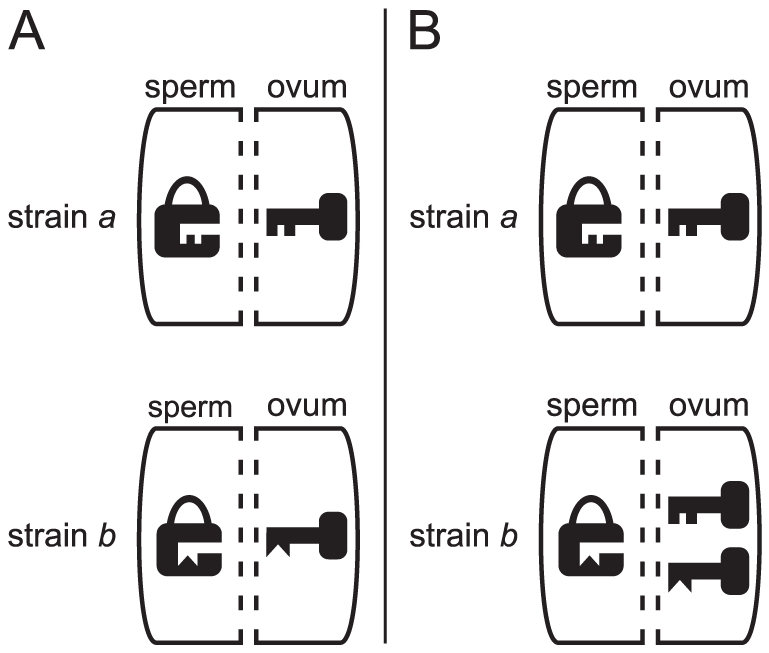
 and
and  are bidirectionally incompatible: Neither
  nor
nor  has the key to each other's lock. (B)
  and
and  are unidirectionally incompatible:
  has the key to
  's lock, but
  does not have the key to
  's lock.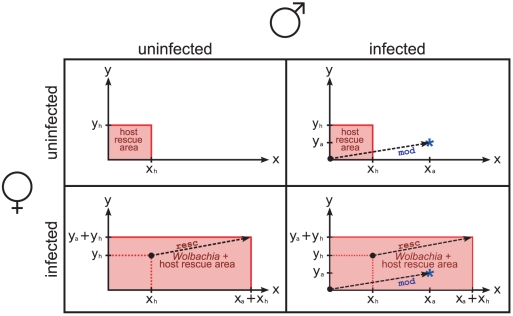
 and
and  , are involved in the generation of CI. Wolbachia contribute
  to factor
  and
and  to factor
  in equal amounts during modification in males and rescue in females (dashed arrows). Hosts contribute the net host contribution
  to factor
  and
and  to factor
  in females only. Rescue occurs within the red areas, either due to hosts only (top row) or in combination with Wolbachia (bottom row). The blue asterisk shows the modification by Wolbachia (right column). CI occurs only if this blue asterisk does not lie within the rescue area because this implies that at least one of the factors
  or
or  is produced at greater quantity in males than in females (top right).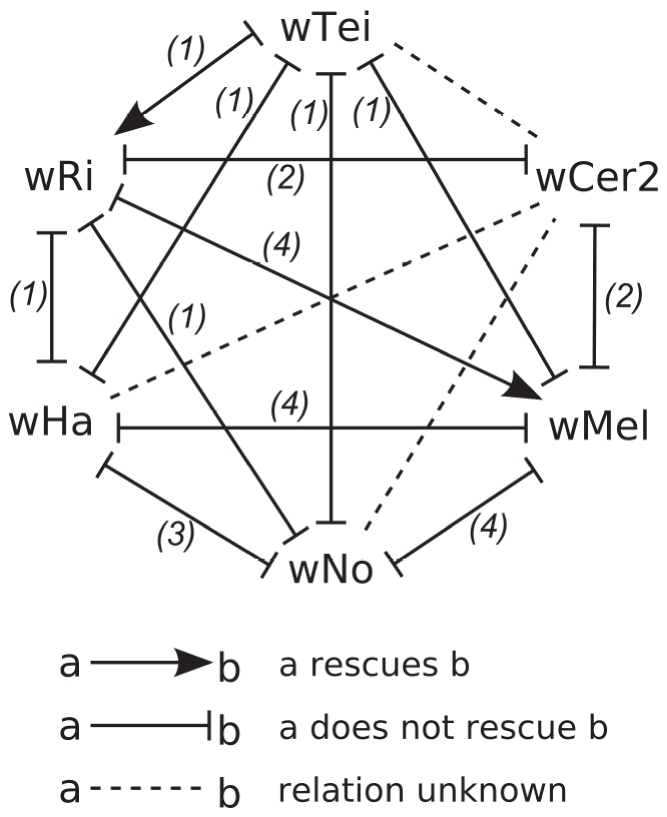
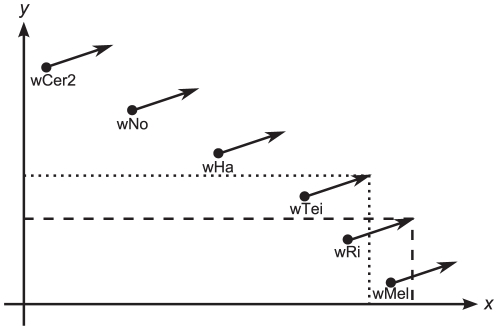
 and
and  ). The black arrow represents the host contribution to rescue. The contribution of a strain to the two resc factors equals its own contribution plus the net host contribution. When both resc factors exceed both mod factors in quantity, rescue is successful. Thus wTei with the help of the net host contribution rescues wRi (indicated by wRi being within the dotted frame). In contrast, wRi can rescue wMel but not wTei (indicated by wMel but not wTei being within the dashed frame).
References
-
- Werren JH. Biology of Wolbachia. Ann Rev Entomol. 1997;42:587–609. - PubMed
-
- Werren JH, Baldo L, Clark ME. Wolbachia: master manipulators of invertebrate biology. Nat Rev Microbiol. 2008;6:741–751. - PubMed
-
- Lassy CW, Karr TL. Cytological analysis of fertilization and early embryonic development in incompatible crosses of Drosophila simulans. Mech Dev. 1996;57:47–58. - PubMed
-
- Callaini G, Dallai R, Riparbelli MG. Wolbachia-induced delay of paternal chromatin condensation does not prevent maternal chromosomes from entering anaphase in incompatible crosses of Drosophila simulans. J Cell Sci. 1997;110(Pt 2):271–280. - PubMed
-
- Telschow A, Hammerstein P, Werren J. The effect of Wolbachia versus genetic incompatibilities on reinforcement and speciation. Evolution. 2005;59:1607–1619. - PubMed
Publication types
MeSH terms
LinkOut - more resources
Full Text Sources
