


Field effectiveness of pandemic and 2009-2010 seasonal vaccines against 2009-2010 A(H1N1) influenza: estimations from surveillance data in France
- PMID: 21573005
- PMCID: PMC3091864
- DOI: 10.1371/journal.pone.0019621
Field effectiveness of pandemic and 2009-2010 seasonal vaccines against 2009-2010 A(H1N1) influenza: estimations from surveillance data in France
Abstract
Background: In this study, we assess how effective pandemic and trivalent 2009-2010 seasonal vaccines were in preventing influenza-like illness (ILI) during the 2009 A(H1N1) pandemic in France. We also compare vaccine effectiveness against ILI versus laboratory-confirmed pandemic A(H1N1) influenza, and assess the possible bias caused by using non-specific endpoints and observational data.
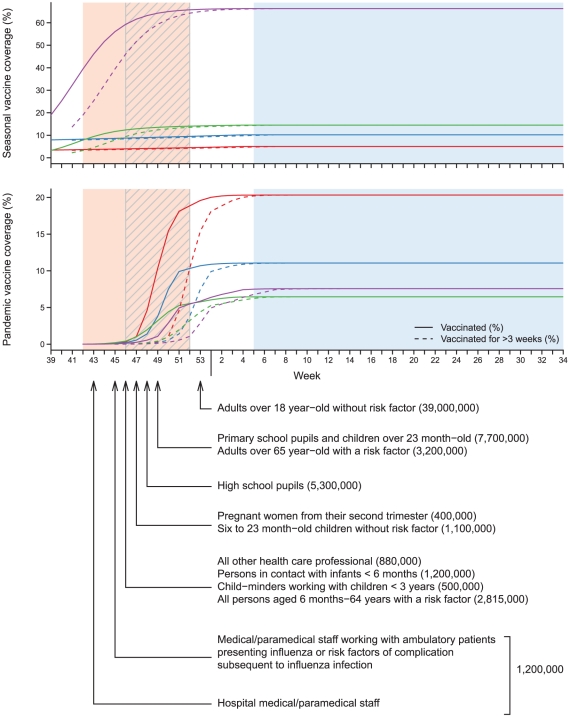
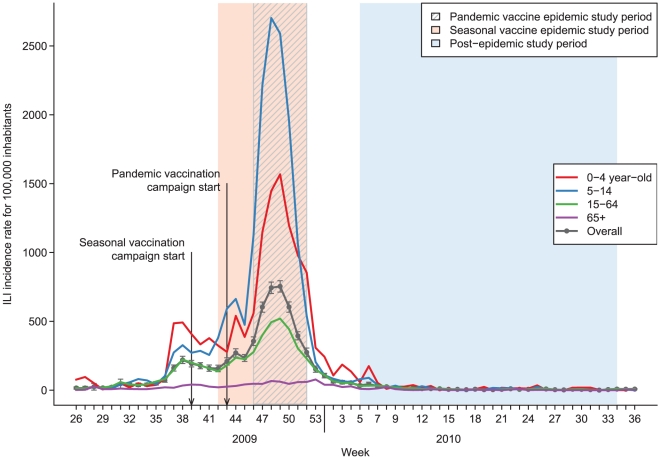
Methodology and principal findings: We estimated vaccine effectiveness by using the following formula: VE = (PPV-PCV)/(PPV(1-PCV)) × 100%, where PPV is the proportion vaccinated in the population and PCV the proportion of vaccinated influenza cases. People were considered vaccinated three weeks after receiving a dose of vaccine. ILI and pandemic A(H1N1) laboratory-confirmed cases were obtained from two surveillance networks of general practitioners. During the epidemic, 99.7% of influenza isolates were pandemic A(H1N1). Pandemic and seasonal vaccine uptakes in the population were obtained from the National Health Insurance database and by telephonic surveys, respectively. Effectiveness estimates were adjusted by age and week. The presence of residual biases was explored by calculating vaccine effectiveness after the influenza period. The effectiveness of pandemic vaccines in preventing ILI was 52% (95% confidence interval: 30-69) during the pandemic and 33% (4-55) after. It was 86% (56-98) against confirmed influenza. The effectiveness of seasonal vaccines against ILI was 61% (56-66) during the pandemic and 19% (-10-41) after. It was 60% (41-74) against confirmed influenza.
Conclusions: The effectiveness of pandemic vaccines in preventing confirmed pandemic A(H1N1) influenza on the field was high, consistently with published findings. It was significantly lower against ILI. This is unsurprising since not all ILI cases are caused by influenza. Trivalent 2009-2010 seasonal vaccines had a statistically significant effectiveness in preventing ILI and confirmed pandemic influenza, but were not better in preventing confirmed pandemic influenza than in preventing ILI. This lack of difference might be indicative of selection bias.
Conflict of interest statement
Figures
References
-
- Haut Conseil de la Santé Publique. List of prioritary target groups for pandemic vaccination (updated December 1, 2009). 2009. Available: http://www.sante-sports.gouv.fr/IMG/pdf/Personnes_invitees_a_se_faire_va.... Accessed 2011 Jan 10.
-
- Haut Conseil de la Santé Publique. Recommendations on the sanitary priorities of influenza A(H1N1)v pandemic vaccines (September 7, 2009). 2009. Available: http://www.sante-sports.gouv.fr/IMG/pdf/Personnes_invitees_a_se_faire_va.... Accessed 2011 Jan 10.
-
- Rousset D, Bouscambert DM, Enouf V, Valette M, Cohen J, et al. A(H1N1)2009 pandemic in France: epidemiological features based on virological surveillance. Influenza and Other Respiratory Viruses Options VII Conference Proceedings. 2011 In press.
Publication types
MeSH terms
Substances
LinkOut - more resources
Full Text Sources
Medical
