


Three-dimensional cryoEM reconstruction of native LDL particles to 16Å resolution at physiological body temperature
- PMID: 21573056
- PMCID: PMC3090388
- DOI: 10.1371/journal.pone.0018841
Three-dimensional cryoEM reconstruction of native LDL particles to 16Å resolution at physiological body temperature
Abstract
Background: Low-density lipoprotein (LDL) particles, the major carriers of cholesterol in the human circulation, have a key role in cholesterol physiology and in the development of atherosclerosis. The most prominent structural components in LDL are the core-forming cholesteryl esters (CE) and the particle-encircling single copy of a huge, non-exchangeable protein, the apolipoprotein B-100 (apoB-100). The shape of native LDL particles and the conformation of native apoB-100 on the particles remain incompletely characterized at the physiological human body temperature (37 °C).
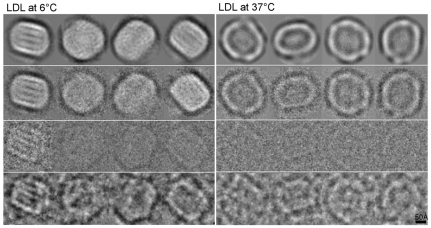
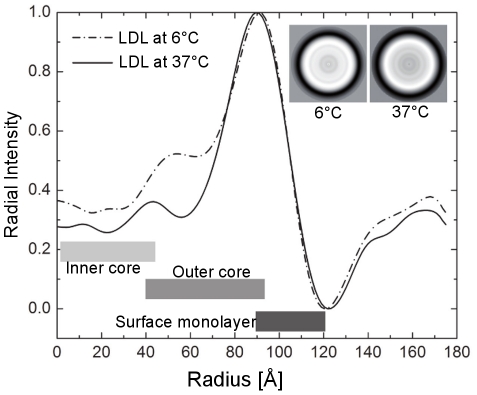
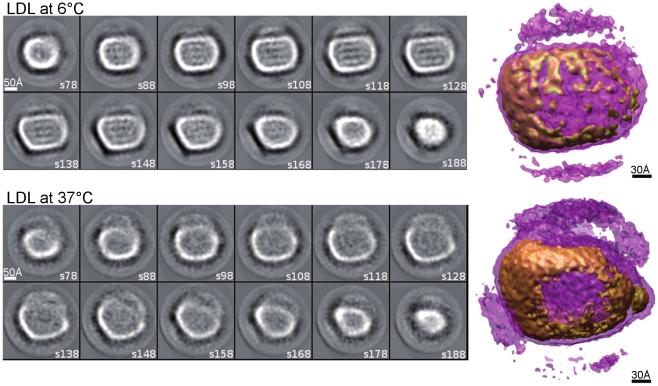
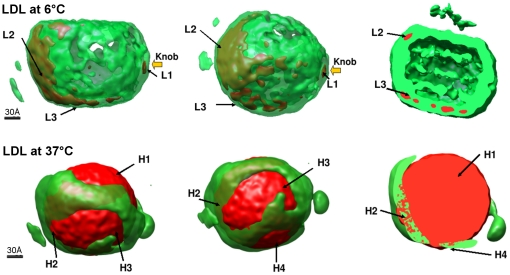
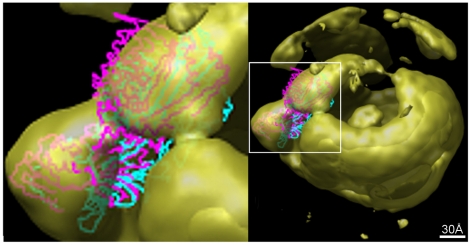
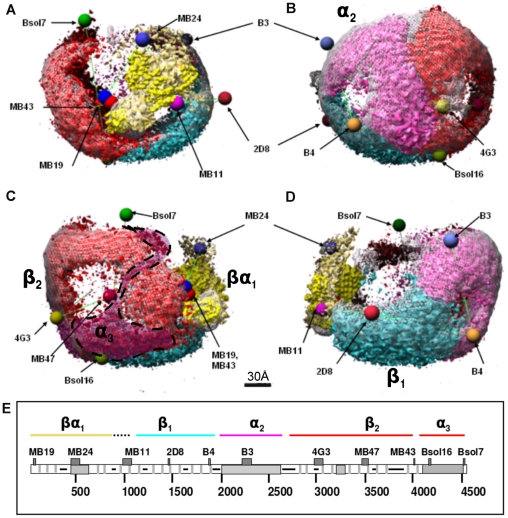
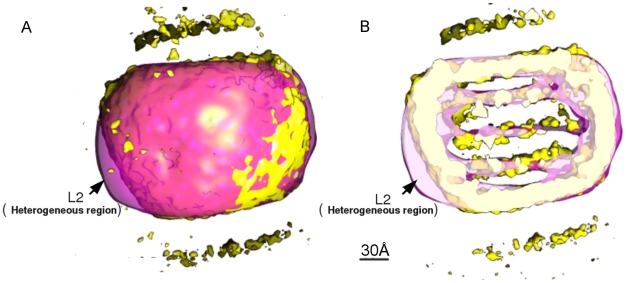
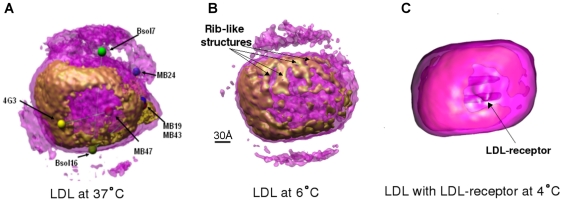
Methodology/principal findings: To study native LDL particles, we applied cryo-electron microscopy to calculate 3D reconstructions of LDL particles in their hydrated state. Images of the particles vitrified at 6 °C and 37 °C resulted in reconstructions at ~16 Å resolution at both temperatures. 3D variance map analysis revealed rigid and flexible domains of lipids and apoB-100 at both temperatures. The reconstructions showed less variability at 6 °C than at 37 °C, which reflected increased order of the core CE molecules, rather than decreased mobility of the apoB-100. Compact molecular packing of the core and order in a lipid-binding domain of apoB-100 were observed at 6 °C, but not at 37 °C. At 37 °C we were able to highlight features in the LDL particles that are not clearly separable in 3D maps at 6 °C. Segmentation of apoB-100 density, fitting of lipovitellin X-ray structure, and antibody mapping, jointly revealed the approximate locations of the individual domains of apoB-100 on the surface of native LDL particles.
Conclusions/significance: Our study provides molecular background for further understanding of the link between structure and function of native LDL particles at physiological body temperature.
Conflict of interest statement
Figures
References
-
- Brown MS, Kovanen PT, Goldstein JL. Regulation of plasma cholesterol by lipoprotein receptors. Science. 1981;212:628–35. - PubMed
-
- Hegele RA. Plasma lipoproteins: genetic influences and clinical implications. Nat Rev Genet. 2009;10:109–121. - PubMed
-
- Williams KJ, Tabas I. The response-to-retention hypothesis of atherogenesis reinforced. Curr Opin Lipidol. 1998;9:471–474. - PubMed
-
- Hevonoja T, Pentikäinen MO, Hyvonen MT, Kovanen PT, Ala-Korpela M. Structure of low density lipoprotein (LDL) particles: basis for understanding molecular changes in modified LDL. Biochim Biophys Acta. 2000;1488:189–210. - PubMed
-
- Pentikäinen MO, Öörni K, Ala-Korpela M, Kovanen PT. Modified LDL - trigger of atherosclerosis and inflammation in the arterial intima. J Intern Med. 2000;247:359–370. - PubMed
Publication types
MeSH terms
Substances
LinkOut - more resources
Full Text Sources
Miscellaneous
