


Atmospheric reaction systems as null-models to identify structural traces of evolution in metabolism
- PMID: 21573072
- PMCID: PMC3089637
- DOI: 10.1371/journal.pone.0019759
Atmospheric reaction systems as null-models to identify structural traces of evolution in metabolism
Abstract
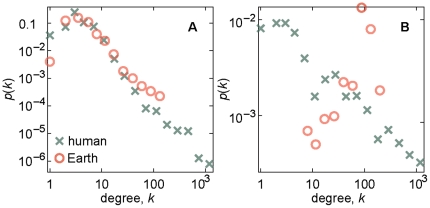
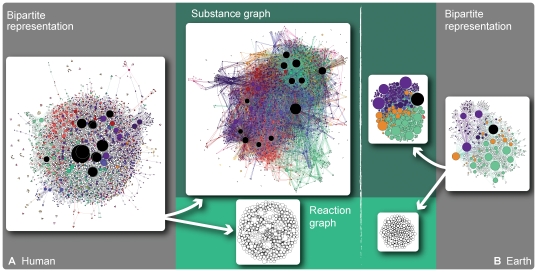
The metabolism is the motor behind the biological complexity of an organism. One problem of characterizing its large-scale structure is that it is hard to know what to compare it to. All chemical reaction systems are shaped by the same physics that gives molecules their stability and affinity to react. These fundamental factors cannot be captured by standard null-models based on randomization. The unique property of organismal metabolism is that it is controlled, to some extent, by an enzymatic machinery that is subject to evolution. In this paper, we explore the possibility that reaction systems of planetary atmospheres can serve as a null-model against which we can define metabolic structure and trace the influence of evolution. We find that the two types of data can be distinguished by their respective degree distributions. This is especially clear when looking at the degree distribution of the reaction network (of reaction connected to each other if they involve the same molecular species). For the Earth's atmospheric network and the human metabolic network, we look into more detail for an underlying explanation of this deviation. However, we cannot pinpoint a single cause of the difference, rather there are several concurrent factors. By examining quantities relating to the modular-functional organization of the metabolism, we confirm that metabolic networks have a more complex modular organization than the atmospheric networks, but not much more. We interpret the more variegated modular arrangement of metabolism as a trace of evolved functionality. On the other hand, it is quite remarkable how similar the structures of these two types of networks are, which emphasizes that the constraints from the chemical properties of the molecules has a larger influence in shaping the reaction system than does natural selection.
Conflict of interest statement
Figures
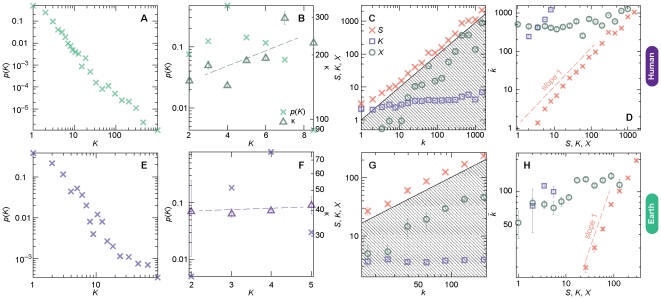
 of nodes with certain values of the three terms that contribute to the degree in the projected reaction networks.
  is averaged over logarithmic bins of S, K, and X values. The dashed line is a reference corresponding to a linear
  -dependence. Panels A–D are for the human metabolic reaction networks, E–H show the corresponding plots for the Earth atmospheric reaction networks.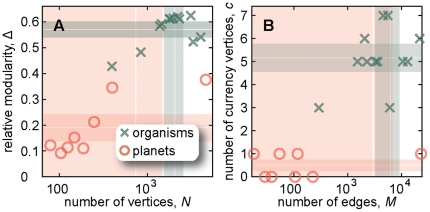
References
-
- Jeong H, Tombor B, Oltvai ZN, Barabási AL. The large-scale organization of metabolic networks. Nature. 2000;407:651–654. - PubMed
-
- Solé RV, Munteanu A. The large-scale organization of chemical reaction networks in astrophysics. Europhys Lett. 2004;68:170–176.
-
- Krebs HA, Johnson The role of citric acid in intermediate metabolism in animal tissues. Enzymologia. 1937;4:148–156. - PubMed
-
- Bethe HA. Energy production in stars. Phys Rev. 1939;55:434–456.
-
- Yung YL, Demore WB. New York: Oxford University Press; 1999. Photochemistry of planetary atmospheres.
Publication types
MeSH terms
LinkOut - more resources
Full Text Sources
