. 2011 May;7(5):e1002043.
doi: 10.1371/journal.pcbi.1002043. Epub 2011 May 5.

Combinations of protein-chemical complex structures reveal new targets for established drugs

Affiliations

Combinations of protein-chemical complex structures reveal new targets for established drugs

Olga V Kalinina et al. PLoS Comput Biol. 2011 May.

Abstract

Biological networks are powerful tools for predicting undocumented relationships between molecules. The underlying principle is that existing interactions between molecules can be used to predict new interactions. Here we use this principle to suggest new protein-chemical interactions via the network derived from three-dimensional structures. For pairs of proteins sharing a common ligand, we use protein and chemical superimpositions combined with fast structural compatibility screens to predict whether additional compounds bound by one protein would bind the other. The method reproduces 84% of complexes in a benchmark, and we make many predictions that would not be possible using conventional modeling techniques. Within 19,578 novel predicted interactions are 7,793 involving 718 drugs, including filaminast, coumarin, alitretonin and erlotinib. The growth rate of confident predictions is twice that of experimental complexes, meaning that a complete structural drug-protein repertoire will be available at least ten years earlier than by X-ray and NMR techniques alone.


Conflict of interest statement

The authors have declared that no competing interests exist.

Figures
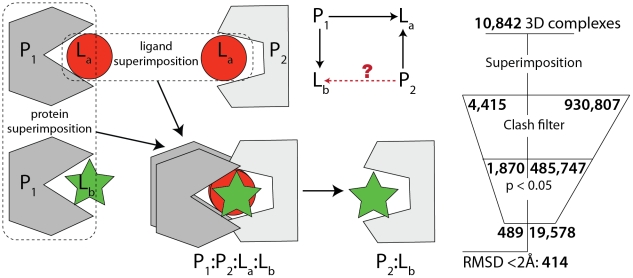
Figure 1
Figure 1. Schematic outlining the method used to predict protein-chemical interactions (left), and summary of how prediction candidates survive the clash filter and how many have statistically significant scores (right).
Figure 2
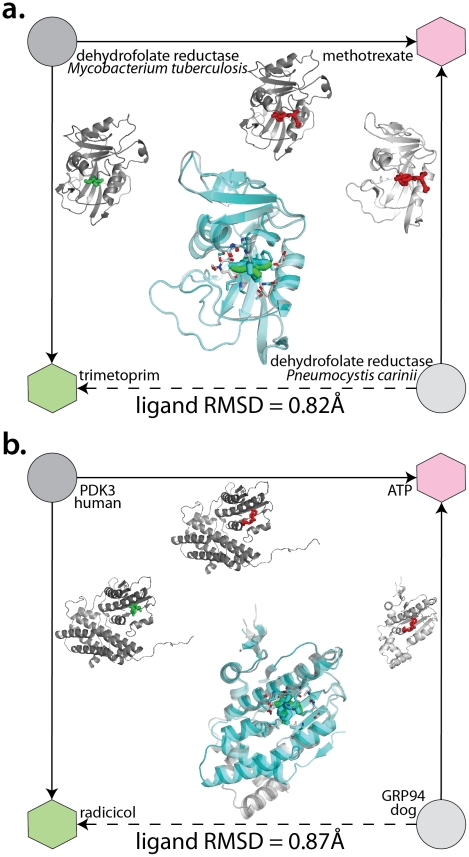
Figure 2. Examples from the benchmark dataset of high-quality predictions.
(A): High-identity subset: the complex of dihydrofolate reductase from Pneumocystis carinii with trimethoprim predicted using complexes with dihydrofolate reductase from Mycobacterium tuberculosis (with trimethoprim, PDB code 1DG5) and methotrexate (with dihydrofolate reductase from Pneumocystis carinii, 1DF7, with dihydrofolate reductase from Mycobacterium tuberculosis, PDB code 3CD2). RMSD from a known 3D structure (PDB code 1DYR) is 0.82 Å. (B): Low-identity or non-homology subset: the complex of endoplasmin GRP94 with radicicol using complexes with pyruvate dehydrogenase kinase isoform 3 (PDK3) (with radicicol, PDB code 2Q8I) and ATP (with PDK3, PDB 1Y8O, with CRP94, PDB 1TC6). RMSD from a known 3D structure (PDB 1QY8) is 0.87 Å.
Figure 3
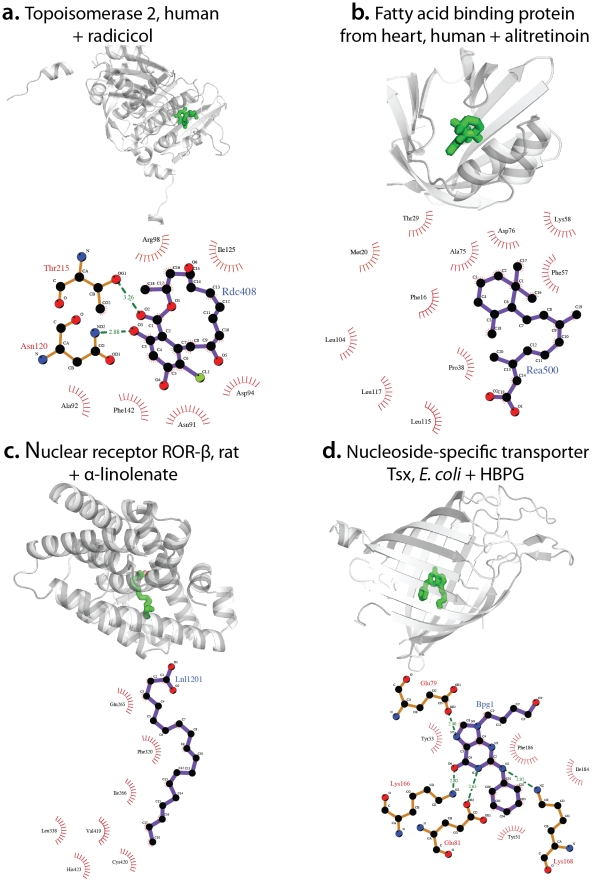
Figure 3. Examples of new predictions with limited literature evidence.
(A): the complex of human topoisomerase 2α with its inhibitor radicicol, predicted via complexes of topoisomerase 2α with adenosine (PDB code 1ZXN), yeast chaperone HSP82 with adenosine (PDB code 1AMW) and radicicol (PDB code 1BGQ). (B): the complex of human fatty acid binding protein FABP3 with alitretinoin, built using complexes of FABP3 with stearic acid (PDB code 1HMR), mouse retinoic acid receptor RXRα with stearic acid (PDB code 1DKF) and alitretinoin (PDB code 1XDK). (C): the complex of rat nuclear receptor RORβ with α-linolenate, predicted using complexes of RORβ with stearic acid (PDB code 1K4W), and maize non-specific lipid-transfer protein with stearic acid (PDB code 1FK4) and with α-linolenate (PDB code 1FK6). (D): the complex of E. coli channel-forming protein Tsx with anti-viral agent HBPG, predicted via structures of Tsx in complex with thimidine (PDB code 1TLW) and of herpes virus Thimidine kinase with thimidine (PDB code 1P7C) and HBPG (PDB code 1QHI).
Figure 4
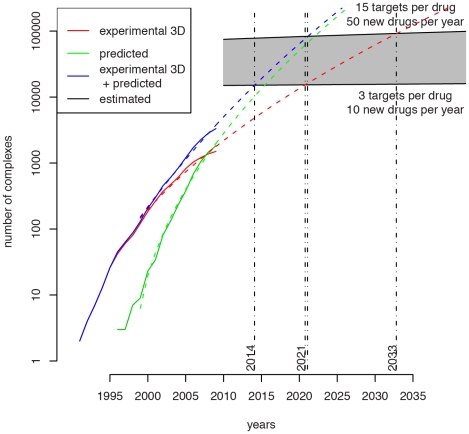
Figure 4. Extrapolation of growth rates for complexes of human proteins with drugs, resolved using experimental methods (red) and amenable to prediction using our method (green) over time.
The sum of the two curves is shown in blue. The total number of existing drug-target complexes is shown in gray and estimated given the average number of targets per drug to be between 3 and 15, the number of targets to be fixed at 5000 and the number of drugs to be increasing linearly at the rate of between 10 and 50 per year (see text for details).

References

    1. Gerstein M, Lan N, Jansen R. Proteomics. Integrating interactomes. Science. 2002;295:284–287. - PubMed
    1. Linding R, Jensen LJ, Ostheimer GJ, van Vugt MA, Jørgensen C, et al. Systematic discovery of in vivo phosphorylation networks. Cell. 2007;129:1415–1426. - PMC - PubMed
    1. Campillos M, Kuhn M, Gavin A, Jensen LJ, Bork P. Drug target identification using side-effect similarity. Science. 2008;321:263–266. - PubMed
    1. Paolini GV, Shapland RHB, van Hoorn WP, Mason JS, Hopkins AL. Global mapping of pharmacological space. Nat Biotechnol. 2006;24:805–815. - PubMed
    1. Keiser MJ, Roth BL, Armbruster BN, Ernsberger P, Irwin JJ, et al. Relating protein pharmacology by ligand chemistry. Nat Biotechnol. 2007;25:197–206. - PubMed

Publication types