Identification of hammerhead ribozymes in all domains of life reveals novel structural variations
- PMID: 21573207
- PMCID: PMC3088659
- DOI: 10.1371/journal.pcbi.1002031
Identification of hammerhead ribozymes in all domains of life reveals novel structural variations
Abstract
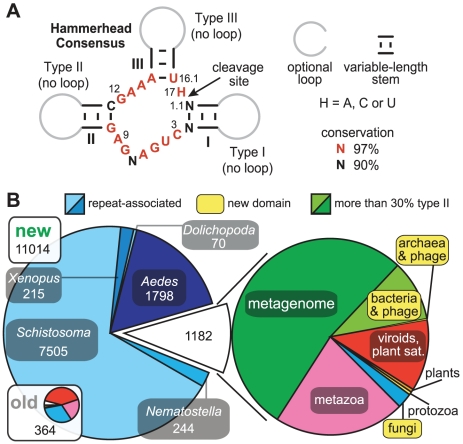
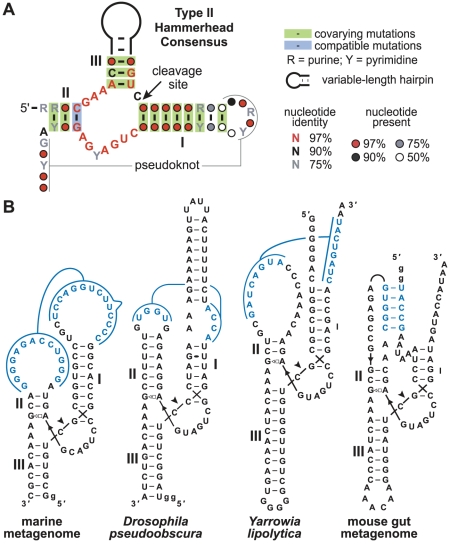
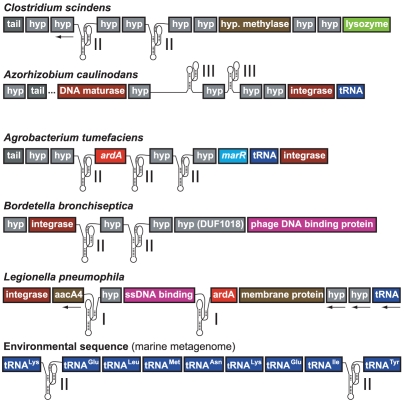
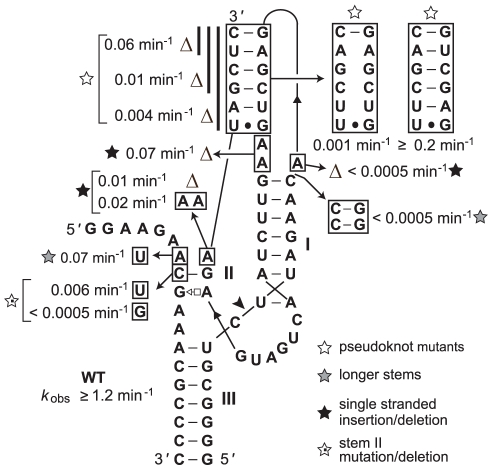
Hammerhead ribozymes are small self-cleaving RNAs that promote strand scission by internal phosphoester transfer. Comparative sequence analysis was used to identify numerous additional representatives of this ribozyme class than were previously known, including the first representatives in fungi and archaea. Moreover, we have uncovered the first natural examples of "type II" hammerheads, and our findings reveal that this permuted form occurs in bacteria as frequently as type I and III architectures. We also identified a commonly occurring pseudoknot that forms a tertiary interaction critical for high-speed ribozyme activity. Genomic contexts of many hammerhead ribozymes indicate that they perform biological functions different from their known role in generating unit-length RNA transcripts of multimeric viroid and satellite virus genomes. In rare instances, nucleotide variation occurs at positions within the catalytic core that are otherwise strictly conserved, suggesting that core mutations are occasionally tolerated or preferred.
Conflict of interest statement
The authors have declared that no competing interests exist.
Figures
References
-
- Forster AC, Symons RH. Self-cleavage of plus and minus RNAs of a virusoid and a structural model for the active sites. Cell. 1987;49:211–220. - PubMed
-
- Cochrane JC, Strobel SA. Catalytic Strategies of Self-Cleaving Ribozymes. Acc Chem Res. 2008;41:1027–1035. - PubMed
-
- Prody GA, Bakos JT, Buzayan JM, Schneider IR, Bruening G. Autolytic Processing of Dimeric Plant Virus Satellite RNA. Science. 1986;231:1577–1580. - PubMed
Publication types
MeSH terms
Substances
Grants and funding
LinkOut - more resources
Full Text Sources
Other Literature Sources