. 2011 Jun;211(3-4):371-85.
doi: 10.1007/s00221-011-2709-9. Epub 2011 May 15.

The joint flanker effect: sharing tasks with real and imagined co-actors

Affiliations

The joint flanker effect: sharing tasks with real and imagined co-actors

Silke Atmaca et al. Exp Brain Res. 2011 Jun.

Abstract

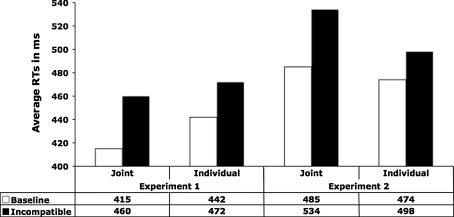
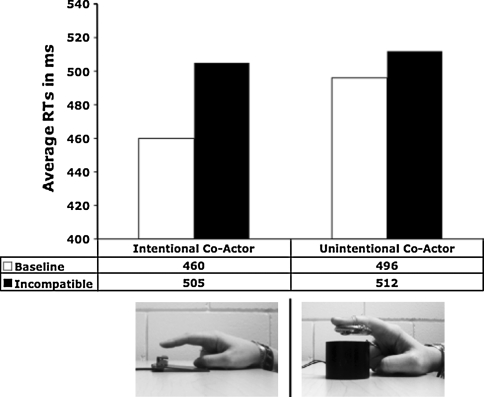
The Eriksen flanker task (Eriksen and Eriksen in Percept Psychophys 16:143-149, 1974) was distributed among pairs of participants to investigate whether individuals take into account a co-actor's S-R mapping even when coordination is not required. Participants responded to target letters (Experiment 1) or colors (Experiment 2) surrounded by distractors. When performing their part of the task next to another person performing the complementary part of the task, participants responded more slowly to stimuli containing flankers that were potential targets for their co-actor (incompatible trials), compared to stimuli containing identical, compatible, or neutral flankers. This joint Flanker effect also occurred when participants merely believed to be performing the task with a co-actor (Experiment 3). Furthermore, Experiment 4 demonstrated that people form shared task representations only when they perceive their co-actor as intentionally controlling her actions. These findings substantiate and generalize earlier results on shared task representations and advance our understanding of the basic mechanisms subserving joint action.


Figures
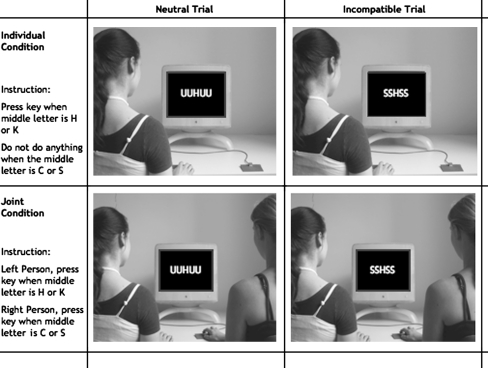
Fig. 1
Fig. 1
Illustration of neutral trials (left column) and incompatible trials (right column) in the individual condition (top row) and joint condition (bottom row). In the joint condition, the flankers on incompatible trials were part of the co-actor’s task rules
Fig. 2
Fig. 2
Experiment 1 (left) and Experiment 2 (right). Average RTs for identical, neutral, and compatible trials (baseline; white bars) and incompatible trials (black bars), in the joint and in the individual condition
Fig. 3
Fig. 3
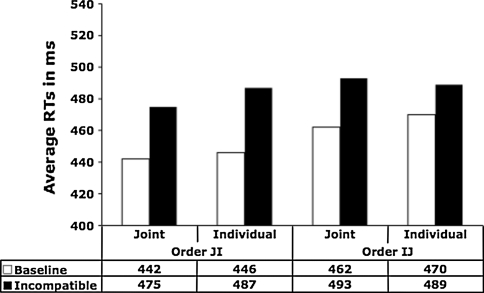
Average RTs for identical, neutral, and compatible trials (baseline; white bars) and incompatible trials (black bars) in the joint and in the individual condition. Left results from participants who performed the joint condition prior to the individual condition. Right results from participants who performed the individual condition prior to the joint condition
Fig. 4
Fig. 4
Average RTs for identical, neutral, and compatible trials (baseline; white bars) and incompatible trials (black bars) in the intentional co-actor condition (left) and in the unintentional co-actor condition (right)

References

    1. Aiello JR, Douthitt EA. Social facilitation from Triplett to electronic performance monitoring. Group Dyn. 2001;5:163–180. doi: 10.1037/1089-2699.5.3.163. - DOI
    1. Amazeen PG, Schmidt RC, Turvey MT. Frequency detuning of the phase entrainment dynamics of visually coupled rhythmic movements. Biol Cybern. 1995;72:511–518. doi: 10.1007/BF00199893. - DOI - PubMed
    1. Atmaca S, Sebanz N, Prinz W, Knoblich G. Action co-representation: the joint SNARC effect. Soc Neurosci. 2008;3:1–11. doi: 10.1080/17470910801900908. - DOI - PubMed
    1. Botvinick MM, Braver TS, Carter CS, Cohen JD. Conflict monitoring and cognitive control. Psychol Rev. 2001;108:624–652. doi: 10.1037/0033-295X.108.3.624. - DOI - PubMed
    1. Brass M, Bekkering H, Wohlschläger A, Prinz W. Compatibility between observed and executed finger movements: comparing symbolic, spatial, and imitative cues. Brain Cogn. 2000;44:124–143. doi: 10.1006/brcg.2000.1225. - DOI - PubMed