. 2011 Jun;39(3):127-36.
doi: 10.3109/10731199.2011.581052.

Polyhemoglobin-superoxide dismutase-catalase-carbonic anhydrase: a novel biotechnology-based blood substitute that transports both oxygen and carbon dioxide and also acts as an antioxidant

Affiliations

Polyhemoglobin-superoxide dismutase-catalase-carbonic anhydrase: a novel biotechnology-based blood substitute that transports both oxygen and carbon dioxide and also acts as an antioxidant

Yuzhu Bian et al. Artif Cells Blood Substit Immobil Biotechnol. 2011 Jun.

Abstract

Polyhemoglobin-superoxide dismutase-catalase-carbonic anhydrase (PolyHb-SOD-CAT-CA) is a therapeutic antioxidant that also transports both oxygen and carbon dioxide. This is formed by crosslinking Hb with SOD, CAT, and CA using glutaraldehyde. Crosslinking stroma free Hb from red blood cell (rbc) reduces CA activity to 55%. Addition of more CA resulted in a preparation with the same CA activity as RBC. PolyHb in the complex acts as a buffer to prevent large pH changes as carbon dioxide is converted to carbonic acid. We then prepare and optimize a novel PolyHb-SOD-CAT-CA, a therapeutic antioxidant that also transports both oxygen and carbon dioxide.


Conflict of interest statement

Declaration of interest: The authors report no conflicts of interest. The authors alone are responsible for the content and writing of the paper.

Figures

Figure 1
Figure 1
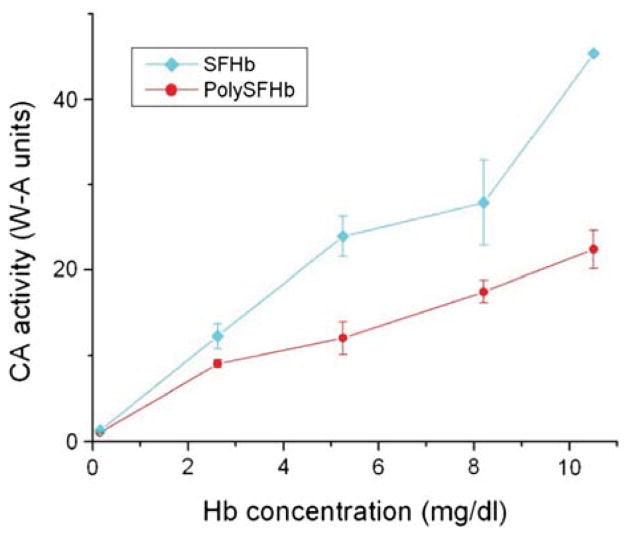
The CO2 hydration activity of SFHb and PolySFHb was assayed. Six concentrations between 0.2–10.5 mg/mL of sample were selected in order to obtain results in an appropriate and measurable range. The CA activity was described in W-A units. Measurements were done in triplicates to indicate statistical reproducibility.
Figure 2
Figure 2
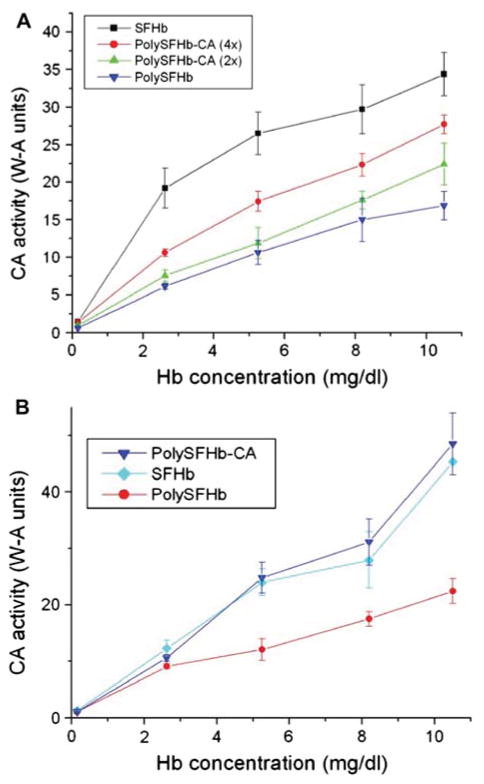
(A) PolySFHb was prepared from SFHb and crosslinked with increasing amount of CA (200 units/mL and 400 units/mL). Enzyme activity of SFHb and PolySFHb prepared from SFHb without additional CA were also assayed. (B) PolySFHb was prepared from SFHb and was assayed for CA activity. The CO2 hydration activity of PolySFHb crosslinked with CA (1070 units/mL) was also measured.
Figure 3
Figure 3
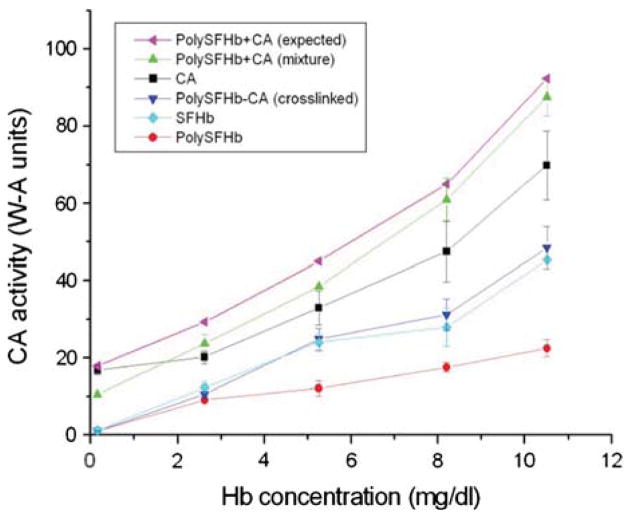
Samples containing CA in free form and samples without free enzyme were assayed for CA activity. The expected activity for the mixture of PolySFHb and free form CA is also indicated.
Figure 4
Figure 4
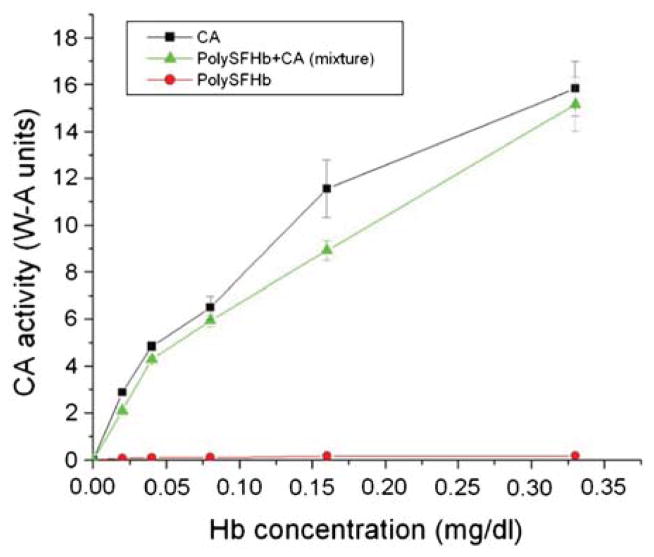
PolySFHb was mixed with CA in free form and assayed for enzyme activity. PolySFHb without additional enzyme and CA alone were also assayed. The sample concentrations were proportionally reduced and selected to be between 0–0.35 mg/mL.
Figure 5
Figure 5
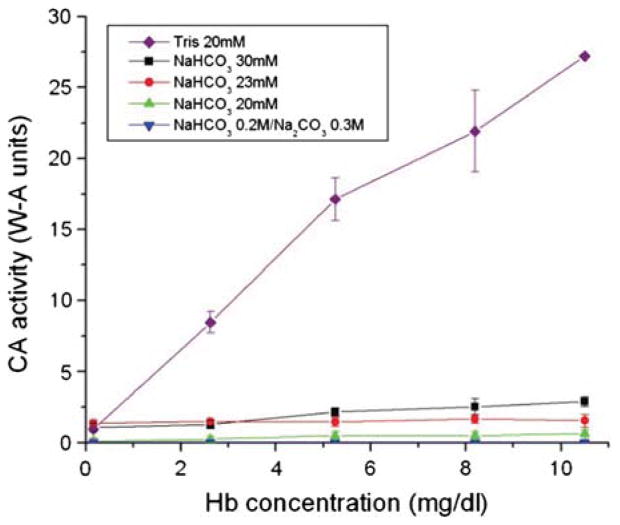
PolySFHb was prepared from SFHb and assayed with the electrometric delta pH assay using different concentrations of bicarbonate and carbonate buffers corresponding to physiological conditions.
Figure 6
Figure 6
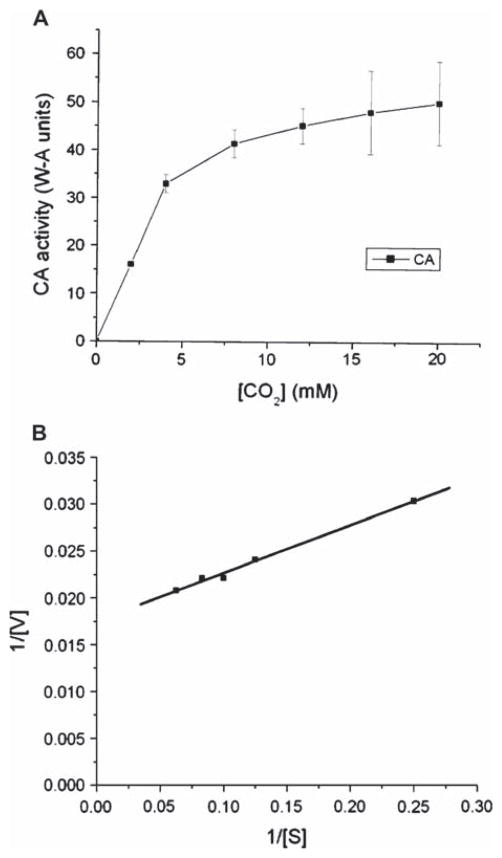
(A) Plot illustrating the Michaelis-Menten equation for CA in free form. The curve was obtained by increasing the substrate concentration until a stable rate of CO2 hydration was obtained. (B) Lineweaver-Burk plot for CA in free form. The curve was obtained by taking the reciprocal of the substrate and the rate of enzyme activity.
Figure 7
Figure 7
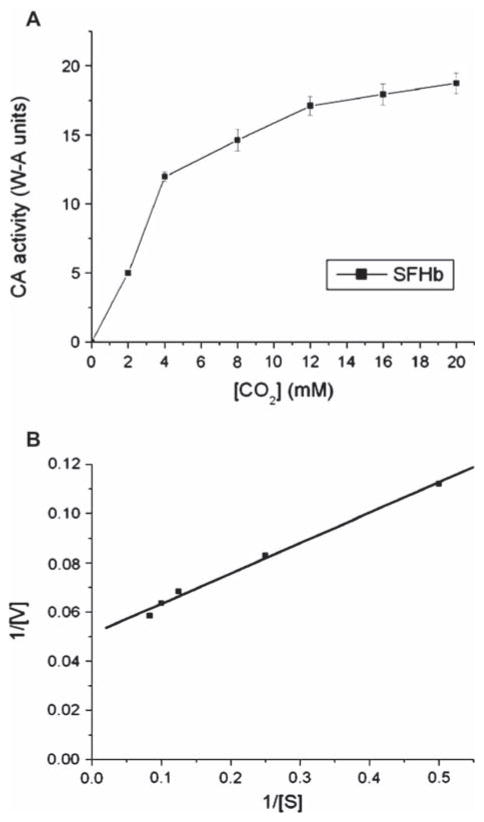
(A) Plot illustrating the Michaelis-Menten equation for SFHb. (B) Lineweaver-Burk plot for SFHb.
Figure 8
Figure 8
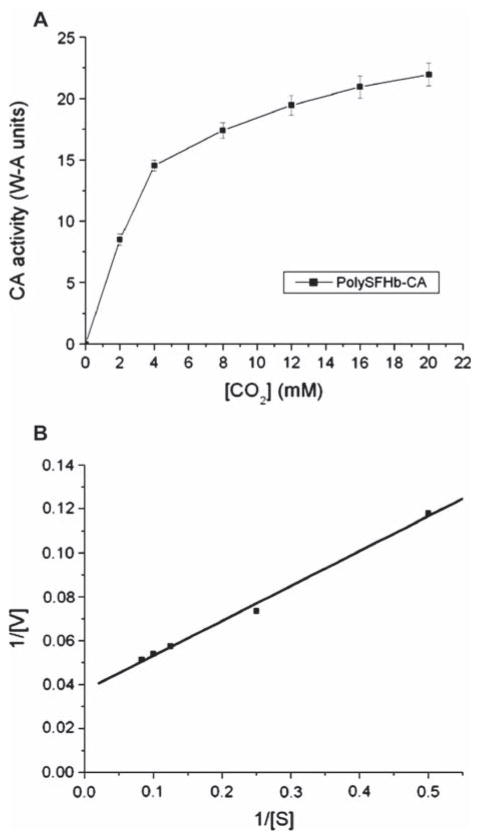
(A) Plot illustrating the Michaelis-Menten equation for PolySFHb-CA. (B) Lineweaver-Burk plot for PolySFHb-CA.
Figure 9
Figure 9
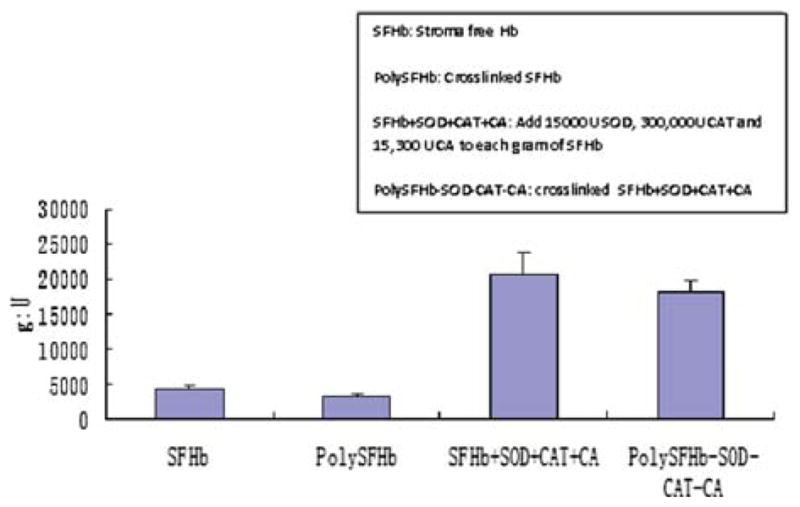
Superoxide dismutase activity of SFHb, PolySFHb, SFHb+SOD+CAT+CA, and polySFHb-SOD-CAT-CA. SOD (1050 units/mL), catalase (21,000 units/mL), and carbonic anhydrase (1070 units/mL) were added to stroma-free hemoglobin (7 g/dl), then polymerized into PolySFHb-SOD-CAT-CA, resulting in a Hb: SOD ratio of 1g: 18,000 after crosslinking.
Figure 10
Figure 10
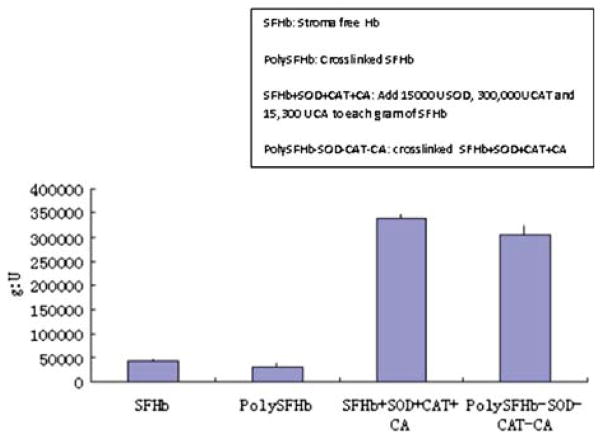
Catalase activity of SFHb, PolySFHb, SFHb+SOD+CAT+CA, and polySFHb-SOD-CAT-CA. SOD (1050 units/mL), catalase (30,000 units/mL), and carbonic anhydrase (1070 units/mL) were added to stroma-free hemoglobin (7 g/dl), then polymerized into PolySFHb-SOD-CAT-CA, resulting in a Hb: SOD ratio of 1g: 310,000 after crosslinking.
Figure 11
Figure 11
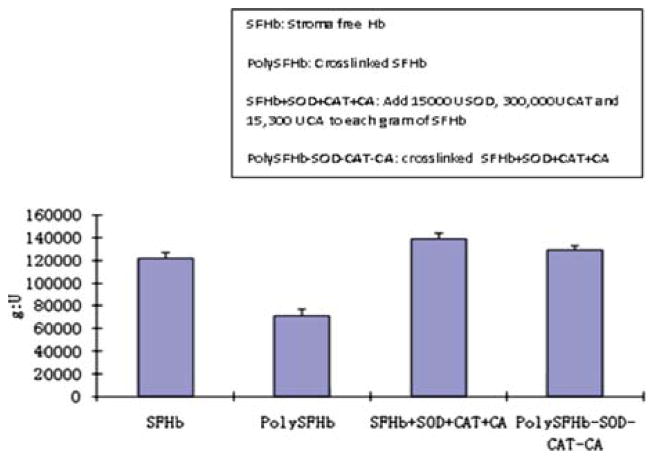
Carbonic anhydrase activity of SFHb, PolySFHb, SFHb+SOD+CAT+CA, and polySFHb-SOD-CAT-CA. SOD (1050 units/mL), catalase (21,000 units/mL), and carbonic anhydrase (1070 units/mL) were added to stroma-free hemoglobin (7 g/dl), then polymerized into PolySFHb-SOD-CAT-CA, resulting in a Hb:CA ratio of 1g: 130,000U after crosslinking

References

    1. Chang TMS. Blood Substitutes: Principles, Methods, Products and Clinical Trials. Vol. 1. Basel: Karger Landes Systems; 1997.
    1. Chang TMS. Artificial Cells: Biotechnology, Nanotechnology, Blood Substitutes, Regenerative Medicine, Bioencapsulation, Cell/StemCell Therapy. Singapore: World Science Publishers/Imperial College Press; 2007.
    1. Winslow RM. Blood Substitutes. London: Elsevier Inc; 2005.
    1. Chang TMS. Semipermeable microcapsules. Science. 1964;146:524–525. - PubMed
    1. Chang TMS. Stabilization of enzyme by microencapsulation with a concentrated protein solution or by crosslinking with glutaraldehyde. Biochem Biophys Res Commun. 1971;44:1531–1533. - PubMed

MeSH terms

Grants and funding