


Executive function and instrumental activities of daily living in mild cognitive impairment and Alzheimer's disease
- PMID: 21575871
- PMCID: PMC3096844
- DOI: 10.1016/j.jalz.2010.04.005
Executive function and instrumental activities of daily living in mild cognitive impairment and Alzheimer's disease
Abstract
Background: Impairment in instrumental activities of daily living (IADL) leads to early loss in productivity and adds significant burden to caregivers. Executive dysfunction is thought to be an important contributor to functional impairment. The objective of this study was to investigate the relationship between executive function and IADL in a large cohort of well-characterized normal older controls, mild cognitive impairment (MCI), and patients with mild Alzheimer's disease, separately as well as across the entire sample, while accounting for demographic, cognitive, and behavioral factors.
Methods: Subjects with baseline clinical datasets (n=793) from the Alzheimer's Disease Neuroimaging Initiative study (228 normal older controls, 387 MCI, 178 Alzheimer's disease) were included in the analysis. A multiple regression model was used to assess the relationship between executive function and IADL.
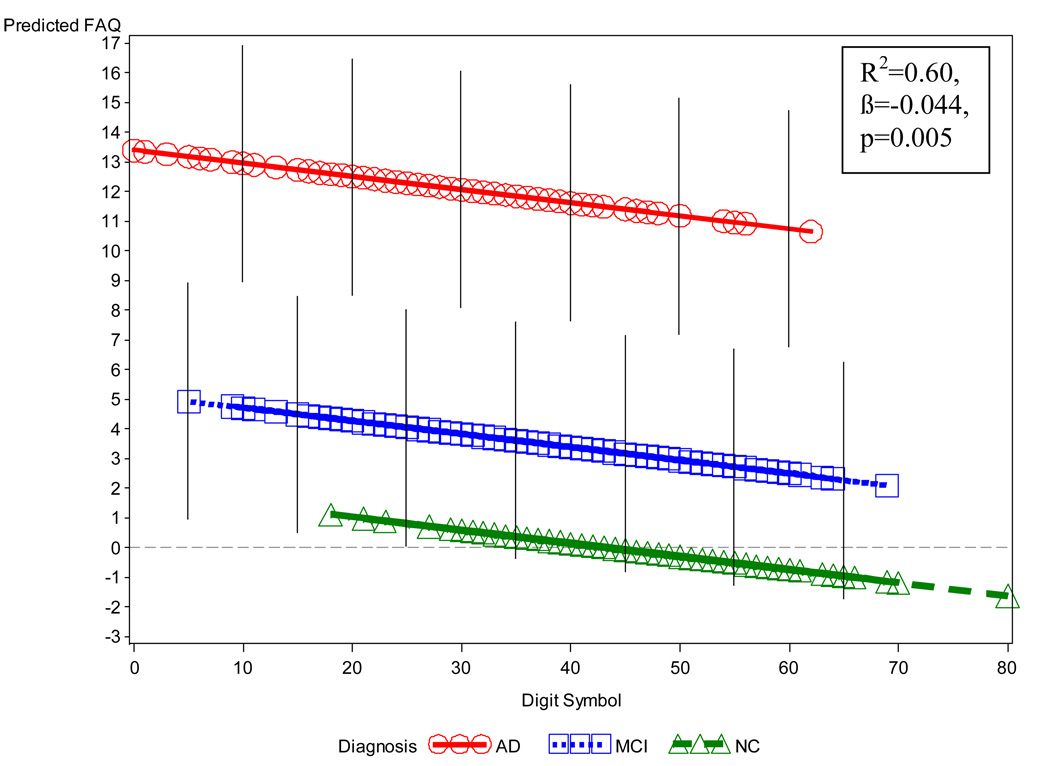
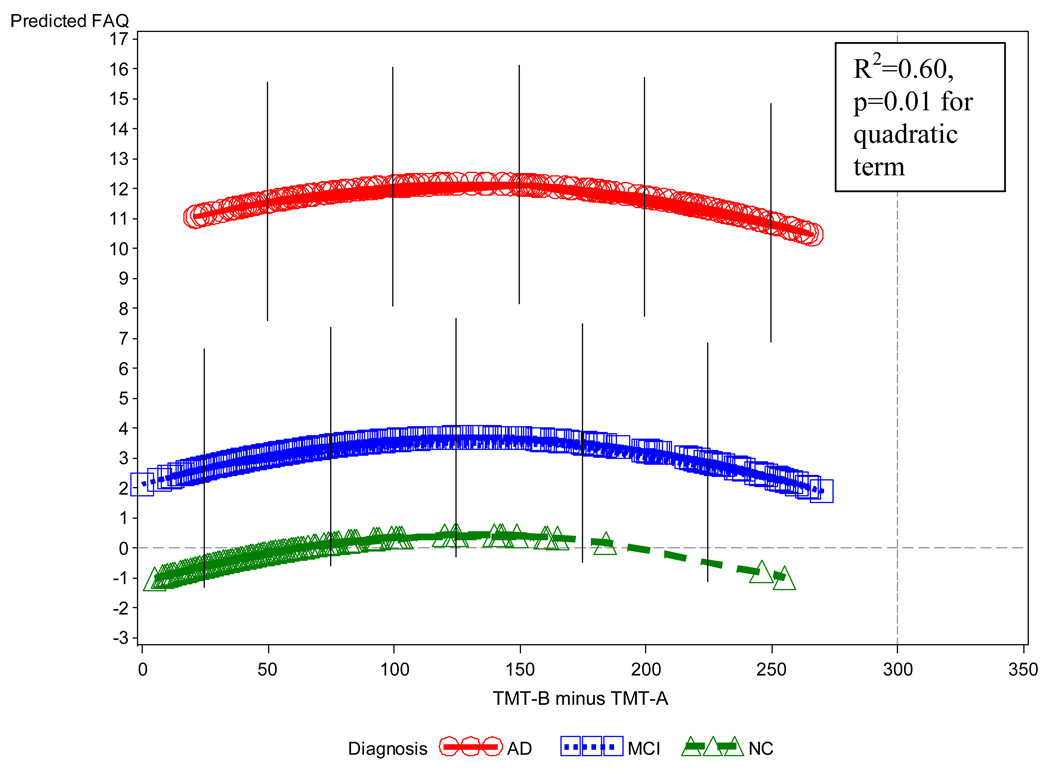
Results: A multiple regression model, including diagnosis, global cognitive impairment, memory performance, and other covariates demonstrated a significant relationship between executive dysfunction and IADL impairment across all subjects (R2=.60, P<.0001 for model; Digit Symbol, partial ß=-.044, P=.005; Trailmaking Test B-A, quadratic relation, P=.01). Similarly, an analysis using MCI subjects only yielded a significant relationship (R2=.16, P<.0001 for model; Digit Symbol, partial ß=-.08, P=.001).
Conclusions: These results suggest that executive dysfunction is a key contributor to impairment in IADL. This relationship was evident even after accounting for degree of memory deficit across the continuum of cognitive impairment and dementia.
Copyright © 2011 The Alzheimer's Association. Published by Elsevier Inc. All rights reserved.
Figures
References
-
- Marshall GA, Fairbanks LA, Tekin S, et al. Neuropathologic correlates of activities of daily living in Alzheimer disease. Alzheimer Dis Assoc Disord. 2006;20:56–59. - PubMed
-
- Rowe CC, Ng S, Ackermann U, et al. Imaging beta-amyloid burden in aging and dementia. Neurology. 2007;68:1718–1725. - PubMed
-
- Salmon E, Lespagnard S, Marique P, et al. Cerebral metabolic correlates of four dementia scales in Alzheimer's disease. J Neurol. 2005;252:283–290. - PubMed
-
- Boyle PA, Malloy PF, Salloway S, et al. Executive dysfunction and apathy predict functional impairment in Alzheimer disease. Am J Geriatr Psychiatry. 2003;11:214–221. - PubMed
-
- Chen P, Ratcliff G, Belle SH, et al. Cognitive tests that best discriminate between presymptomatic AD and those who remain nondemented. Neurology. 2000;55:1847–1853. - PubMed
Publication types
MeSH terms
Grants and funding
LinkOut - more resources
Full Text Sources
Other Literature Sources
Medical
