


Review
doi: 10.1098/rstb.2010.0399.
Harnessing the placebo effect: the need for translational research
Affiliations
- PMID: 21576150
- PMCID: PMC3130404
- DOI: 10.1098/rstb.2010.0399
Item in Clipboard
Review
Harnessing the placebo effect: the need for translational research
Philos Trans R Soc Lond B Biol Sci.
.
Abstract
Laboratory research recently has greatly enhanced the understanding of placebo and nocebo effects by identifying specific neuromodulators and brain areas associated with them. However, little progress has been made in translating this knowledge into improved patient care. Here, we discuss the limitations in our knowledge about placebo (and nocebo) effects and the need for translational research with the aim of guiding physicians in maximizing placebo effects and minimizing nocebo effects in their routine clinical practice. We suggest some strategies for how, when and why interventions to promote beneficial placebo responses might be administered in the clinical setting.
Figures
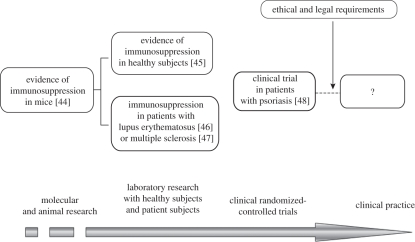
Translational placebo research. The scheme shows the way to move efficiently from animal and molecular findings to clinical research with healthy and patient subjects. The scope is to apply scientific results into clinical research aimed at improving patient care. An evaluation of legal and ethical requirements is necessary to harness placebos in clinical routine practice. In the field of the immune system, molecular and animal findings have been successfully transferred into clinical trials.
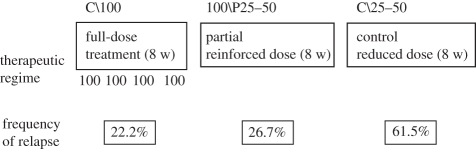
A model of conditioned pharmacotherapeutic effects. The diagram shows an example of a conditioned pharmacotherapeutic trial in patients with severe psoriasis. The three-arm trial included a full-dose treatment group (C\100); a partial reinforced dose group (100\P25–50) and a control-reduced dose group (C\25–50). The cumulative amount of active drug in groups 100\P25–50 and C\25–50 was identical. However, partial reinforcement patients received a full dose of corticosteroid medication 25–50% of the time and placebo medication other times; patients in the control group received 25–50% of the dose continuously. Similar outcomes (frequency of relapse) were observed in the full-dose treatment and partial reinforcement group, suggesting that a regime of reinforcement can gain significant clinical benefits. Data from Ader et al. [48].
References
-
- Colloca L., Benedetti F. 2005. Placebos and painkillers: is mind as real as matter? Nat. Rev. Neurosci. 6, 545–552 10.1038/nrn1705 (doi:10.1038/nrn1705) - DOI - PubMed
-
- Benedetti F., Lanotte M., Lopiano L., Colloca L. 2007. When words are painful: unraveling the mechanisms of the nocebo effect. Neuroscience 147, 260–271 10.1016/j.neuroscience.2007.02.020 (doi:10.1016/j.neuroscience.2007.02.020) - DOI - PubMed
-
- Woolf S. H. 2008. The meaning of translational research and why it matters. JAMA 299, 211–213 10.1001/jama.2007.26 (doi:10.1001/jama.2007.26) - DOI - PubMed
-
- Brody H. 1982. The lie that heals: the ethics of giving placebos. Ann. Intern. Med. 97, 112–118 - PubMed
-
- Miller F. G., Brody H. 2011. Understanding and harnessing placebo effect: clearing away the underbrush. J. Med. Philos. 36, 69–78 10.1093/jmp/jhq061 (doi:10.1093/jmp/jhq061) - DOI - PMC - PubMed
Publication types
MeSH terms
Substances
Grants and funding
LinkOut - more resources
Full Text Sources
