Review
. 2011 Jul 1;3(7):a004457.
doi: 10.1101/cshperspect.a004457.

Alzheimer's disease

Affiliations
Review

Alzheimer's disease

Dennis J Selkoe. Cold Spring Harb Perspect Biol. .

Abstract

Over the last three decades, advances in biochemical pathology and human genetics have illuminated one of the most enigmatic subjects in biomedicine--neurodegeneration. Eponymic diseases of the nervous system such as Alzheimer's, Parkinson's, and Huntington's diseases that were long characterized by mechanistic ignorance have yielded striking progress in our understanding of their molecular underpinnings. A central theme in these and related disorders is the concept that certain normally soluble neuronal proteins can misfold and aggregate into oligomers and amyloid fibrils which can confer profound cytotoxicity. Perhaps the foremost example, both in terms of its societal impact and how far knowledge has moved toward the clinic, is that of Alzheimer's disease (AD). Here, we will review the classical protein lesions of the disorder that have provided a road map to etiology and pathogenesis. We will discuss how elucidating the genotype-to-phenotype relationships of familial forms of Alzheimer's disease has highlighted the importance of the misfolding and altered proteostasis of two otherwise soluble proteins, amyloid β-protein and tau, suggesting mechanism-based therapeutic targets that have led to clinical trials.


Figures

Figure 1.
Figure 1.
Schematic diagrams of the β-amyloid precursor protein (APP) and its principal metabolic derivatives. The upper diagram depicts the largest of the known APP alternate splice forms, comprising 770 amino acids. Regions of interest are indicated at their correct relative positions. A 17-residue signal peptide occurs at the amino terminus (box with vertical lines). Two alternatively spliced exons of 56 and 19 amino acids are inserted at residue 289; the first contains a serine protease inhibitor domain of the Kunitz type (KPI). A single membrane-spanning domain (TM) at amino acids 700723 is indicated by the vertical dotted lines. The amyloid β-protein (Aβ) fragment includes 28 residues just outside the membrane plus the first 12–14 residues of the transmembrane domain. In the middle diagram, the arrow indicates the site (after residue 687; same site as the white dot in the Aβ region of APP in the upper diagram) of a constitutive proteolytic cleavage made by protease(s) designated α-secretase that enables secretion of the large, soluble ectodomain of APP (APPs- α) into the medium and retention of the 83 residue carboxy-terminal fragment in the membrane. The C83 fragment can undergo cleavage by protease called γ-secretase at residue 711 or residue 713 to release the p3 peptides. The lower diagram depicts the alternative proteolytic cleavage after residue 671 by enzyme called β-secretase that results in the secretion of the slightly truncated APPs- β molecule and the retention of a 99-residue carboxy-terminal fragment. The C99 fragment can also undergo heterogenous cleavages by γ-secretase to release the Aβ peptides.
Figure 2.
Figure 2.
βAPP mutations genetically linked to familial Alzheimer’s disease or related disorders. The sequence within APP that contains the Aβ and transmembrane region is expanded and shown by the single-letter amino acid code. The underlined residues represent the Aβ1-42 peptide. The vertical broken lines indicate the location of the transmembrane domain. The bold letters below the sequence indicate the currently known missense mutations identified in certain patients with familial Alzheimer’s disease or hereditary cerebral hemorrhage with amyloidosis. The family with the AG92G mutation can experience cerebral hemorrhages from amyloid angiopathy and/or Alzheimer’s disease as the phenotypes. Three-digit numbers refer to the residue number according to the βAPP770 isoform.
Figure 3.
Figure 3.
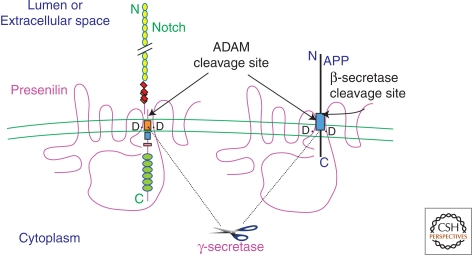
Model of the role of presenilin (PS) in Notch and APP processing based on current information. Polytopic PS protein, which occurs principally as a cleaved heterodimer. Some Notch and APP molecules form complexes with PS. Two aspartates (D) in TM6 and TM7 of PS are required for the cleavages of Notch and APP within their TM domains, and these align with the respective sites of cleavage in the two substrates. PS-mediated proteolysis of both Notch and APP is preceded by ectodomain shedding by an ADAM family protease (“α-secretase”). Alternatively, APP can undergo ectodomain shedding by β-secretase. Several motifs are depicted in Notch: EGF-like repeats (yellow circles), LNG repeats (red diamonds), a single TM (orange box), the RAM23 domain (blue square), a nuclear localization sequence (pink rectangle), and six cdc10/ankyrin repeats (green ovals). Following the putative intramembranous cleavage mediated by PS, the Notch intracellular domain is released to the nucleus to activate transcription of target genes. APP contains the Aβ region (light blue box), which is released into the lumen after sequential cleavages of APP by β-secretase and then γ-secretase/PS. The APP intracellular domain is released into the cytoplasm.

References

    1. Anliker B, Muller U 2006. The functions of mammalian amyloid precursor protein and related amyloid precursor-like proteins. Neurodegener Dis 3: 239–246 - PubMed
    1. Bales KR, Verina T, Dodel RC, Du Y, Altstiel L, Bender M, Hyslop P, Johnstone EM, Little SP, Cummins DJ, et al. 1997. Lack of apolipprotein E dramatically reduces amyloid β-peptide deposition. Nat Genet 17: 263–264 - PubMed
    1. Bard F, Cannon C, Barbour R, Burke RL, Games D, Grajeda H, Guido T, Hu K, Huang J, Johnson-Wood K, et al. 2000. Peripherally administered antibodies against amyloid β-peptide enter the central nervous system and reduce pathology in a mouse model of Alzheimer disease. Nat Med 6: 916–919 - PubMed
    1. Borchelt DR, Thinakaran G, Eckman CB, Lee MK, Davenport F, Ratovitsky T, Prada C-M, Kim G, Seekins S, Yager D, et al. 1996. Familial Alzheimer’s disease–linked presenilin 1 variants elevate Aβ1-42/1-40 ratio in vitro and in vivo. Neuron 17: 1005–1013 - PubMed
    1. Brockhaus M, Grunberg J, Rohrig S, Loetscher H, Wittenburg N, Baumeister R, Jacobsen H, Haass C 1998. Caspasse-mediated cleavage is not required for the activity of presenilins in amyloidogenesis and NOTCH signaling. NeuroReport 9: 1481–1486 - PubMed

Publication types