. 2011 Jun 1;25(11):1121-31.
doi: 10.1101/gad.2038811. Epub 2011 May 16.

Limiting Ago protein restricts RNAi and microRNA biogenesis during early development in Xenopus laevis

Affiliations

Limiting Ago protein restricts RNAi and microRNA biogenesis during early development in Xenopus laevis

Elsebet Lund et al. Genes Dev. .

Abstract

We show that, in Xenopus laevis oocytes and early embryos, double-stranded exogenous siRNAs cannot function as microRNA (miRNA) mimics in either deadenylation or guided mRNA cleavage (RNAi). Instead, siRNAs saturate and inactivate maternal Argonaute (Ago) proteins, which are present in low amounts but are needed for Dicer processing of pre-miRNAs at the midblastula transition (MBT). Consequently, siRNAs impair accumulation of newly made miRNAs, such as the abundant embryonic pre-miR-427, but inhibition dissipates upon synthesis of zygotic Ago proteins after MBT. These effects of siRNAs, which are independent of sequence, result in morphological defects at later stages of development. The expression of any of several exogenous human Ago proteins, including catalytically inactive Ago2 (Ago2mut), can overcome the siRNA-mediated inhibition of miR-427 biogenesis and function. However, expression of wild-type, catalytically active hAgo2 is required to elicit RNAi in both early embryos and oocytes using either siRNA or endogenous miRNAs as guides. The lack of endogenous Ago2 endonuclease activity explains why these cells normally are unable to support RNAi. Expression of catalytically active exogenous Ago2, which appears not to perturb normal Xenopus embryonic development, can now be exploited for RNAi in this vertebrate model organism.


Figures
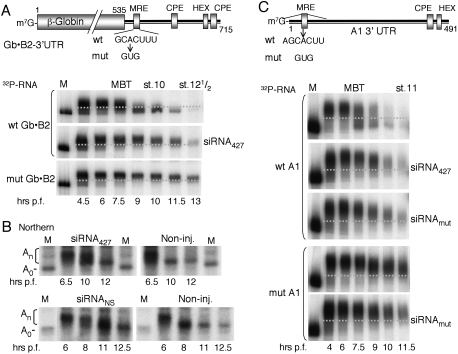
Figure 1.
Figure 1.
Inhibition of miR-427-dependent deadenylation by exogeneous siRNA. (A) Schematic representation of the chimeric β-globin•cyclin B2 3′ UTR reporter mRNA (Gb•B2) indicating wild-type (wt) and inactivating mutant (mut) seed matches for miR-427 (MRE), cytoplasmic polyadenylation elements (CPE), and hexanucleotide polyadenylation signal (HEX). 32P-labeled Gb•B2 reporter RNAs with wild-type (top, middle) or mutant MREs were injected alone or together with siRNA427 (200 fmol per embryo) into one- to two-cell embryos [1.5–2 h post-fertilization), and polyadenylation and deadenylation were monitored over time by denaturing PAGE of total RNAs (one embryo equivalent per lane). Marker lanes (M) show the nonpolyadenylated reporter RNAs prior to injection, and stippled lines demarcate polyadenylated from deadenylated reporter RNAs. For nucleotide sequences of siRNA427 (a miR-427 mimic), siRNAmut (a variant designed to compensate for the seed match mutation in MREmut), and siRNANS (a nonspecific commercial siRNA), see the Materials and Methods. (B) Impaired deadenylation of endogenous cyclin B2 mRNAs independent of siRNA sequence. Kinetics of deadenylation in untreated embryos (Non-inj.) or embryos injected at the one-cell stage with siRNA427 (left) or a non-specific siRNANS (right) (100 fmol per embryo) were monitored over time by Northern blot analyses of 3′-terminal fragments of cyclin B2 mRNA generated by digestion with RNase H. Marker lanes (M) show 3′-terminal fragments lacking poly(A) (A0). (C) 32P-labeled cyclin A1 3′ UTR reporter RNAs (top diagram) with wild-type or mutant miR427 target sites (MRE) were injected alone or together with the indicated siRNAs (200 fmol per embryo), and polyadenylation and deadenylation were monitored over time as in A.
Figure 2.
Figure 2.
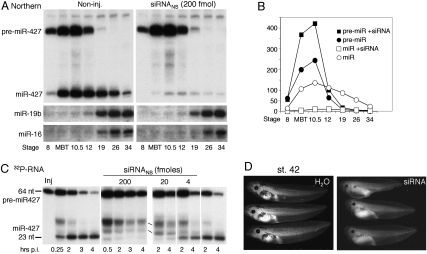
siRNA-mediated inhibition of miRNA biogenesis and disruption of tadpole development. (A) Impairment of miR-427 biogenesis by siRNAs. Accumulation of endogenous X. laevis miRNAs in untreated embryos (Non-inj.) or embryos injected with siRNANS at the one-cell stage was monitored over time by Northern blot analyses of total RNAs (one embryo equivalent of total RNAs per lane). Individual blots were probed for miR-427, miRNA-19b, or miRNA-16, as indicated. (B) PhosphorImager quantification of the miR-427 blots shown in A. (C) Dosage-dependent inhibition of pre-miRNA processing. 32P-labeled pre-miR-427 RNAs were injected into one- to two-cell embryos alone (left and right panels) or together with different amounts of siRNANS, and Dicer processing was monitored over time post-injection by denaturing PAGE of total RNAs (one embryo equivalent per lane). (D) Abnormal development of tadpoles derived from siRNA-injected embryos. One-cell embryos were injected with 100 fmol of siRNANS or H2O, and their development was monitored by visual inspection at stage 42. Images of tadpoles developed from noninjected embryos are shown in Supplemental Fig. S1.
Figure 3.
Figure 3.
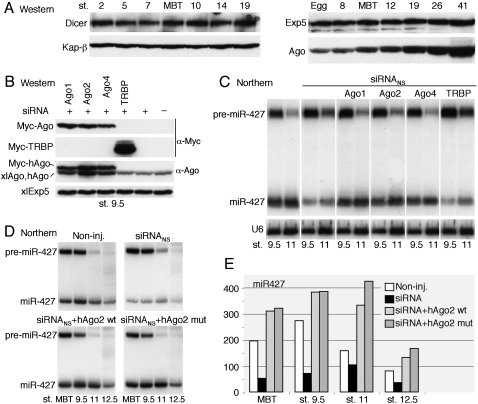
Titration of limiting Ago proteins by exogenous siRNA. (A) Developmental control of accumulation of xlAgo proteins in early embryos. Western blots of whole-cell extracts from eggs or embryos were probed with antibodies specific for the indicated proteins (cf. Supplemental Fig. S2); two (left panels) or one (right panels) embryo equivalents were loaded per lane. (B) Expression of exogenous Ago or TRBP proteins in early embryos. One-cell embryos were injected with siRNANS (30 fmol per embryo) alone or together with in vitro synthesized mRNAs encoding Myc-tagged human proteins, as indicated, and protein levels at stage 9.5 were monitored as in A. Note that the α-Ago antibody (anti-EIF2C2, Abnova) detects all three hAgo proteins, albeit with different efficiencies (cf. α-Ago and α-Myc signal). Kap-β and xlExp5 served as loading controls in A and B, respectively. (C) Suppression of siRNANS-mediated inhibition of miR-427 processing by exogenous Ago proteins. Accumulation of miR-427 in embryos from the experiment shown in B was monitored by Northern blot analyses as in Figure 2A. (D) Limiting Ago proteins in early embryos. Embryos were programmed to express wild-type (wt) or catalytically inactive (mut) Myc-hAgo2 in the presence of siRNANS (20 fmol per embryo), and miR-427 biogenesis was monitored as in C. (E) PhosphorImager quantification of mature miR-427 hybridization signals in D.
Figure 4.
Figure 4.
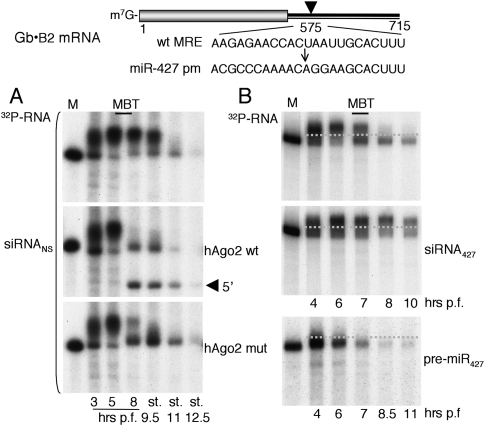
Rescue of deadenylation and RNAi deficiencies in early embryos. (A) Suppression of siRNANS-mediated inhibition of deadenylation at MBT by exogenous Ago proteins. A 32P-labeled Gb•B2 reporter RNA with a perfect match miR-427 target site in the 3′ UTR plus siRNANS (20 fmol per embryo) was injected alone or together with synthetic mRNA encoding wild-type or mutant Myc-hAgo2, and reporter RNA stabilities were monitored over time as in Figure 1A. The arrowhead indicates the 5′-terminal RNAi cleavage product. Note that, in the absence of exogenous hAgo proteins, siRNANS-mediated inhibition of deadenylation was alleviated late in gastrulation (stages 11 and 12.5), coincident with increased accumulation of endogenous zygotic xlAgo proteins (cf. Fig. 3A and Supplemental Fig. S3B). (B) Lack of RNAi in the absence of exogenous Ago2. The 32P-labeled Gb•B2 reporter RNA was injected alone or together with siRNA427 (100 fmol per embryo) or pre-miR-427 (Lund et al. 2009) into one- to two-cell embryos and analyzed as in A.
Figure 5.
Figure 5.
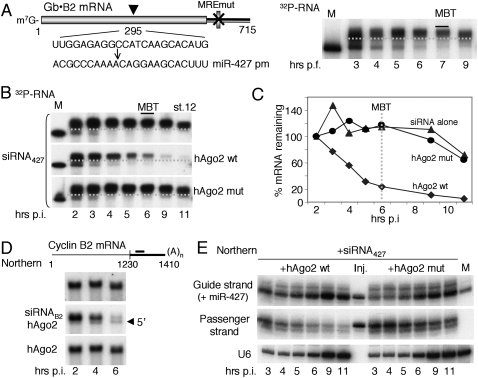
Lack of endogenous xlAgo2 catalytic activity in early embryos. (A) Inactivity of a coding region miR-427 target site. A 32P-labeled Gb•B2 reporter RNA with a perfect match miR-427 target sequence within the β-globin coding region and an inactive MREmut in the 3′ UTR was injected into one- to two-cell embryos and analyzed as in Figure 1A. Note that the miR-427pm target site in the coding region does not elicit deadenylation at MBT. (B) siRNA427-guided RNAi in preMBT embryos. The 32P-labeled reporter RNA plus siRNA427 (20 fmol per embryo) was injected alone or together with synthetic mRNAs encoding wild-type or mutant Myc-tagged hAgo2 and analyzed as in A. (C) Both 5′-terminal and 3′-terminal cleavage products were detected in the presence of hAgo2wt (Supplemental Fig. S3), and the extent of RNAi was quantified by PhosphorImager analyses. (D) siRNAB2-guided RNAi of endogenous cyclin B2 mRNA. Synthetic mRNA encoding wild-type myc-tagged hAgo2 was injected alone or together with siRNAB2 (30 fmol), and mRNA stability was monitored by Northern blot analysis of full-length cyclin B2 mRNA. The arrowhead indicates the 5′− terminal RNAi cleavage product. siRNAB2 targets the 3′ UTR of X. laevis cyclin B2 mRNA (black bar in top schematic). (E) Ago2-mediated destabilization of the passenger strand of siRNA427. Samples shown in B were analyzed by Northern blot hybridization using probes specific for the guide or passenger strand of siRNA427. Marker lanes with one embryo equivalent of total RNA from noninjected stage 9.5 embryos (M) and siRNA427 prior to injection (Inj.) show that the amount of siRNA427 injected was comparable with that of endogenous miR-m27. The increase in guide strand hybridization signals at 5–6 h post-injection reflects the onset of endogenous miR-427 synthesis.
Figure 6.
Figure 6.
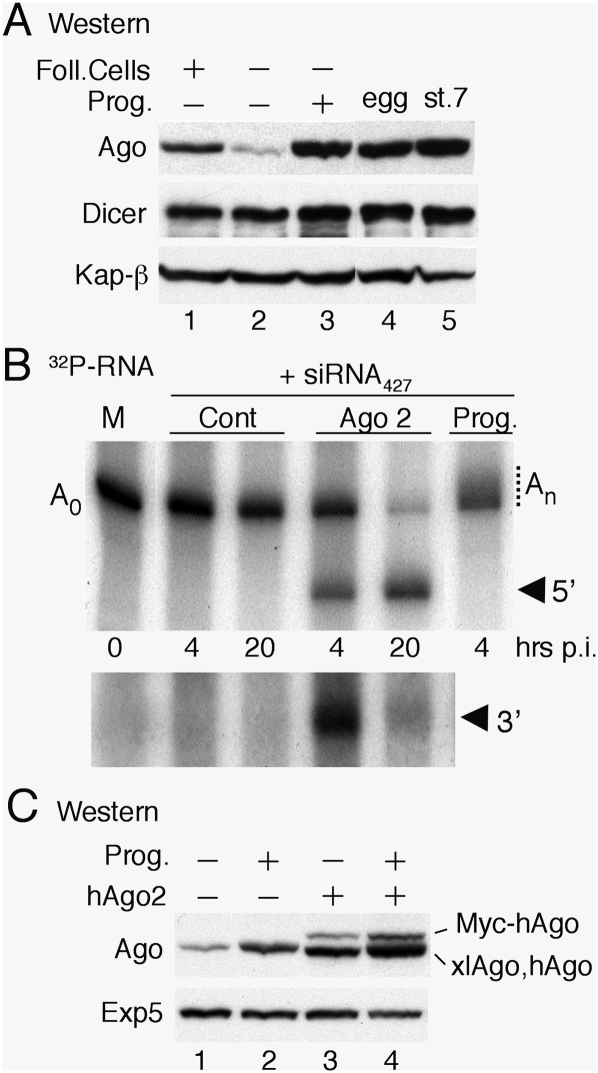
Absence of Ago2 catalytic activity from Xenopus oocytes. (A) Up-regulation of Ago protein levels during oocyte maturation. Whole-cell extracts from oocytes (lanes 1–3), eggs (lane 4), and stage 7 embryos (lane 5) were analyzed by Western blotting as in Figure 3. Immature (stage VI) oocytes were untreated (lane 1) or treated to remove follicle cells (lane 2) and matured by treatment with progesterone (lane 3). (B) Lack of RNAi in oocytes in the absence of exogenous Ago2. A 32P-labeled reporter RNA containing a perfect match miR-427 target site in the 3′ UTR (cf. Fig. 4) was coinjected with siRNA427 (20 fmol per embryo) into the cytoplasms of control oocytes (Cont), oocytes preinjected with synthetic mRNA encoding Myc-tagged hAgo2 (Ago2), or matured oocytes (Prog.), which supported polyadenylation (An). The bottom panel shows a longer autoradiographic exposure for detection of the shorter 3′ cleavage product. (C) Normal up-regulation of endogenous xlAgo proteins in the presence of exogenous hAgo2. Accumulation of Ago proteins in immature oocytes (lanes 1,3) or matured oocytes (lanes 2,4) in the absence (lanes 1,2) or presence of exogenous hAgo2 (lanes 3,4) was monitored as in A.
Figure 7.
Figure 7.
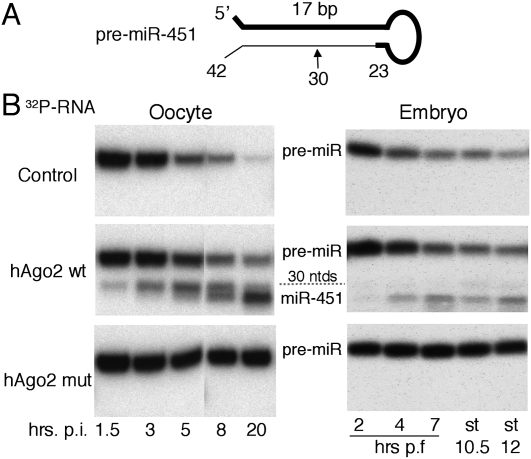
Requirement for exogenous Ago2 in pre-miR-451 processing. (A) Schematic representation of the evolutionarily conserved short hairpin structure of vertebrate pre-miR-451, indicating the mature miRNA (bold line) and the initial Ago2 cleavage site at nucleotide 30. (B) 32P-labeled pre-miR-451 RNA was injected into oocytes (left) or one- to two-cell embryos (right) that were untreated (control) or programmed to express the indicated hAgo2 proteins, and pre-miR-451 processing was monitored by denaturing PAGE. Embryo stages 10.5 and 12 correspond to ∼10 and ∼12.5 h post-fertilization. The identity of the processing products was confirmed by RNase T1 fingerprinting (not shown).

Comment in

References

    1. Amaya E, Musci TJ, Kirschner MW 1991. Expression of a dominant negative mutant of the FGF receptor disrupts mesoderm formation in Xenopus embryos. Cell 66: 257–270 - PubMed
    1. Armisen J, Gilchrist MJ, Wilczynska A, Standart N, Miska EA 2009. Abundant and dynamically expressed miRNAs, piRNAs, and other small RNAs in the vertebrate Xenopus tropicalis. Genome Res 19: 1766–1775 - PMC - PubMed
    1. Audic Y, Anderson C, Bhatty R, Hartley RS 2001. Zygotic regulation of maternal cyclin A1 and B2 mRNAs. Mol Cell Biol 21: 1662–1671 - PMC - PubMed
    1. Bartel DP 2004. MicroRNAs: genomics, biogenesis, mechanism, and function. Cell 116: 281–297 - PubMed
    1. Bohnsack MT, Czaplinski K, Gorlich D 2004. Exportin 5 is a RanGTP-dependent dsRNA-binding protein that mediates nuclear export of pre-miRNAs. RNA 10: 185–191 - PMC - PubMed

Publication types