. 2011 May 31;108(22):9196-201.
doi: 10.1073/pnas.1015298108. Epub 2011 May 16.

Control of Toxoplasma reactivation by rescue of dysfunctional CD8+ T-cell response via PD-1-PDL-1 blockade

Affiliations

Control of Toxoplasma reactivation by rescue of dysfunctional CD8+ T-cell response via PD-1-PDL-1 blockade

Rajarshi Bhadra et al. Proc Natl Acad Sci U S A. .

Abstract

In this study, we document that Toxoplasma gondii differentiation and reactivation are mediated by systemic CD8 T-cell dysfunction during chronic infection. We demonstrate that CD8(+) T-cell exhaustion occurs despite control of parasitemia during early-chronic toxoplasmosis. During later phases, these cells become exhausted, leading to parasite reactivation and mortality. Concomitant with increased CD8(+) T-cell apoptosis and decreased effector response, this dysfunction is characterized by a graded elevation in expression of inhibitory receptor PD-1 on these cells in both lymphoid and nonlymphoid tissue. Blockade of the PD-1-PDL-1 pathway reinvigorates this suboptimal CD8(+) T-cell response, resulting in control of parasite reactivation and prevention of mortality in chronically infected animals. To the best of our knowledge, this report is unique in showing that exposure to a persistent pathogen despite initial control of parasitemia can lead to CD8(+) T-cell dysfunction and parasite reactivation.


Conflict of interest statement

The authors declare no conflict of interest.

Figures
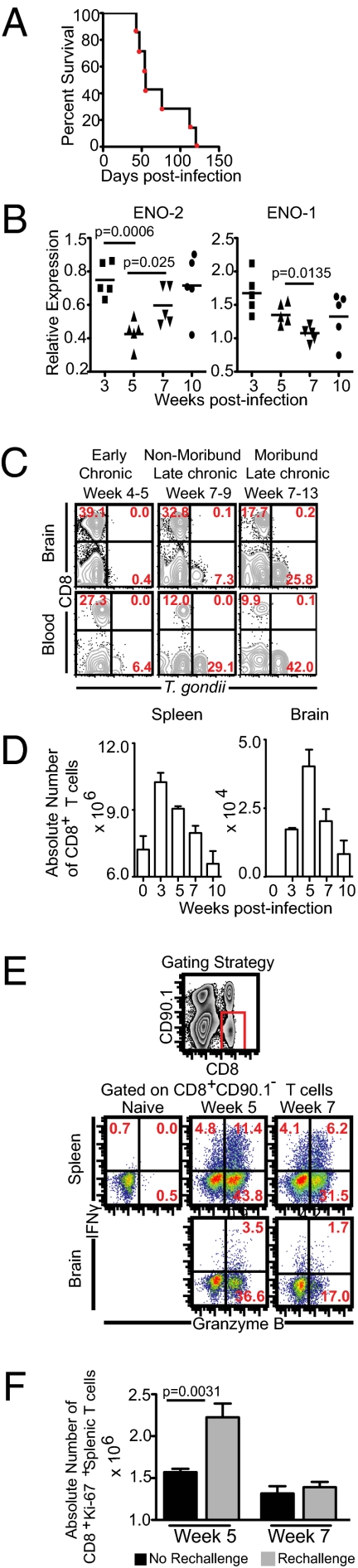
Fig. 1.
Fig. 1.
Parasite reactivation during late-chronic T. gondii infection correlates with poor CD8+ T-cell response. (A) C57BL/6 mice were infected with 10 ME49 cysts orally and survival was monitored on a daily basis. (B) Relative expression of ENO-1 and ENO-2 at weeks 3, 5, 7, and 10 postinfection in the brain was computed for each sample. Transcript levels at day 10 postinifection was taken as 1. (C) T. gondii-infected cells in the brain and blood leukocyte-gated samples were assayed by flow cytometry. (D) The absolute number of CD8+ T cells at weeks 3, 5, 7, and 10 postinfection. (E) IFN-γ and Granzyme B production by CD8+ T cells was evaluated in splenocytes or brain cells from infected mice in presence Toxoplasma lysate antigen. (F) At weeks 5 and 7 after primary infection, mice were rechallenged orally with 10 cysts and animals were killed 4 d later. The absolute number of cycling CD8+ T cells was evaluated in the spleen during early-chronic and late-chronic infection with or without rechallenge. The data represent two experiments with at least four mice per group. Error bars represent SD throughout.
Fig. 2.
Fig. 2.
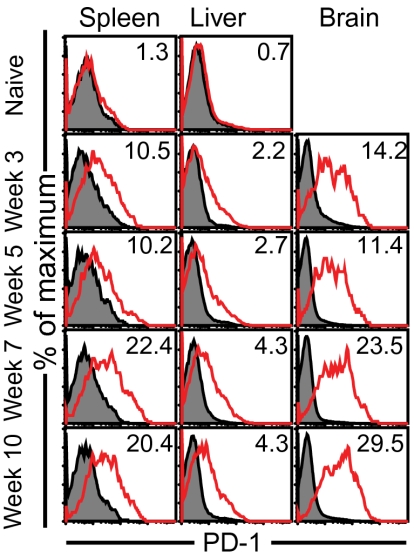
PD-1 is expressed at high levels on CD8+ T cells in both lymphoid and nonlymphoid tissue during late-chronic Toxoplasmosis. PD-1 expression on CD8+ T cells from tissues (spleen, brain, and liver) was measured at weeks 3, 5, 7, and 10 postinfection. Filled histogram represents staining with isotype-control antibody. The data represent three experiments with at least four mice per group.
Fig. 3.
Fig. 3.
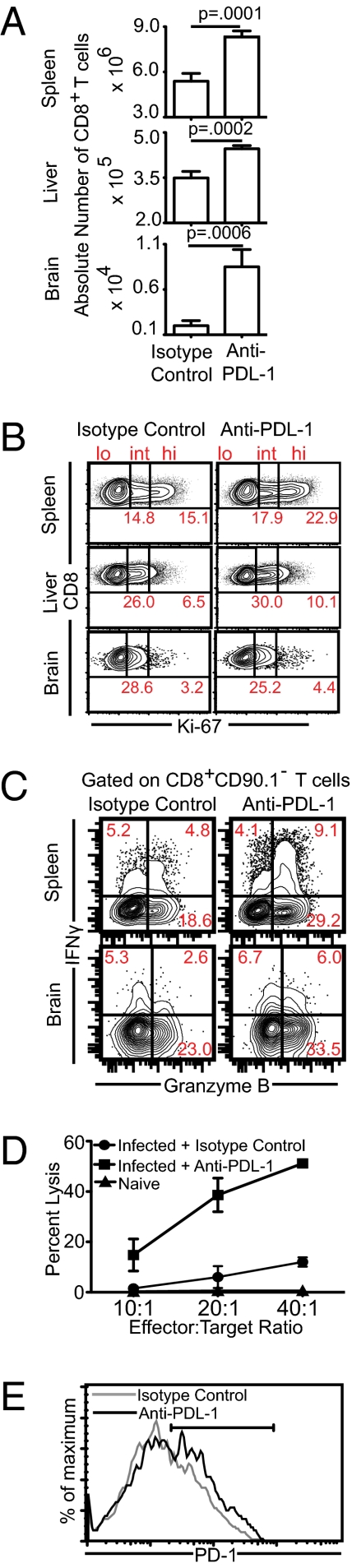
Blockade of PD-1–PDL-1 pathway reinvigorates CD8+ T-cell response in both lymphoid and nonlymphoid tissue in chronically infected mice. (A) Chronically infected mice were treated with anti–PDL-1 for 2 wk and then killed at week 7 postinfection. The absolute number of CD8+ T cells was evaluated in the spleen, liver, and brain. (B) The frequency of proliferating CD8+ T cells was assessed by intracellular staining for Ki-67. (C) IFN-γ and Granzyme B production by CD8+ T cells was evaluated in splenocytes or brain cells from infected mice in the presence of TLA. (D) Antigen-specific cytotoxicity of splenic CD8+ T-cells was measured by 51Cr-release assay. (E) PD-1 expression on splenic CD8+ T cells from anti–PDL-1 or isotype control antibody-treated mice was evaluated by flow cytometry. The data represent three experiments with at least four mice per group.
Fig. 4.
Fig. 4.
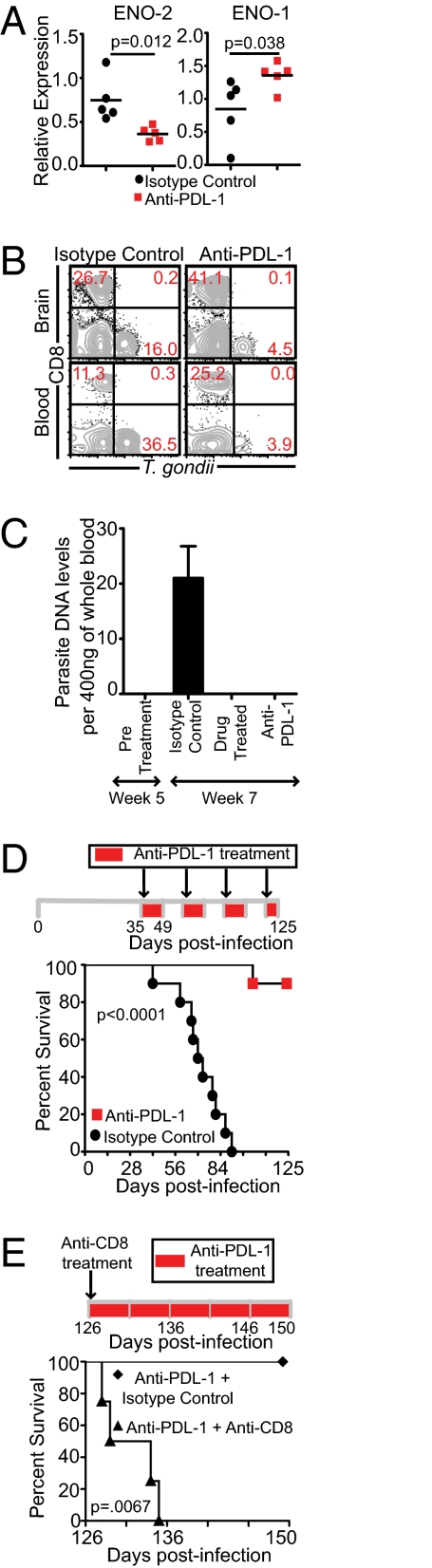
Anti–PDL-1 treatment controls parasite reactivation and prevents mortality in chronically infected mice. (A) Relative expression of ENO-1 and ENO-2 was computed for each sample. Transcript levels at day 10 postinfection was taken as 1. (B) T. gondii-infected cells in the brain and blood leukocyte-gated samples (n = 5) were assayed by flow cytometry. (C) Parasite genomic DNA level was computed in whole blood before initiation of treatment (week 5 postinfection) or 2 wk after initiation of treatment (week 7 postinfection) (n = 4–5). (D) Anti–PDL-1 antibody was injected every third day, starting at week 5 postinfection (n = 10). To minimize the development of an allogeneic response, the antibody was administered with 2-wk interruptions until termination of the experiment. (E) Surviving anti–PDL-1 treated mice from the previous experiment were administered anti–PDL-1 along with anti CD8 (n = 4) or anti–PDL-1 and control antibody (n = 4) every third day unitl the conclusion of the experiment. Survival was monitored on a daily basis. Data represent two experiments.

References

    1. Luft BJ, Remington JS. Toxoplasmic encephalitis in AIDS. Clin Infect Dis. 1992;15:211–222. - PubMed
    1. Grant IH, Gold JW, Rosenblum M, Niedzwiecki D, Armstrong D. Toxoplasma gondii serology in HIV-infected patients: The development of central nervous system toxoplasmosis in AIDS. AIDS. 1990;4:519–521. - PubMed
    1. Zangerle R, Allerberger F, Pohl P, Fritsch P, Dierich MP. High risk of developing toxoplasmic encephalitis in AIDS patients seropositive to Toxoplasma gondii. Med Microbiol Immunol (Berl) 1991;180:59–66. - PubMed
    1. Jones JL, et al. Surveillance for AIDS-defining opportunistic illnesses, 1992–1997. MMWR CDC Surveill Summ. 1999;48:1–22. - PubMed
    1. Vidal JE, et al. Cerebral toxoplasmosis in HIV-positive patients in Brazil: Clinical features and predictors of treatment response in the HAART era. AIDS Patient Care STDS. 2005;19:626–634. - PubMed

Publication types