


Exploring global changes in nitrogen and phosphorus cycles in agriculture induced by livestock production over the 1900-2050 period
- PMID: 21576477
- PMCID: PMC3876211
- DOI: 10.1073/pnas.1012878108
Exploring global changes in nitrogen and phosphorus cycles in agriculture induced by livestock production over the 1900-2050 period
Erratum in
- Proc Natl Acad Sci U S A. 2013 Dec 24;110(52):21195
Abstract
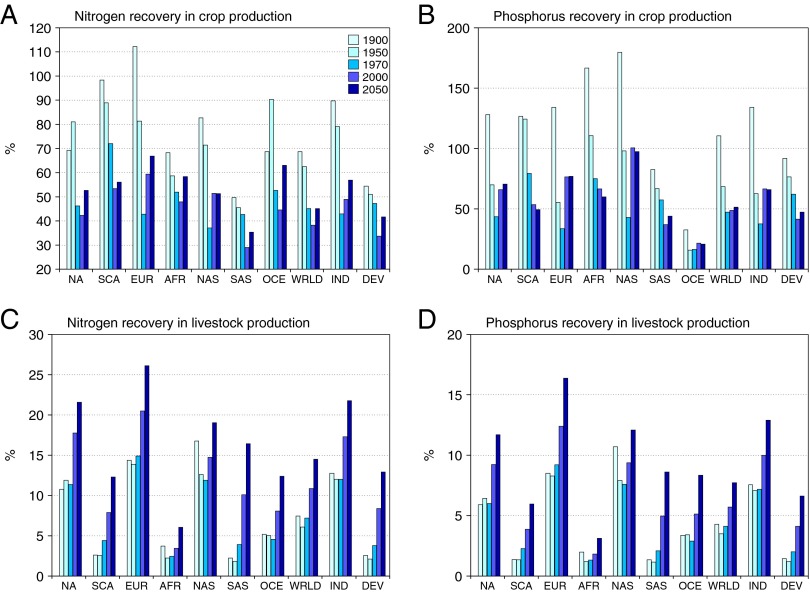
Crop-livestock production systems are the largest cause of human alteration of the global nitrogen (N) and phosphorus (P) cycles. Our comprehensive spatially explicit inventory of N and P budgets in livestock and crop production systems shows that in the beginning of the 20th century, nutrient budgets were either balanced or surpluses were small; between 1900 and 1950, global soil N surplus almost doubled to 36 trillion grams (Tg) · y(-1) and P surplus increased by a factor of 8 to 2 Tg · y(-1). Between 1950 and 2000, the global surplus increased to 138 Tg · y(-1) of N and 11 Tg · y(-1) of P. Most surplus N is an environmental loss; surplus P is lost by runoff or accumulates as residual soil P. The International Assessment of Agricultural Knowledge, Science, and Technology for Development scenario portrays a world with a further increasing global crop (+82% for 2000-2050) and livestock production (+115%); despite rapidly increasing recovery in crop (+35% N recovery and +6% P recovery) and livestock (+35% N and P recovery) production, global nutrient surpluses continue to increase (+23% N and +54% P), and in this period, surpluses also increase in Africa (+49% N and +236% P) and Latin America (+75% N and +120% P). Alternative management of livestock production systems shows that combinations of intensification, better integration of animal manure in crop production, and matching N and P supply to livestock requirements can effectively reduce nutrient flows. A shift in human diets, with poultry or pork replacing beef, can reduce nutrient flows in countries with intensive ruminant production.
Keywords: emissions; global nitrogen and phosphorus cycle; soil nutrient budget.
Conflict of interest statement
The authors declare no conflict of interest.
Figures
References
-
- Galloway JN, et al. Transformation of the nitrogen cycle: Recent trends, questions, and potential solutions. Science. 2008;320:889–892. - PubMed
-
- Galloway JN, Cowling EB. Reactive nitrogen and the world: 200 years of change. Ambio. 2002;31:64–71. - PubMed
-
- Diaz RJ, Rosenberg R. Spreading dead zones and consequences for marine ecosystems. Science. 2008;321:926–929. - PubMed
-
- Howarth RW, et al. Regional nitrogen budgets and riverine N and P fluxes of the drainages to the North Atlantic Ocean: Natural and human influences. Biogeochemistry. 1996;35:2235–2240.
-
- Vollenweider RA, Marchetti R, Viviani R, editors. Marine Coastal Eutrophication. Amsterdam: Elsevier; 1992. p. 1310.
Publication types
MeSH terms
Substances
LinkOut - more resources
Full Text Sources
Other Literature Sources
Medical
Research Materials
Miscellaneous
