


Review
doi: 10.1161/CIRCULATIONAHA.110.956839.
Epigenetic modifications: basic mechanisms and role in cardiovascular disease
Affiliations
- PMID: 21576679
- PMCID: PMC3107542
- DOI: 10.1161/CIRCULATIONAHA.110.956839
Item in Clipboard
Review
Epigenetic modifications: basic mechanisms and role in cardiovascular disease
Circulation.
.
No abstract available
Conflict of interest statement
The authors have no conflicts of interest to disclose.
Figures
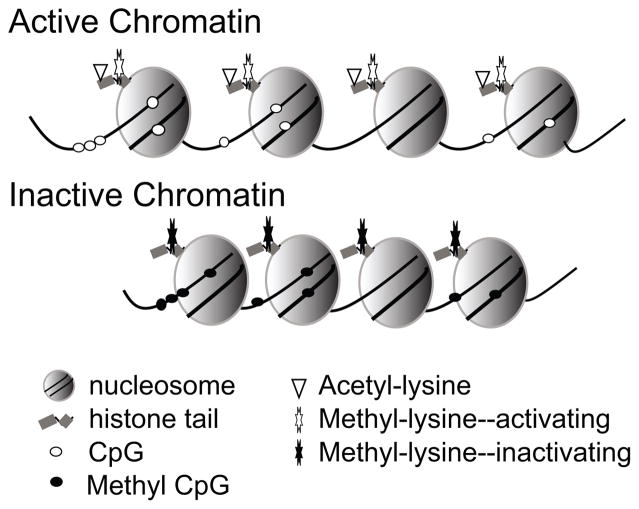
Chromosomal DNA is packaged around histone cores to form nucleosomes. Nucleosome spacing in open structure that is accessible to nuclear factors is maintained, in part, by post-translational modification of histone tails, including lysine acetylation and specific lysine methylation. CpG dinucleotides are unequally distributed throughout chromosomal DNA, and may be concentrated in regions called CpG islands that can overlap gene promoters. Methylation of cytosines in CpG dinucleotides is overall associated with inactive, condensed states of the chromosome. Inactive chromatin is also maintained by specific histone lysine modifications.
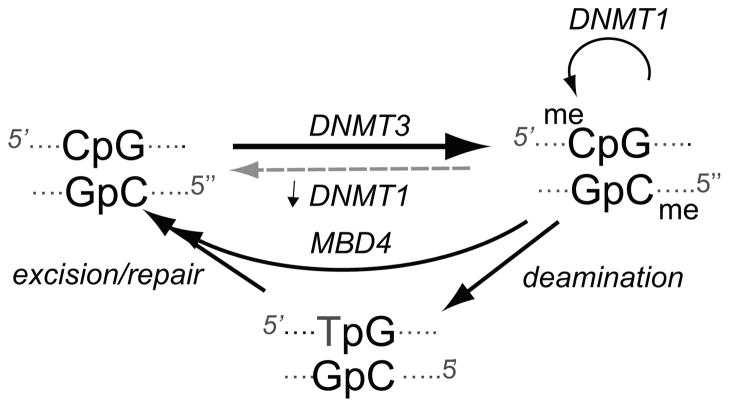
DNA methylation at the cytosine in CpG dinucleotides is initiated de novo by the DNA methyl transferases (DNMT) 3A and 3B. Following replication, DNMT1 plays a primary role in maintaining the methylation state in the daughter strands. Demethylation is thought to occur by reduction of DNMT1 activity or by excision repair mechanisms following deamidation of methyl cytosine (meC) to create a T:G mismatch. Recent findings (discussed further in the text) suggest that the methyl-DNA binding protein 4 (MBD4) may mediate demethylation by an hormonally regulated mechanism that does not involve deamination of meC, rather it involves the DNA glycosylase activity of MBD4 followed by a base-excision repair mechanism.
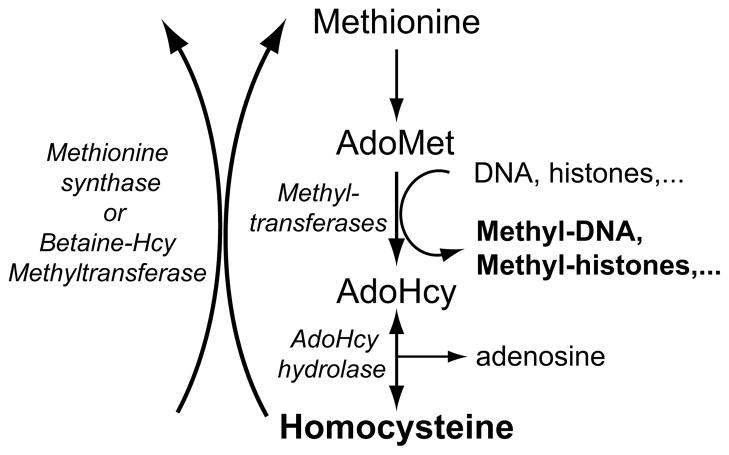
S-adenosyl-methionine (AdoMet) is the primary source of methyl groups for hundreds of transmethylases that methylate DNA, RNA, histones, other proteins, and small biological molecules. Following transfer of methyl groups, S-adenosyl-homocysteine (AdoHcy) is formed. Accumulation of AdoHcy can inhibit methyltranferases. The hydrolysis of AdoHcy yields homocysteine (Hcy) and adenosine. Intracellular homocysteine can be removed from the cell, reform AdoHcy, become further metabolized in the transsulfuration pathways (not illustrated), or become methylated to form methionine by the folate-dependent methionine synthase or the folate-independent betaine-Hcy methyltransferase.
References
-
- Campos EI, Reinberg D. Histones: annotating chromatin. Annu Rev Genet. 2009;43:559–599. - PubMed
-
- Fedorova E, Zink D. Nuclear architecture and gene regulation. Biochim Biophys Acta. 2008;1783:2174–2184. - PubMed
-
- Bird AP. CpG-rich islands and the function of DNA methylation. Nature. 1986;321:209–213. - PubMed
-
- Lister R, Pelizzola M, Dowen RH, Hawkins RD, Hon G, Tonti-Filippini J, Nery JR, Lee L, Ye Z, Ngo QM, Edsall L, Antosiewicz-Bourget J, Stewart R, Ruotti V, Millar AH, Thomson JA, Ren B, Ecker JR. Human DNA methylomes at base resolution show widespread epigenomic differences. Nature. 2009;462:315–322. - PMC - PubMed
-
- Reik W. Stability and flexibility of epigenetic gene regulation in mammalian development. Nature. 2007;447:425–432. - PubMed
Publication types
MeSH terms
Substances
Grants and funding
LinkOut - more resources
Full Text Sources
Other Literature Sources
