. 2011 Jun;121(6):2493-503.
doi: 10.1172/JCI46216. Epub 2011 May 16.

A mycolic acid-specific CD1-restricted T cell population contributes to acute and memory immune responses in human tuberculosis infection

Affiliations

A mycolic acid-specific CD1-restricted T cell population contributes to acute and memory immune responses in human tuberculosis infection

Damien J Montamat-Sicotte et al. J Clin Invest. 2011 Jun.

Abstract

Current tuberculosis (TB) vaccine strategies are largely aimed at activating conventional T cell responses to mycobacterial protein antigens. However, the lipid-rich cell wall of Mycobacterium tuberculosis (M. tuberculosis) is essential for pathogenicity and provides targets for unconventional T cell recognition. Group 1 CD1-restricted T cells recognize mycobacterial lipids, but their function in human TB is unclear and their ability to establish memory is unknown. Here, we characterized T cells specific for mycolic acid (MA), the predominant mycobacterial cell wall lipid and key virulence factor, in patients with active TB infection. MA-specific T cells were predominant in TB patients at diagnosis, but were absent in uninfected bacillus Calmette-Guérin-vaccinated (BCG-vaccinated) controls. These T cells were CD1b restricted, detectable in blood and disease sites, produced both IFN-γ and IL-2, and exhibited effector and central memory phenotypes. MA-specific responses contracted markedly with declining pathogen burden and, in patients followed longitudinally, exhibited recall expansion upon antigen reencounter in vitro long after successful treatment, indicative of lipid-specific immunological memory. T cell recognition of MA is therefore a significant component of the acute adaptive and memory immune response in TB, suggesting that mycobacterial lipids may be promising targets for improved TB vaccines.


Figures
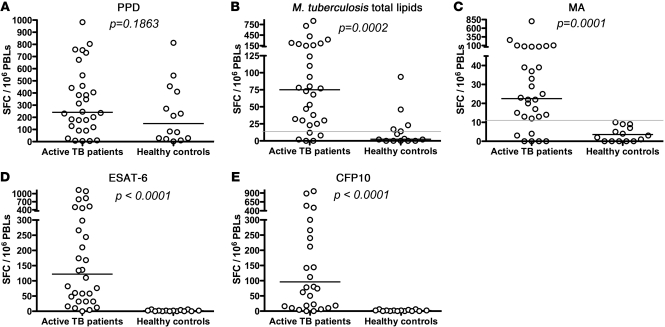
Figure 1
Figure 1. T cell responses to M. tuberculosis peptide and lipid antigens in active TB patients and BCG-vaccinated healthy donors.
PBLs from 30 untreated TB patients and 14 BCG-vaccinated healthy donors were incubated overnight in the presence of autologous blood monocyte–derived DCs pulsed with (A) PPD, (B) M. tuberculosis total lipids, (C) MA, (D) ESAT-6, or (E) CFP10. The production of IFN-γ was measured by IFN-γ ELISpot. Horizontal bars represent the median of each population. The gray lines in B and C represent the limit of detection for this assay and the cut-off for a positive response.
Figure 2
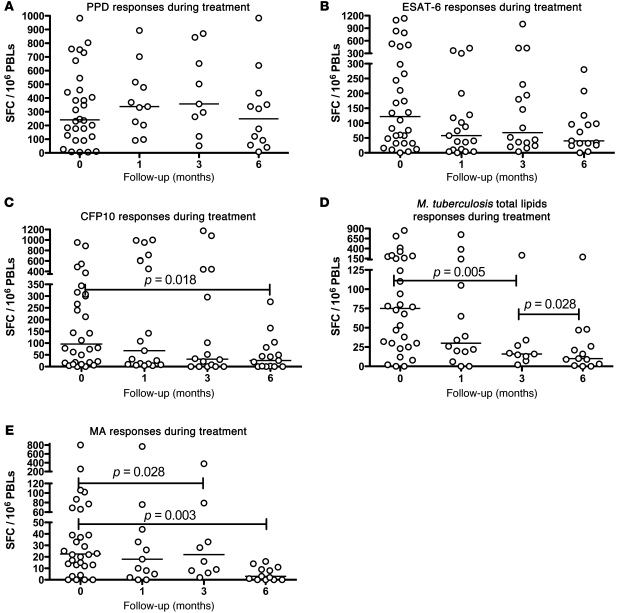
Figure 2. T cell responses to M. tuberculosis antigens in TB patients during and after treatment.
PBLs from active TB patients were incubated overnight in the presence of autologous blood monocyte–derived DCs pulsed with (A) PPD, (B) ESAT-6, or (C) CFP10, (D) M. tuberculosis total lipids, or (E) MA. IFN-γ production in response to these antigens was measured in patients at 4 different stages of treatment: diagnosis and 1, 3, and 6 months after treatment using an IFN-γ ELISpot. Horizontal bars represent the median of each population.
Figure 3
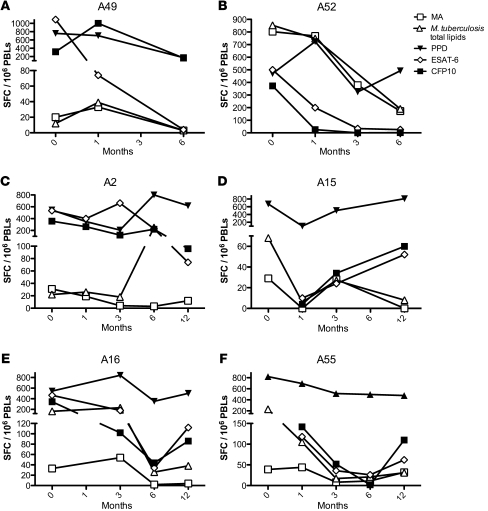
Figure 3. Longitudinal study of T cell responses to M. tuberculosis antigens in TB patients during treatment.
IFN-γ production from 6 TB patients in response to MA, M. tuberculosis total lipids, PPD, ESAT-6, and CFP10 was serially monitored from diagnosis up to 6 months after diagnosis for 2 patients (A and B; patients A49 and A52) and for 12 months after diagnosis for 4 patients (CF; patients A2, A15, A16, and A55) using IFN-γ ELISpot.
Figure 4
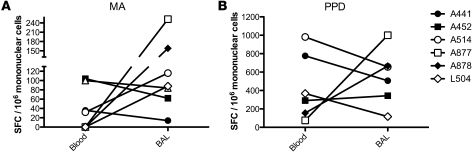
Figure 4. MA- and PPD-specific T cell responses from the blood and the BAL of TB patients.
PBLs and BALMCs from 6 active TB patients (A441, A452, A501, A514, A877, A878) and 1 person with LTBI (L504) were incubated overnight in the presence of blood monocyte–derived DCs pulsed with either PI (negative control; data not shown) (A) MA or (B) PPD. IFN-γ production was measured by IFN-γ ELISpot.
Figure 5
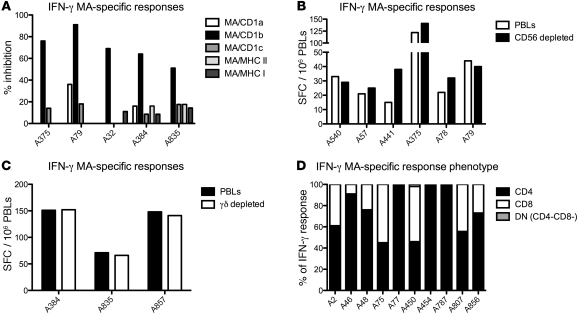
Figure 5. Functional characterization of MA-specific T cells.
(A) PBLs from active TB patients were incubated overnight with MA-pulsed DCs in the presence of an isotype control antibody, anti-CD1a, anti-CD1b, anti-CD1c, anti-HLA ABC, or anti–HLA-DP, -DQ, -DR. IFN-γ response was analyzed using ELISPOT. PBLs from active TB patients were depleted of CD56+ cells (B) and γδ T cells (C) and incubated overnight with MA-pulsed DCs. IFN-γ–secreting T cells were quantified by ex vivo ELISPOT. (D) CD4/CD8 phenotype was assessed for PBLs from 10 active TB patients incubated in the presence of blood monocyte–derived DCs pulsed with MA or PI. IFN-γ–producing T cells were enriched through magnetic separation and analyzed by flow cytometry. Absolute values of IFN-γ–producing cells per 100,000 PBLs after enrichment were as follows for CD4+, CD8+, and double-negative (DN) cells: A2 (24, 15, 0 per hundred thousand [pht]); A46 (140, 14, 0 pht); A48 (56, 18, 0 pht); A75 (7, 9, 0 pht); A77 (9, 6, 0 pht); A454 (226, 0, 0 pht); A450 (463, 522, 20 pht); A787 (78, 0, 0 pht); A807 (72, 3, 0 pht); A856 (19, 6, 0 pht).
Figure 6
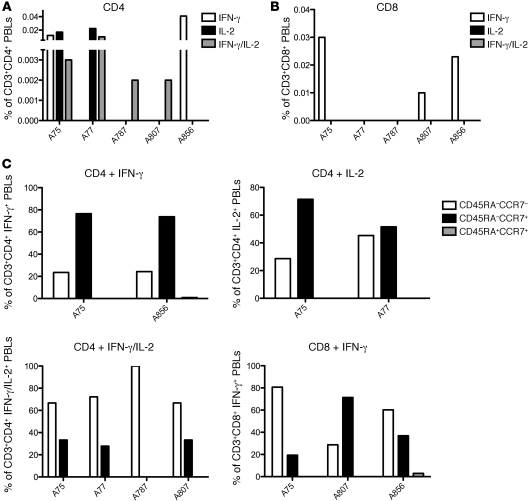
Figure 6. Phenotypic characterization of MA-specific T cells.
PBLs from 5 active untreated TB patients were incubated in the presence of blood-derived DCs pulsed with PI or MA. IFN-γ– and IL-2–producing T cells were enriched through magnetic separation and stained with anti-CD3, anti-CD4, anti-CD8, anti-CCR7, anti-CD45RA, and 7-AAD. Stained cells were analyzed by flow cytometry. (AB) IFN-γ and IL-2 secretion from MA-specific CD4+ T cells (A) and MA-specific CD8+ T cells (B). (C) CD45RA and CCR7 cell-surface marker phenotype of MA-specific T cells of different functional subsets and CD4/CD8 phenotypes according to cytokine production.
Figure 7
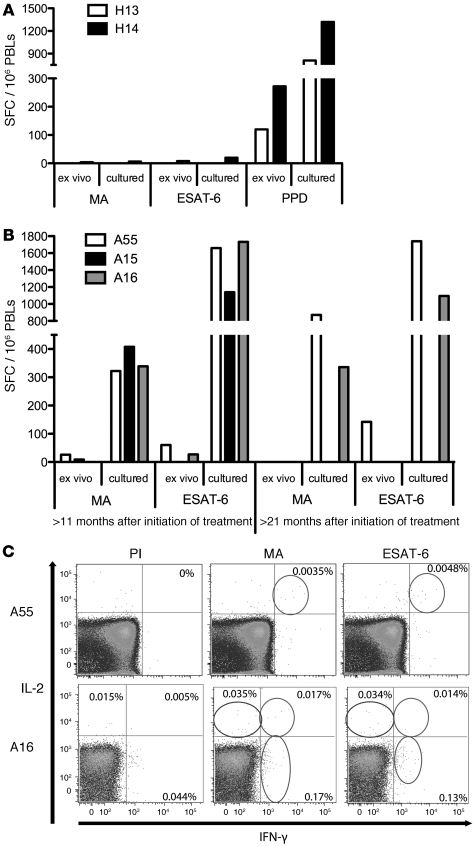
Figure 7. Expansion of MA-specific T cell responses from the blood of TB patients more than 6 months after curative treatment.
PBLs from (A) 2 healthy donors (H13, H14) and (B) 3 TB patients (A15, A16, and A55 bled 27, 21, and 11 months after initiation of treatment, respectively, and 10 months later) were incubated for 14 days in the presence of blood monocyte–derived DCs pulsed with PI, MA, ESAT-6, or PPD. Cultured T cells were then harvested and restimulated with blood-derived DCs pulsed with their respective antigens, and results analyzed by ELISpot. (C) Direct ex vivo staining of uncultured PBLs from patients A55 and A16 (21 and 37 months after treatment initiation, respectively). PBLs were incubated in the presence of monocyte-derived DCs pulsed with PI, MA, or ESAT-6. IFN-γ– and IL-2–producing T cells were enriched through magnetic separation and stained with anti-CD3, anti-CD4, anti-CD8, anti-CCR7, and anti-CD45RA. Stained cells were analyzed by flow cytometry. Circles represent positive dual IFN-γ/IL-2–secreting T cells (top right quadrants); positive IL-2–only–secreting T cells (top left quadrants); and positive IFN-γ–only–secreting T cells (bottom right quadrants). Percentages of live CD3+ cells are shown in each quadrant in which a response was present.

References

    1. WHO. Global tuberculosis control; epidemiology, strategy, financing. In:World Health Report 2009 . Geneva, Switzerland: World Health Organization; 2009:6–33.
    1. Kaufmann SH, McMichael AJ. Annulling a dangerous liaison: vaccination strategies against AIDS and tuberculosis. Nat Med. 2005;11(4 suppl):S33–S44. - PMC - PubMed
    1. Dye C. Doomsday postponed? Preventing and reversing epidemics of drug-resistant tuberculosis. Nat Rev Microbiol. 2009;7(1):81–87. doi: 10.1038/nrmicro2048. - DOI - PubMed
    1. Colditz GA, et al. Efficacy of BCG vaccine in the prevention of tuberculosis. Meta-analysis of the published literature. Jama. 1994;271(9):698–702. doi: 10.1001/jama.271.9.698. - DOI - PubMed
    1. Kaufmann SH, Baumann S, Nasser Eddine A. Exploiting immunology and molecular genetics for rational vaccine design against tuberculosis. Int J Tuberc Lung Dis. 2006;10(10):1068–1079. - PubMed

Publication types

MeSH terms