


doi: 10.1063/1.3580763.
Epub 2011 Apr 20.
Feasibility of noninvasive cavitation-guided blood-brain barrier opening using focused ultrasound and microbubbles in nonhuman primates
- PMID: 21580802
- PMCID: PMC3094460
- DOI: 10.1063/1.3580763
Item in Clipboard
Feasibility of noninvasive cavitation-guided blood-brain barrier opening using focused ultrasound and microbubbles in nonhuman primates
Appl Phys Lett.
.
Abstract
In vivo transcranial and noninvasive cavitation detection with blood-brain barrier (BBB) opening in nonhuman primates is hereby reported. The BBB in monkeys was opened transcranically using focused ultrasound (FUS) in conjunction with microbubbles. A passive cavitation detector, confocal with the FUS transducer, was used to identify and monitor the bubble behavior. During sonication, the cavitation spectrum, which was found to be region-, pressure-, and bubble-dependent, provided real-time feedback regarding the opening occurrence and its properties. These findings demonstrate feasibility of transcranial, cavitation-guided BBB opening using FUS and microbubbles in noninvasive human applications.
Figures
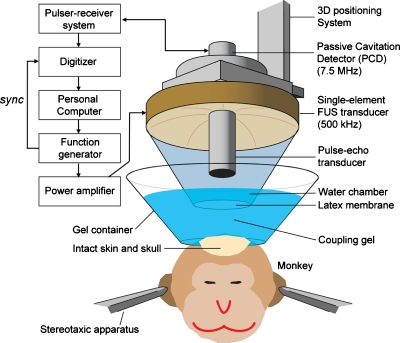
Experimental setup of in vivo FUS-induced BBB opening and transcranial cavitation detection in the monkey. A 7.5 MHz pulse-echo transducer served as the PCD.
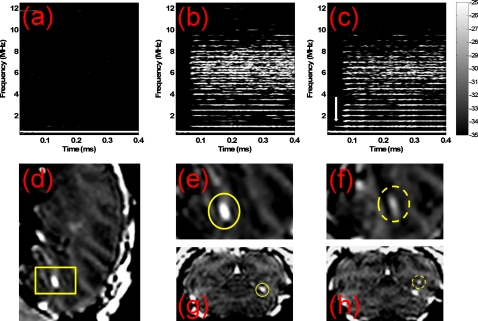
The BBB opening in Monkey 1 confirmed by 3D-MRI images. No higher harmonics or broadband response are detected at 0.30 MPa in (a) the spectrogram without microbubble administration. The corresponding spectrogram of the first pulse with microbubbles administration shows that the broadband acoustic emissions are detected at (b) 0.30 MPa and (c) 0.45 MPa. The 3D-MR images confirm that the BBB is opened at (d), (e), and (g)] 0.30 MPa and (f) and (h) 0.45 MPa with inertial cavitation. The yellow box in the sagittal plane in (d) defines a region of interest from which images in (e) and (f) were acquired. The coronal plane with BBB opening is provided at (g) 0.30 MPa and (h) 0.45 MPa. The vertical white arrow in (c) indicates that the time-point of occurrence of the second harmonic coincides with the travel distance to the skull.
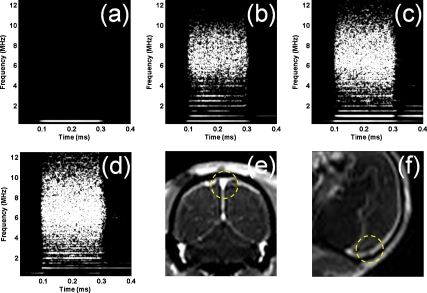
(a) The spectrogram without microbubble administration shows that all the harmonics and broadband response are from microbubbles. Spectrograms during FUS sonication with monkey 2 at (b) 0.20 MPa, (c) 0.25 MPa, (d) 0.30 MPa, and MR images with (e) coronal and (f) sagittal planes show that the broadband response is detected at all pressure but no BBB opening is induced (yellow circle).
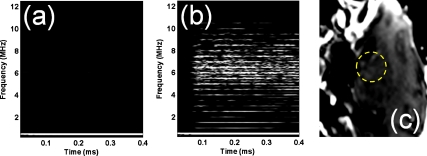
(a) Spectrogram without microbubble administration shows that all the harmonics and broadband response correspond microbubbles. (b) Spectrogram at 0.45 MPa shows that ultraharmonic and broadband response occurred. The MR image with (c) sagittal plane, however, shows that no BBB opening is induced in the sonicated region (yellow circle).
References
Grants and funding
LinkOut - more resources
Full Text Sources
Other Literature Sources