. 2011 Jul;81(1):192-205.
doi: 10.1111/j.1365-2958.2011.07688.x. Epub 2011 May 17.

The SLH-domain protein BslO is a determinant of Bacillus anthracis chain length

Affiliations

The SLH-domain protein BslO is a determinant of Bacillus anthracis chain length

Valerie J Anderson et al. Mol Microbiol. 2011 Jul.

Abstract

The Gram-positive pathogen Bacillus anthracis grows in characteristic chains of individual, rod-shaped cells. Here, we report the cell-separating activity of BslO, a putative N-acetylglucosaminidase bearing three N-terminal S-layer homology (SLH) domains for association with the secondary cell wall polysaccharide (SCWP). Mutants with an insertional lesion in the bslO gene exhibit exaggerated chain lengths, although individual cell dimensions are unchanged. Purified BslO complements this phenotype in trans, effectively dispersing chains of bslO-deficient bacilli without lysis and localizing to the septa of vegetative cells. Compared with the extremely long chain lengths of csaB bacilli, which are incapable of binding proteins with SLH-domains to SCWP, bslO mutants demonstrate a chaining phenotype that is intermediate between wild-type and csaB. Computational simulation suggests that BslO effects a non-random distribution of B. anthracis chain lengths, implying that all septa are not equal candidates for separation.


Figures

Fig. 1
Fig. 1. Isolation of a B. anthracis bslO mutant with septum cleavage defect
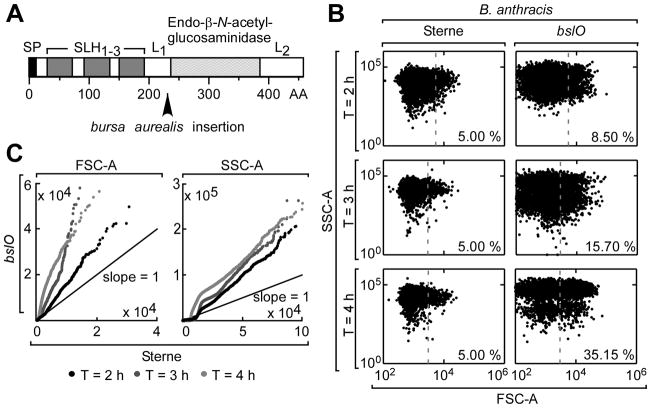
A. Schematic of the domain organization of the bslO open reading frame. The black arrow indicates the size of the truncated translational product expected as a result of bursa aurealis insertion in the bslO gene. SP, SLH1–3, L1 and L2 indicate the BslO signal peptide, surface-layer homology domain triplet and linker region 1 and 2, respectively. The putative enzymatic domain flanked by L1 and L2 is predicted to function as an endo-β-N-acetyl-glucosaminidase. B. Flow cytometry scatter plots of light side-scatter (SSC-A) versus light forward-scatter (FSC-A) of fixed, vegetative B. anthracis Sterne (left) or bslO mutant (right) cells 2, 3 and 4 h post-germination. Each panel represents events (N = 10,000) gated on values larger than that of a fixed, non-germinated spore population. Gray broken line denotes 95th FSC-A of Sterne population for each time point indicated and the percentages of each population exceeding the Sterne 95th percentile is given in the bottom right of each panel. C. Scatter plot of magnitude-sorted FSC-A (left) and SSC-A (right) data in A), plotting age-matched bslO cohorts against B. anthracis Sterne cohorts. (Black: 2 h post-germination; dark gray: 3 h post-germination,; light gray: 4 h post-germination, black line-1:1 unity reference line).
Fig. 2
Fig. 2. Morphological phenotypes of bslO mutant B. anthracis
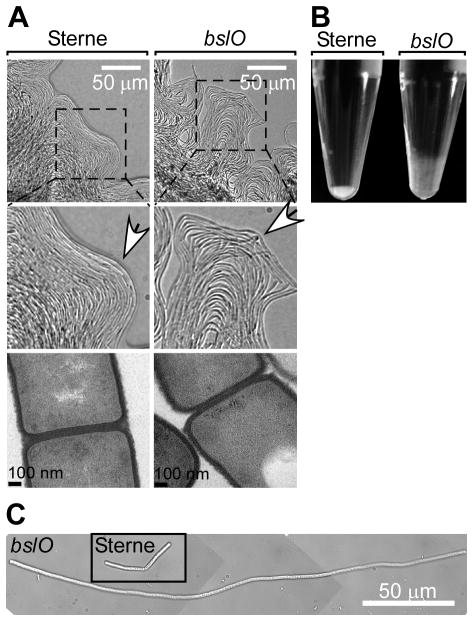
A. Differential-interference contrast (DIC) micrographs of the edges of a B. anthracis Sterne (left) or a bslO mutant(right) colony as grown on LB agar (400 × magnification). White arrows on insets point out irregular contours of bslO colony margins. Thin-section transmission electron microscopy(TEM)images of B. anthracis Sterne (left) and bslO mutant bacilli (right) show comparable cell wall and septal architecture. B. Photograph of culture sediments in eppendorf tubes after centrifugation (18,000 ×g) of B. anthracis Sterne (left) or bslO mutant bacilli (right) grown in LB. C. DIC micrographs of a bslO mutant or B. anthracis Sterne (inset) 4 h post-germination in LB.
Fig. 3
Fig. 3. Role of bslO with respect to B. anthracis growth phase and chain length
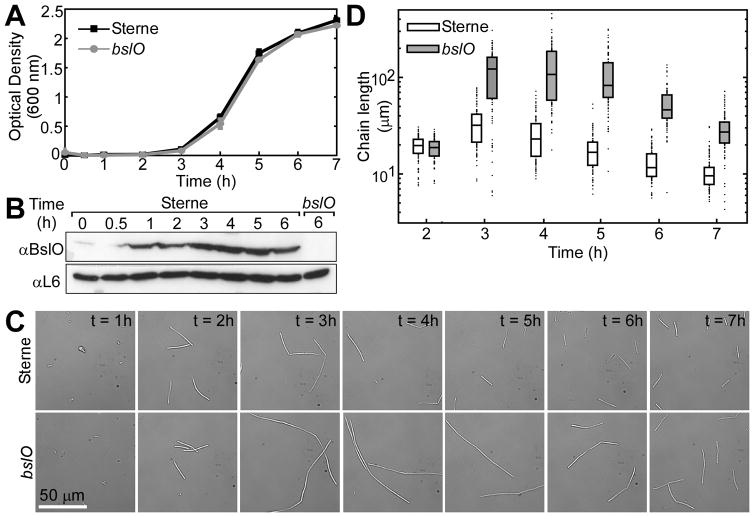
A. Growth curve of B. anthracis Sterne (black squares) and its bslO mutant (gray circles) germinated in LB at 37 °C as determined by optical density (Abs600 nm). Bars indicate standard deviation (N = 3). B. Immunoblots of total bacterial extracts from mechanically-lysed bacilli probing with polyclonal rabbit antibodies specific for BslO or the ribosomal subunit L6 (loading control). C. DIC micrographs of vegetative bacilli grown as shown in Panel A and fixed at the indicated time points (1000× magnification). D. Box and whisker plot of B. anthracis Sterne (white) and bslO (gray) chain lengths in A (N=100) measured from DIC micrographs as shown in D at indicated time points. Box bounds 25th and 75th percentiles. Black bar denotes sample median and black circles represent first and fourth quartile. Data represents 1 of 3 independent biological replicates.
Fig. 4
Fig. 4. Cis and trans complementation of bslO mutant bacilli
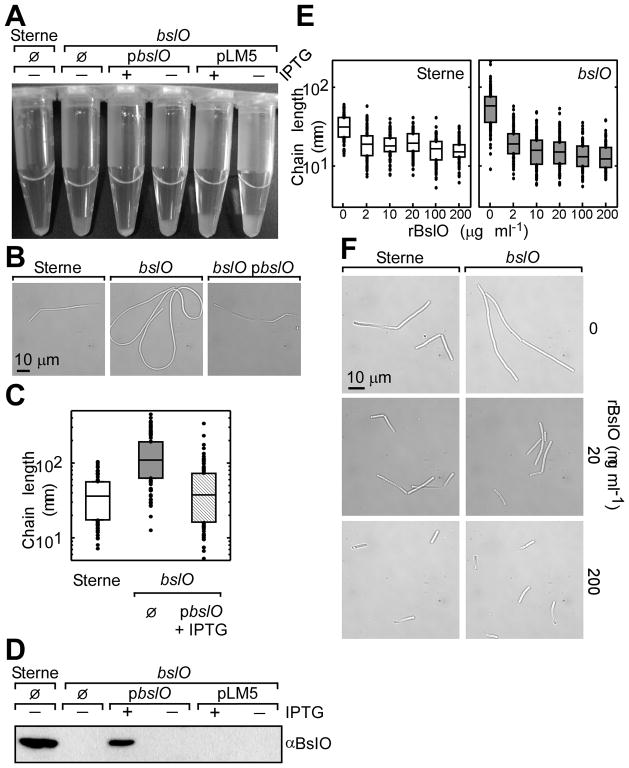
A. Photograph of culture sediments in eppendorf tubes after centrifugation (18,000 ×g) of B. anthracis Sterne or bslO mutant bacilli transformed with mock (O), plasmid pbslO or empty vector control(pLM5). IPTG was added to induce expression of plasmid encoded bslO. B. DIC micrographs of representative B. anthracis Sterne, bslO and bslO (pbslO)(+IPTG) bacilli during exponential growth. C. Box and whisker plot of B. anthracis Sterne (white), bslO (dark gray) and complemented strain[bslO (pbslO)] grown in the presence of 1 mM IPTG(lines) chain lengths (N=100) measured from DIC micrographs 4 h post-germination. Box bounds 25th and 75th percentiles. Black bar denotes sample median and black circles represent first and fourth quartile. Data represents 1 of 2 independent biological replicates. D. Immunoblot of total protein preparations of cultures from Panel A with polyclonal rabbit antibodies specific for BslO, verifying the restoration of BslO protein production in the presence of the complementation vector and inducer. E. Box plots of bslO mutant (top) or B. anthracis Sterne (bottom) chain lengths(N=100) measured from DIC micrographs after treatment with increasing concentrations of recombinant, purified rBslO. Box bounds 25th and 75th percentiles. Black bar denotes sample median and black circles represent first and fourth quartile. Data represents 1 of 2 independent biological replicates. F. DIC micrographs of vegetative B. anthracis Sterne or blsO mutant bacilli with or without rBslO treatment (20 or 200 μg·ml−1)for 1 hour at 37°C (1000× magnification).
Fig. 5
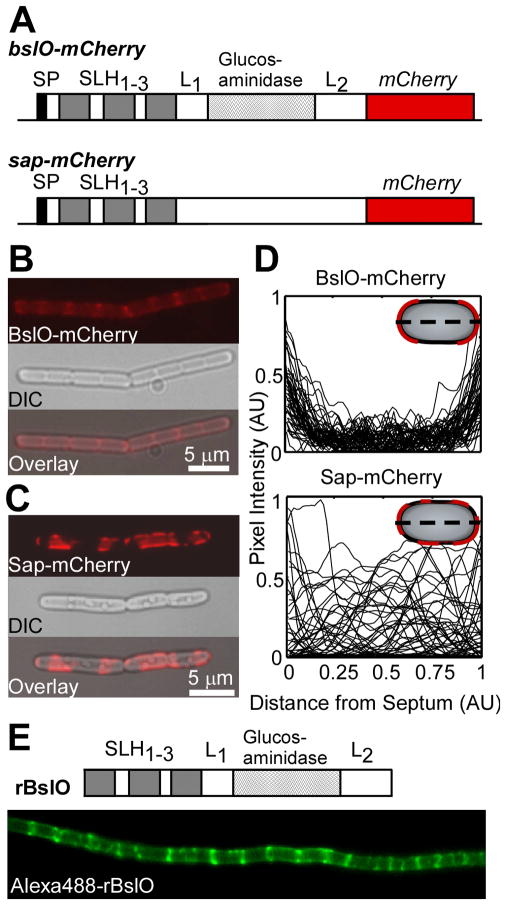
Fig. 5. BslO-mCherry and rBslO localize to cell septa
A. Schematic of the domain organization of bslO (top)and the S-layer protein sap (bottom) open reading frames as C-terminal translational hybrids to the fluorescent protein (mcherry) on the chromosome of B. anthracis Sterne. B,C. Red fluorescence channel (top), DIC (middle) and overlay (bottom) of a representative bslO-mcherry (B) and sap-mcherry (C) bacillus during exponential growth. D. Red epifluorescence line plots of intensity normalized (0–1) by the dimmest and brightest pixels observed, respectively. The transects constitute the major axis of individual bslO-mcherry (top) or sap-mcherry (bottom) cells, normalized (0 to 1)by the length of each cell. Cartoon bacilli (gray ovals) in the upper right depict the position of the intensity transects (broken black line) and representative fluorescent hybrid protein distributions (red). E. Schematic of the domain organization of rBslO as purified from E. coli (top). Micrographs of Alexafluor488-conjugated rBslO incubated with bslO bacilli shows that the recombinant protein preferentially localizes to cell septa.
Fig. 6
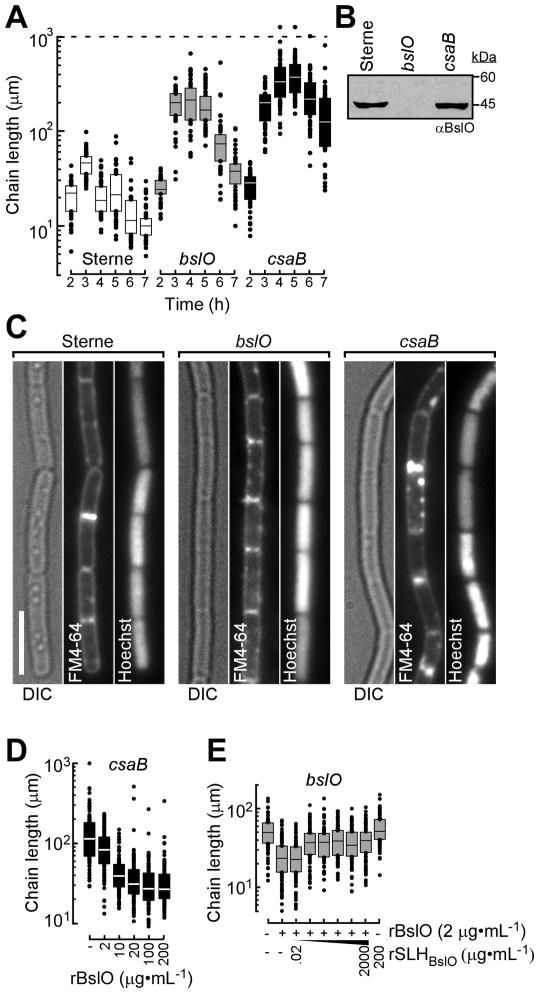
Fig. 6. rBslO activity on csaB bacilli
A. box and whisker plot of germinated B. anthracis Sterne (white) and bslO (gray) or csaB mutant bacilli (black) chain lengths (N=100) measured from phase micrographs at indicated time points. Box bounds 25th and 75th percentiles. Black bar denotes sample median and black circles represent first and fourth quartile. Data represents 1 of 3 independent biological replicates. B. Immunoblot of total protein preparations of B. anthracis Sterne, bslO and csaB mutant cultures with polyclonal antibodies specific for BslO, verifying the production of BslO by csaB mutant bacilli. C. Representative DIC and fluorescent micrographs of B. anthracis Sterne, bslO and csaB mutant bacilli stained with Hoechst (DNA/blue) and FM4–64 (membrane/red)to analyze chromosome partitioning and cell separation. D. Box and whisker plot of csaB mutant chain lengths (N=100) measured from phase micrographs after 1 h incubation (37 °C) with rBslO at indicated concentrations. Box bounds 25th and 75th percentiles. White bar denotes sample median and black circles represent first and fourth quartile. Data represents 1 of 3 independent biological replicates. E. Box and whisker plot of bslO mutant chain lengths (N=100) measured from phase micrographs after 1 h incubation (37°C) with a mixture of rBslO and purifiedSLH1–3 − domain of BslO at concentrations indicated. Box bounds 25th and 75th percentiles. Black bar denotes sample median and black circles represent first and fourth quartile. Data represents 1 of 2 independent biological replicates.
Fig. 7
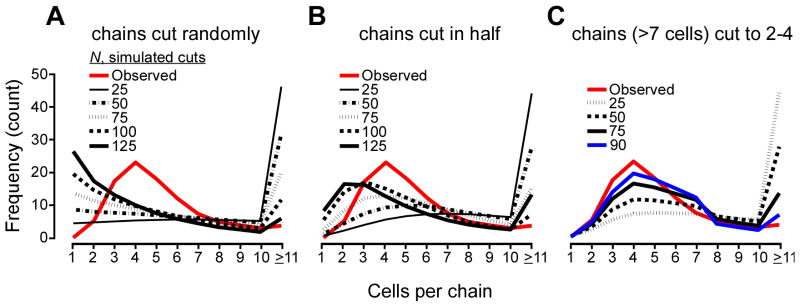
Fig. 7. Simulations of BslO-mediated separation of B. anthracis chains
A. Mean curves of cell-per-chain distributions given BslO has an equal probability of cleaving any septum. B. Mean curves of cell-per-chain distributions given BslO acts on the center-most septum of a randomly-selected chain. C. Mean curves of cell-per-chain distributions given BslO may only cleave septa of bacilli that are minimally 8 cells per chain in length and only at septa that liberate daughter cells of a minimum length drawn randomly from the set [2,2,3,3,3,4]. The red curve indicates the cell-per-chain distribution of observed chain lengths estimated from 1,000 iterations. The remaining curves are the mean of 10,000 simulations of iterative cleavage events as indicated. The red box shows which cells are candidates for cleavage, given the lengths of the cartoon bacilli. The bracketed chains below indicate all possible outcomes that satisfy each model’s rule(s) for cleavage events.

References

    1. Abramoff M, Magelhaes P, Ram S. Image processing with ImageJ. Biophotonics International. 2004;11:36–42.
    1. Ahn JS, Chandramohan L, Liou LE, Bayles KW. Characterization of CidR-mediated regulation in Bacillus anthracis reveals a previously undetected role of S-layer proteins as murein hydrolases. Mol Microbiol. 2006;62:1158–1169. - PubMed
    1. Allman R, Hann AC, Manchee R, Lloyd D. Characterization of bacteria by multiparameter flow cytometry. J Appl Bacteriol. 1992;73:438–444. - PubMed
    1. Baba T, Schneewind O. Targeting of muralytic enzymes to the cell division site of Gram-positive bacteria: repeat domains direct autolysin to the equatorial surface ring of Staphylococcus aureus. EMBO J. 1998;17:4639–4646. - PMC - PubMed
    1. Bendtsen JD, Nielsen H, von Heijne G, Brunak S. Improved prediction of signal peptides: SignalP 3.0. J Mol Biol. 2004;340:783–795. - PubMed

Publication types

MeSH terms