


Structural and cellular characterization of electrospun recombinant human tropoelastin biomaterials
- PMID: 21586601
- PMCID: PMC3358515
- DOI: 10.1177/0885328211399480
Structural and cellular characterization of electrospun recombinant human tropoelastin biomaterials
Abstract
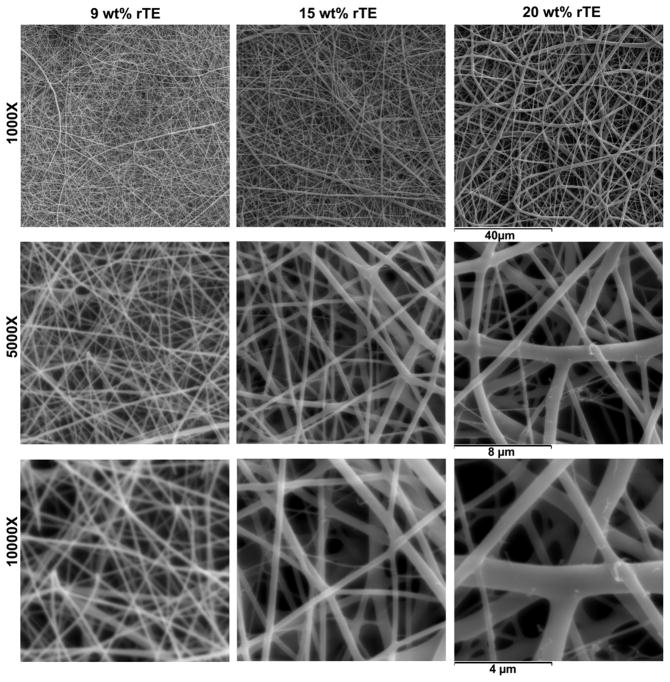
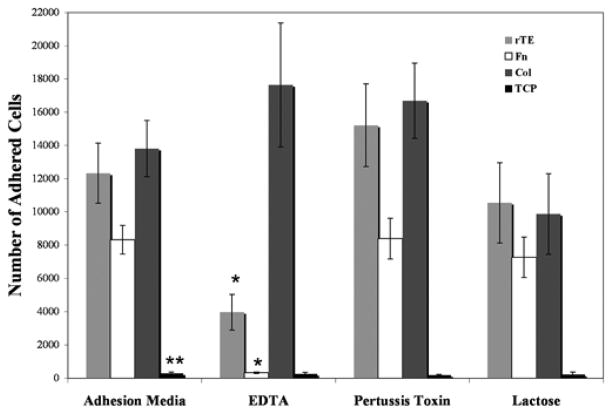
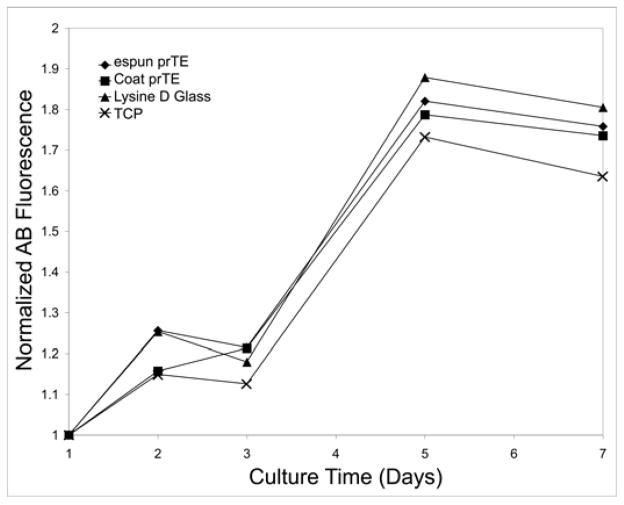
An off-the-shelf vascular graft biomaterial for vascular bypass surgeries is an unmet clinical need. The vascular biomaterial must support cell growth, be non-thrombogenic, minimize intimal hyperplasia, match the structural properties of native vessels, and allow for regeneration of arterial tissue. Electrospun recombinant human tropoelastin (rTE) as a medial component of a vascular graft scaffold was investigated in this study by evaluating its structural properties, as well as its ability to support primary smooth muscle cell adhesion and growth. rTE solutions of 9, 15, and 20 wt% were electrospun into sheets with average fiber diameters of 167 ± 32, 522 ± 67, and 735 ± 270 nm, and average pore sizes of 0.4 ± 0.1, 5.8 ± 4.3, and 4.9 ± 2.4 µm, respectively. Electrospun rTE fibers were cross-linked with disuccinimidyl suberate to produce an insoluble fibrous polymeric recombinant tropoelastin (prTE) biomaterial. Smooth muscle cells attached via integrin binding to the rTE coatings and proliferated on prTE biomaterials at a comparable rate to growth on prTE coated glass, glass alone, and tissue culture plastic. Electrospun tropoelastin demonstrated the cell compatibility and design flexibility required of a graft biomaterial for vascular applications.
Figures


References
-
- Lloyd-Jones D, Adams RJ, Brown TM, Carnethon M, Dai S, De Simone G, Ferguson TB, Ford E, Furie K, Gillespie C, Go A, Greenlund K, Haase N, Hailpern S, Ho PM, Howard V, Kissela B, Kittner S, Lackland D, Lisabeth L, Marelli A, McDermott MM, Meigs J, Mozaffarian D, Mussolino M, Nichol G, Roger VL, Rosamond W, Sacco R, Sorlie P, Thom T, Wasserthiel-Smoller S, Wong ND, Wylie-Rosett J. Heart disease and stroke statistics--2010 update: a report from the American Heart Association. Circulation. 121(7):e46–e215. - PubMed
-
- Brewster DC. Prosthetic grafts. In: Rutherford RB, editor. Vascular Surgery. 4. Philadelphia: W. B. Saunders; 1995. pp. 492–521.
-
- Abbott WM, Rehring TF. Biologic and synthetic prosthetic materials for vascular conduits. In: Hobson RW, Wilson S, Veith FJ, editors. Vascular Surgery: Principles and Practice. 3. New York: Marcel Dekker; 2004. pp. 611–620.
-
- Sawyer PN, Fitzgerald J, Kaplitt MJ, Sanders RJ, Williams GM, Leather RP, Karmody A, Hallin RW, Taylor R, Fries CC. Ten year experience with the negatively charged glutaraldehyde-tanned vascular graft in peripheral vascular surgery. Initial multicenter trial. Am J Surg. 1987;154(5):533–7. - PubMed
-
- Dardik H, Wengerter K, Qin F, Pangilinan A, Silvestri F, Wolodiger F, Kahn M, Sussman B, Ibrahim IM. Comparative decades of experience with glutaraldehyde-tanned human umbilical cord vein graft for lower limb revascularization: an analysis of 1275 cases. J Vasc Surg. 2002;35(1):64–71. - PubMed
Publication types
MeSH terms
Substances
Grants and funding
LinkOut - more resources
Full Text Sources
Other Literature Sources
