


Longitudinal changes in Scores on the Autism Diagnostic Interview--Revised (ADI-R) in pre-school children with autism: Implications for diagnostic classification and symptom stability
- PMID: 21586639
- PMCID: PMC4426200
- DOI: 10.1177/1362361309358332
Longitudinal changes in Scores on the Autism Diagnostic Interview--Revised (ADI-R) in pre-school children with autism: Implications for diagnostic classification and symptom stability
Abstract
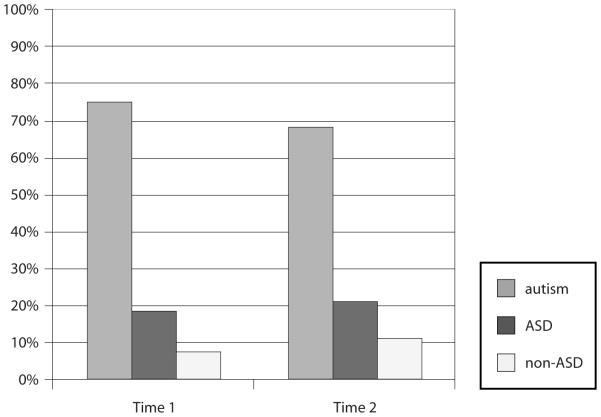
We prospectively examined mean changes in Autism Diagnostic Interview-Revised (ADI-R) Total and Domains scores and stability of the ADI-R diagnostic classification in 28 children with autism initially assessed at age 2-4 years and reassessed 2 years later. Mean Total, Social Interaction, and Communication scores decreased significantly from Time 1 to Time 2 Restricted/repetitive Domain mean scores did not change over time. The ADI-R diagnostic classification was stable in 67% of children using the current published criteria. The stability increased to 78% when a modified criterion was used in the Restricted/repetitive Domain and to 88% when the broader ASD criteria were used. Among pre-schoolers with autism, parent-reported symptoms decreased significantly at two-year follow-up in Social and Communication Domains but not in the Restricted/repetitive Domain. However, ADI-R diagnostic classification remained relatively stable over time. Revising ADI-R diagnostic criteria in the Restricted/repetitive Domain or including the broader ASD criteria may improve its sensitivity and diagnostic stability in younger children.
Figures
References
-
- American Psychiatric Association . Diagnostic and Statistical Manual of Mental Disorders, Fourth Edition,Text Revision (DSM-IV-TR®) APA Press; Washington, DC: 2000. Pervasive Developmental Disorders.
-
- Baranek G. Autism during Infancy: A Retrospective Video Analysis of Sensory-Motor and Social Behaviors at 9–12 Months of Age. Journal of Autism and Developmental Disorders. 1999;29:213–220. - PubMed
-
- Charman T, Taylor E, Drew A, Cockerill H, Brown J, Baird G. Outcomes at 7 Years of Children Diagnosed with Autism at Age 2: Predictive Validity of Assessments Conducted at 2 and 3 Years of Age and Pattern of Symptom Change over Time. Journal of Child Psychology and Psychiatry. 2005;46:500–513. - PubMed
-
- Chawarska K, Klin A, Volkmar F. Autism Spectrum Disorder in the Second Year: Stability and Change in Syndrome Expression. Journal of Child Psychology and Psychiatry. 2007;48:128–138. - PubMed
-
- Cox A, Klein K, Charman T, Baird G, Baron-Cohen S, Swettenham J, et al. Autism Spectrum Disorders at 20 and 42 Months of Age: Stability of Clinical and ADI-R Diagnosis. Journal of Child Psychology and Psychiatry. 1999;40:719–732. - PubMed
Publication types
MeSH terms
Grants and funding
LinkOut - more resources
Full Text Sources
