Review
. 2011 May;23(5):1685-99.
doi: 10.1105/tpc.111.083279. Epub 2011 May 17.

How can research on plants contribute to promoting human health?

Affiliations
Review

How can research on plants contribute to promoting human health?

Cathie Martin et al. Plant Cell. 2011 May.

Abstract

One of the most pressing challenges for the next 50 years is to reduce the impact of chronic disease. Unhealthy eating is an increasing problem and underlies much of the increase in mortality from chronic diseases that is occurring worldwide. Diets rich in plant-based foods are strongly associated with reduced risks of major chronic diseases, but the constituents in plants that promote health have proved difficult to identify with certainty. This, in turn, has confounded the precision of dietary recommendations. Plant biochemistry can make significant contributions to human health through the identification and measurement of the many metabolites in plant-based foods, particularly those known to promote health (phytonutrients). Plant genetics and metabolic engineering can be used to make foods that differ only in their content of specific phytonutrients. Such foods offer research tools that can provide significant insight into which metabolites promote health and how they work. Plant science can reduce some of the complexity of the diet-health relationship, and through building multidisciplinary interactions with researchers in nutrition and the pathology of chronic diseases, plant scientists can contribute novel insight into which foods reduce the risk of chronic disease and how these foods work to impact human health.


Figures
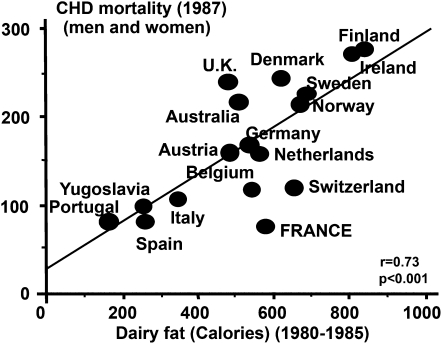
Figure 1.
Figure 1.
Relation between Age-Standardized Death Rate from Coronary Heart Disease (Mean for Men and Women) and Consumption of Dairy Fat in Countries Reporting Wine Consumption. Regression equation = y26.3 + 0.27 dairy fat. CHD, coronary heart disease. (Reprinted from Renaud and de Lorgeril [1992], Figure 1, with permission from Elsevier.)
Figure 2.
Figure 2.
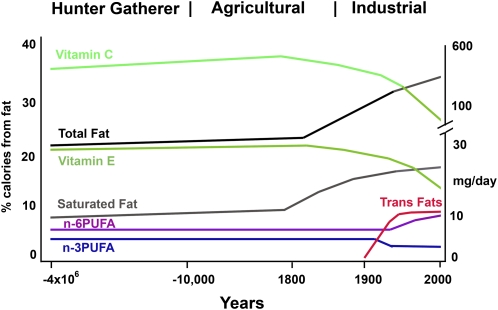
Hypothetical Scheme of Fat, Fatty Acid (ω6, ω3, trans, and Total) Intake (as Percentage of Calories from Fat) and Intake of Vitamins E and C (mg/day). Data were extrapolated from cross-sectional analyses of contemporary hunter-gatherer populations and from longitudinal observations and their putative changes during the preceding 100 years. Changes in average consumption of fruit and vegetables mirror changes in the intake of vitamin C ranging from estimates of 550 to 1800 g/day for hunter gatherers (Kuipers et al., 2010) to 77 to 770 g/day for current Europeans (Boffetta et al., 2010). (Adapted from Simopoulos [2002], Figure 1, with permission from Elsevier.)
Figure 3.
Figure 3.
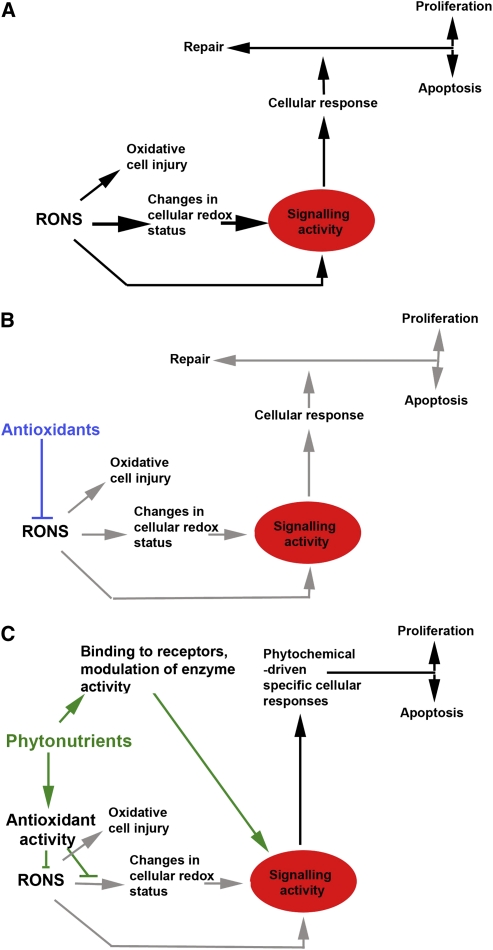
Classical View of How Antioxidants Influence Cell Signaling and Summary of the Current View of How Phytonutrients Impact Cell Signaling. (A) The classical view of oxidant–antioxidant effects on animal cell signaling and response. RONS can act on cell signaling, either directly or indirectly, through changes in the redox cellular equilibrium (e.g., a decrease in the reduced-to-oxidized glutathione ratio). (B) Antioxidants modulate RONS-mediated cell responses by shielding their reactivity or reducing their availability, at both the extracellular and the intracellular levels. (C) The current view of how phytonutrients impact cell signaling. Phytonutrients interact with cell signaling thanks to mechanisms independent of their antioxidant properties, by directly affecting the activities of a wide spectrum of cellular targets, including key enzymes and membrane and nuclear receptors. In the presence of perturbations in the cellular redox status, a combination of the two paths occurs. (Adapted from Virgili and Marino [2008], Figure 1, with permission from Elsevier.)
Figure 4.
Figure 4.
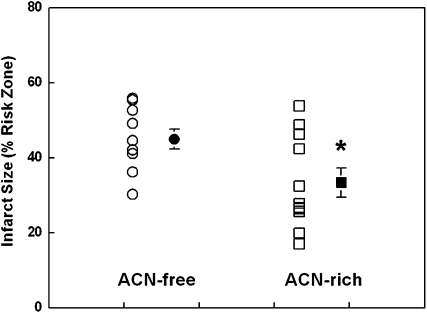
Effect of Chronic Consumption of Anthocyanins on the Sensitivity to ex Vivo Ischemia-Reperfusion Injury as Assessed by Infarct Size in Rats. Open symbols represent individual values, and closed symbols are means ± 6 se, n = 10/group. *Different from anthocyanin (ACN)-free; P < 0.05. (Reprinted from Toufektsian et al. [2008], Figure 2, with permission from the American Society for Nutrition.)
Figure 5.
Figure 5.
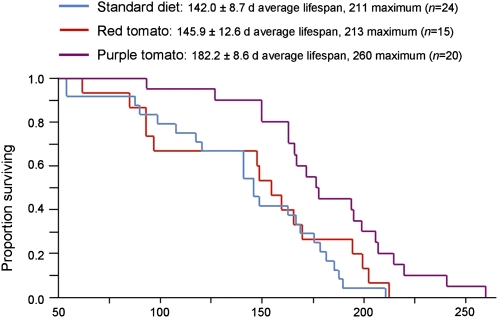
Life Expectancy of Trp53−/− Mice Fed the Standard Diet or Diets Supplemented with 10% Red or Purple Tomato Powder. Kaplan-Meier survival plot; errors given in ±se. (Reprinted from Butelli et al. [2008], Figure 4, with permission from Nature Biotechnology.)

References

    1. Albani D., Polito L., Signorini A., Forloni G. (2010). Neuroprotective properties of resveratrol in different neurodegenerative disorders. Biofactors 36: 370–376 - PubMed
    1. Allred C.D., Allred K.F., Ju Y.H., Virant S.M., Helferich W.G. (2001a). Soy diets containing varying amounts of genistein stimulate growth of estrogen-dependent (MCF-7) tumors in a dose-dependent manner. Cancer Res. 61: 5045–5050 - PubMed
    1. Allred C.D., Ju Y.H., Allred K.F., Chang J., Helferich W.G. (2001b). Dietary genistin stimulates growth of estrogen-dependent breast cancer tumors similar to that observed with genistein. Carcinogenesis 22: 1667–1673 - PubMed
    1. American Institute for Cancer Research (1997). World Cancer Research Fund Food Nutrition and the Prevention of Cancer: A Global Perspective. (Washington D.C.: American Institute for Cancer Research; ). - PubMed
    1. Asensi-Fabado M.A., Munné-Bosch S. (2010). Vitamins in plants: Occurrence, biosynthesis and antioxidant function. Trends Plant Sci. 15: 582–592 - PubMed

Publication types