


A multimarker QPCR-based platform for the detection of circulating tumour cells in patients with early-stage breast cancer
- PMID: 21587256
- PMCID: PMC3111197
- DOI: 10.1038/bjc.2011.164
A multimarker QPCR-based platform for the detection of circulating tumour cells in patients with early-stage breast cancer
Abstract
Background: The detection of circulating tumour cells (CTCs) has been linked with poor prognosis in advanced breast cancer. Relatively few studies have been undertaken to study the clinical relevance of CTCs in early-stage breast cancer.
Methods: In a prospective study, we evaluated CTCs in the peripheral blood of 82 early-stage breast cancer patients. Control groups consisted of 16 advanced breast cancer patients and 45 healthy volunteers. The CTC detection was performed using ErbB2/EpCAM immunomagnetic tumour cell enrichment followed by multimarker quantitative PCR (QPCR). The CTC status and common clinicopathological factors were correlated to relapse-free, breast cancer-related and overall survival.
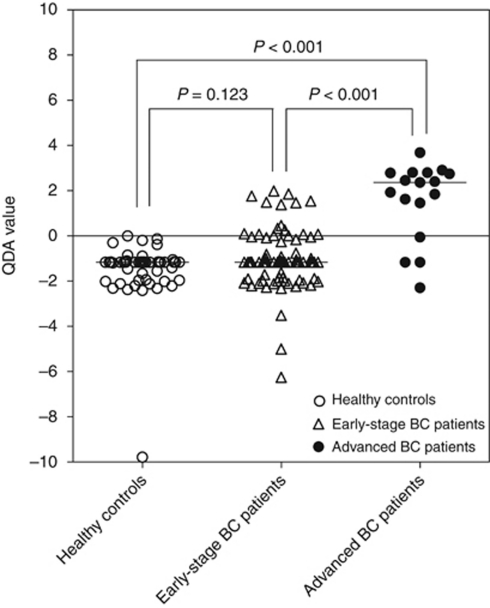
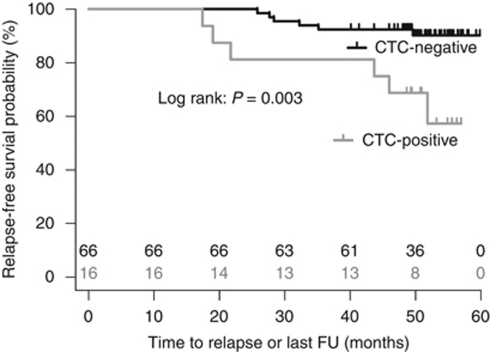
Results: Circulating tumour cells were detected in 16 of 82 (20%) patients with early-stage breast cancer and in 13 out of 16 (81%) with advanced breast cancer. The specificity was 100%. The median follow-up time was 51 months (range: 17-60). The CTC positivity in early-stage breast cancer patients resulted in significantly poorer relapse-free survival (log rank test: P=0.003) and was an independent predictor of relapse-free survival (multivariate hazard ratio=5.13, P=0.006, 95% CI: 1.62-16.31).
Conclusion: The detection of CTCs in peripheral blood of early-stage breast cancer patients provided prognostic information for relapse-free survival.
Figures
References
-
- Allard WJ, Matera J, Miller MC, Repollet M, Connelly MC, Rao C, Tibbe AG, Uhr JW, Terstappen LW (2004) Tumor cells circulate in the peripheral blood of all major carcinomas but not in healthy subjects or patients with nonmalignant diseases. Clin Cancer Res 10: 6897–6904 - PubMed
-
- Balic M, Dandachi N, Hofmann G, Samonigg H, Loibner H, Obwaller A, van der Kooi A, Tibbe AG, Doyle GV, Terstappen LW, Bauernhofer T (2005) Comparison of two methods for enumerating circulating tumor cells in carcinoma patients. Cytometry B Clin Cytom 68: 25–30 - PubMed
-
- Bieche I, Laurendeau I, Tozlu S, Olivi M, Vidaud D, Lidereau R, Vidaud M (1999) Quantitation of MYC gene expression in sporadic breast tumors with a real-time reverse transcription-PCR assay. Cancer Res 59: 2759–2765 - PubMed
-
- Bonnomet A, Brysse A, Tachsidis A, Waltham M, Thompson EW, Polette M, Gilles C (2010) Epithelial-to-mesenchymal transitions and circulating tumor cells. J Mammary Gland Biol Neoplasia 15: 261–273 - PubMed
-
- Bosma AJ, Weigelt B, Lambrechts AC, Verhagen OJ, Pruntel R, Hart AA, Rodenhuis S, van’t Veer LJ (2002) Detection of circulating breast tumor cells by differential expression of marker genes. Clin Cancer Res 8: 1871–1877 - PubMed
Publication types
MeSH terms
LinkOut - more resources
Full Text Sources
Medical
Research Materials
Miscellaneous
