. 2011 May 12;6(5):e14802.
doi: 10.1371/journal.pone.0014802.

Genetic classification of populations using supervised learning

Collaborators, Affiliations

Genetic classification of populations using supervised learning

Michael Bridges et al. PLoS One. .

Abstract

There are many instances in genetics in which we wish to determine whether two candidate populations are distinguishable on the basis of their genetic structure. Examples include populations which are geographically separated, case-control studies and quality control (when participants in a study have been genotyped at different laboratories). This latter application is of particular importance in the era of large scale genome wide association studies, when collections of individuals genotyped at different locations are being merged to provide increased power. The traditional method for detecting structure within a population is some form of exploratory technique such as principal components analysis. Such methods, which do not utilise our prior knowledge of the membership of the candidate populations. are termed unsupervised. Supervised methods, on the other hand are able to utilise this prior knowledge when it is available.In this paper we demonstrate that in such cases modern supervised approaches are a more appropriate tool for detecting genetic differences between populations. We apply two such methods, (neural networks and support vector machines) to the classification of three populations (two from Scotland and one from Bulgaria). The sensitivity exhibited by both these methods is considerably higher than that attained by principal components analysis and in fact comfortably exceeds a recently conjectured theoretical limit on the sensitivity of unsupervised methods. In particular, our methods can distinguish between the two Scottish populations, where principal components analysis cannot. We suggest, on the basis of our results that a supervised learning approach should be the method of choice when classifying individuals into pre-defined populations, particularly in quality control for large scale genome wide association studies.


Conflict of interest statement

Competing Interests: The authors have declared that no competing interests exist.

Figures

Figure 1
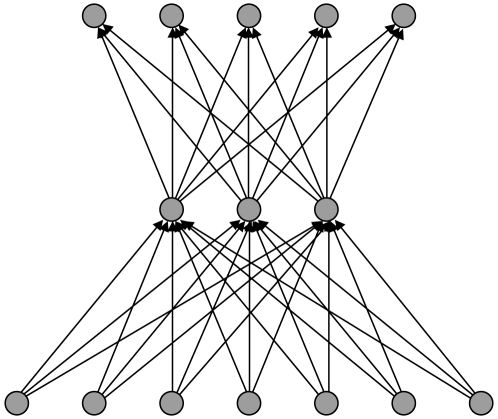
Figure 1. An example of a 3-layer neural network with 7 input nodes, 3 nodes in the hidden layer and 5 output nodes.
Each line represents one weight.
Figure 2
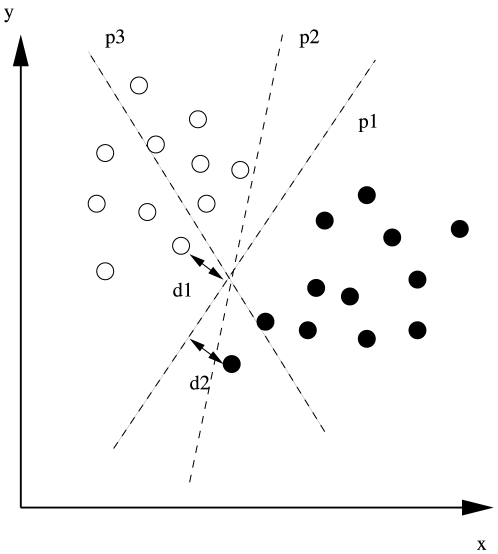
Figure 2. An example of a two-dimensional feature space for data of known class divided by three hyperplanes p1, p2 and p3.
Clearly p1 divides most efficiently.
Figure 3
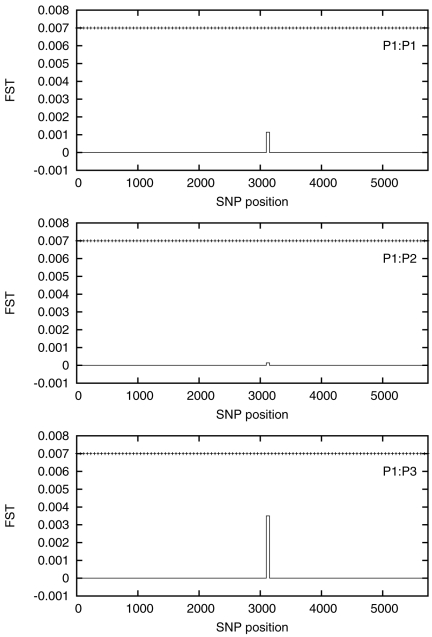
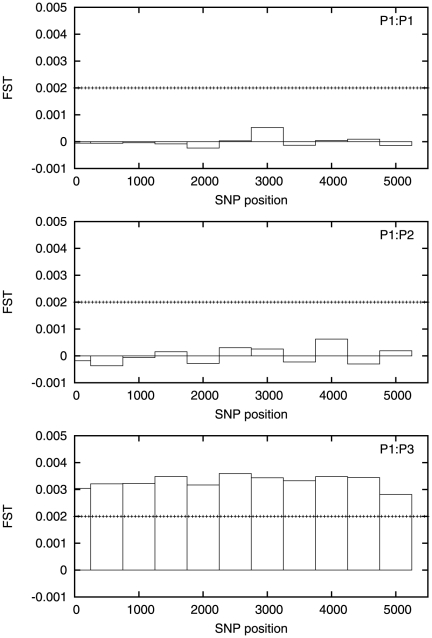
Figure 3. Estimated values for a 50 SNP sliding window for P1∶P1 (top), P1∶P2 (middle), P1∶P3 (bottom).
The formula image is essentially zero everywhere except for a small region approximately halfway along the chromosome. The horizontal dotted line is the value of formula image.
Figure 4
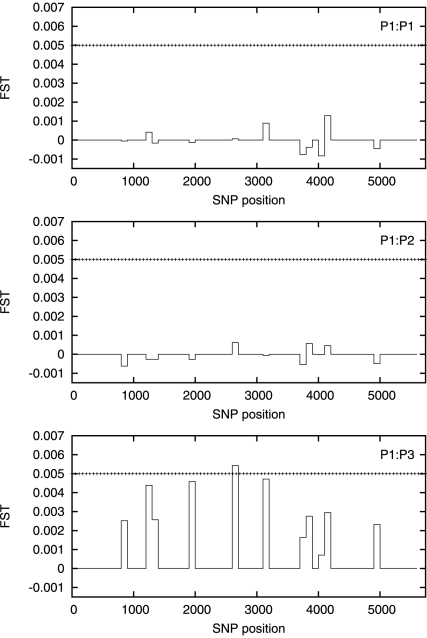
Figure 4. Estimated values for a 100 SNP sliding window for P1∶P1 (top), P1∶P2 (middle), P1∶P3 (bottom).
The horizontal dotted line is the value of formula image. Note that although formula image is always non-negative, the estimator may become negative for small values of formula image.
Figure 5
Figure 5. Estimated values for a 500 SNP sliding window for P1∶P1 (top), P1∶P2 (middle) and P1∶P3 (bottom).
The horizontal dotted line is the value of formula image.
Figure 6
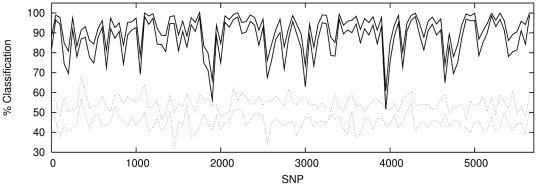
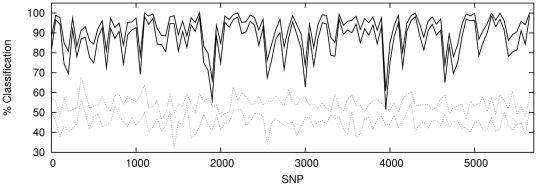
Figure 6. Classification with windows of 50 contiguous, non-overlapping SNPs for P1 against P2 (solid lines) with classification results for a sample of P1 against P1 (dotted lines) shown for comparison.
The regions enclosed between the lines illustrate 1formula image confidence intervals.
Figure 7
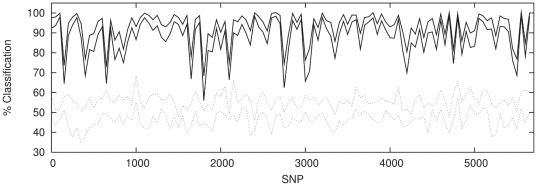
Figure 7. Top panel shows classification with windows of 50 contiguous, non-overlapping SNPs for P1 against P3 (solid lines) with classification results for a sample of P3 against P3 (dotted lines) shown for comparison.
The regions enclosed between the lines illustrate 1formula image confidence intervals.
Figure 8
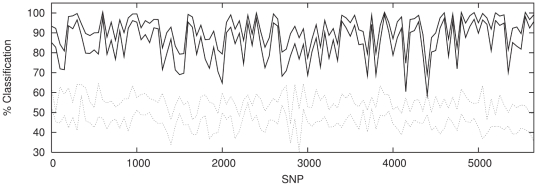
Figure 8. Top panel shows classification with windows of 50 contiguous, non-overlapping SNPs for P2 against P3 (solid lines) with classification results for a sample of P2 against P2 (dotted lines) shown for comparison.
The regions enclosed between the lines illustrate 1formula image confidence intervals.
Figure 9
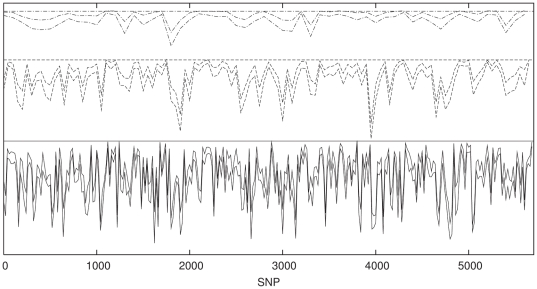
Figure 9. Classification with windows of 100 (dot-dashed), 50 (dashed) and 20 (solid) contiguous, non-overlapping SNPs for P1 against P2.
Note that as the window size increases, the accuracy converges to the most accurate classification, indicating that the ANN is successfully discarding irrelevant information. For clarity we have added an offset to each spectrum and omitted the ordinate axis, the horizontal lines represent formula image classification in each case.
Figure 10
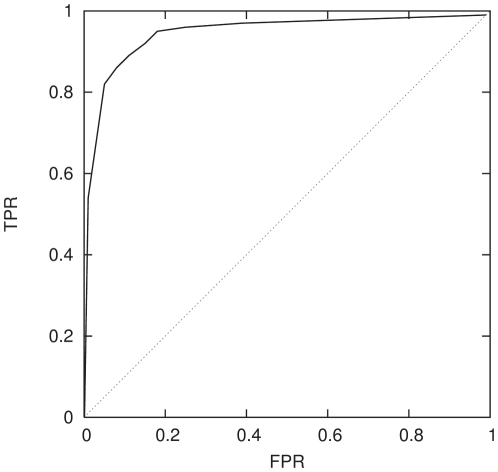
Figure 10. Receiver Operating Characteristic (ROC) curve, that is a plot of true positive rate (TPR) against false positive rate (FPR) of the neural network classifier trained using the first 50 SNPs using P1∶P2 (solid curve).
A random classifier (dotted curve) is shown for comparison.
Figure 11
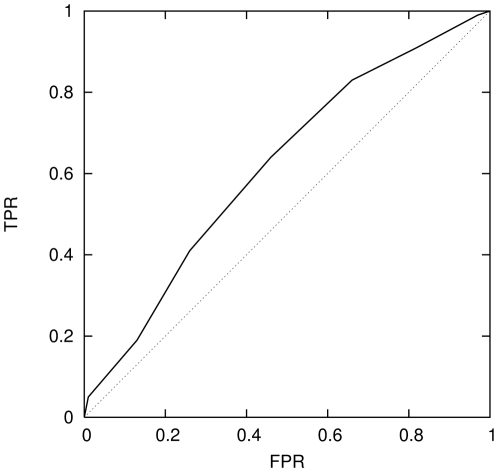
Figure 11. Receiver Operating Characteristic (ROC) curve of the neural network classifier trained using 50 SNPs form 1950 to 2000 also for P1∶P2 (solid curve).
A random classifier (dotted curve) is shown for comparison.
Figure 12
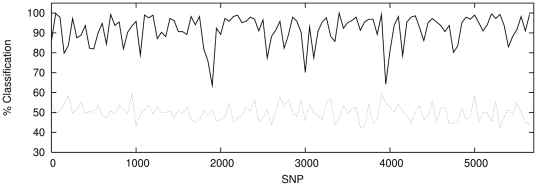
Figure 12. SVM classification with windows of 50 contiguous, non-overlapping SNPs for P1 against P2 (solid lines) with classification results for a sample of P1 against P1 (dotted lines) shown for comparison.
Figure 13
Figure 13. ANN classification with windows of 50 contiguous, non-overlapping SNPs for P1 against P2 (solid lines) with classification results for a sample of P1 against P1 (dotted lines) shown for comparison.

References

    1. Lao O, Lu T, NothNagel M, Junge O, Freitag-Wolf S, et al. Correlation Between Genetic and Geographic Structure in Europe. Curr Biol . 2008;18:1241–1248. - PubMed
    1. Reich D, Thangaraj K, Patterson N, Price A, Singh L. Reconstructing Indian Population History. Nature. 2009;461:489–494. - PMC - PubMed
    1. International Schizophrenia Consortium website. Available: http://pngu.mgh.harvard.edu/isc. Accessed 2011.
    1. Patterson N, Price A, Reich D. Population Structure and Eigenanalysis. PLoS Genetics. 2006;2:2074–2093. - PMC - PubMed
    1. Reich D, Kumarasamy T, Patterson N, Price AL, Singh L. Reconstructing Indian Population History. Nature. 2009;461:489–494. - PMC - PubMed

Publication types